Showing posts with label nature. Show all posts

Sunday, May 14, 2023

A Trek to Laam Dal & Baleni Pass


Is there anything that compares to the sheer immensity and magnificence of the Himalayas?

Each year we spend about a week away from 'civilisation' pondering over this question. A week away from internet / mobile connections, roads, toilets and home comforts. This summer it was a trek to Laam Dal and Baleni Pass in the Dhauladhar Mountains of Himachal Pradesh

On the maps it did not seem like a difficult trail - the pass was at a height of less than 4000m, the terrain seemed quite all right, and Google Earth told us that in this season we would encounter some snow, mainly on the ridges and mountain peaks. However unseasonal, heavy rains - and snowfall in the mountains -  turned this 'easy' trek into a tough one. We had planned to cross from the Bharmour-Chamba region, across the Dhauladhar Range, to the Kangra Valley. Ultimately we had to turn back from Baleni Pass and retrace our steps because the snow-covered, steep valleys of Kangra were deemed to be too dangerous.

It has been raining all over North India for the past two weeks, and by the time we assembled at Chamba the chances of the trek getting called off seemed like a distinct possibility. Somehow the weather cleared up a bit when we reached our staging point off highway 154A - Brehi Village.

A few hour of trudging through forests and clambering over boulders and streams brought us to a Forest Rest House in Drakund. Here it was bright and sunny - a wide range of birds could be seen: the stunning blue Asian Fairy Bluebirds (Irena puella), golden orioles, yellow-billed blue magpies and parakeets. In the evening it was windy but the sound of distant thunder did not disturb us in our tents.

The next day too was sunny but thanks to the heavy snowfall over the past week we started seeing snow much earlier than expected. We had to cross about seven small glaciers to reach our next camping site at Dugga Goth, a rocky valley studded with massive boulders and ringing with the sound of streams emerging from under one vast glacier that spread from the camping site all the way to the snow-capped mountain peaks that surrounded us. 


This area was well above 2500m and home to the strikingly beautiful Monal pheasants. They have the habit of singing while flying so it was quite easy to spot them flying past in the valleys below, singly or in pairs. There were lots of smaller birds too - redstarts that hopped boldly from one boulder to another, bushchats and flocks of numerous other unidentified birds. The ground here was riddled with holes which turned out to be a vast network of condos belonging to the cute, shy, and elusive Himalayan Marmots!

With our camp at Dugga Goth as the base, we set off the next way to see the lakes. About four hours of climbing through snow brought us to a vast bowl shaped valley at 3395m. There was no sign of any lakes here - just a vast expanse of undulating snow that turned into a sea of blinding white under the afternoon sun. High on the horizon, beautiful cumulus clouds emerged from the far side of the Dhauladhar snow-peaks and drifted past the cobalt blue skies. On the opposite side dark rain-clouds could be seen coming in from the Pir Panjal range.

Mercifully we faced only a small hailstorm on our way back to camp. Tiny pearl-shaped beads bounced off our raincoats as we slid down the snow slopes. While walking on  the glacier the snow had loosened up and the guides kept cautioning us to be extra careful - large cracks could be seen in some areas and the areas near boulders and underground streams were particularly vulnerable to collapsing under your weight.

The next day we started early, hoping to cross Baleni Pass before the sun got too hot -- up at 04:00, a quick breakfast by the campfire and tents packed and ready to move by 05:30. The same snow that had buckled to your ankles (and, at times, knees) yesterday evening, was now hard as rock. As the climb got steeper kept urging us to dig our toes to get a better grip. An outcrop of rocks at Chid-Point provided a resting point where scores of crag-martins circled overhead.

It was 09:55 by the time we zig-zagged our way to the Baleni Pass ridge. What a different vista lay in front of us here! - unlike the snow-covered slopes we had just crossed on the Chamba side, a vast brown Kangra valley lay below us, with a river winding through it and disappearing into the haze. We were struggled to stand in the face of strong winds when the head-guide delivered his verdict - it was too dangerous to climb down the slopes leading to Kangra at this time. We had to turn back.

Climbing up had been a struggle and the very thought of having to go down the same route, at a time when the snow had softened under the sun, was rather disheartening. On the way down the guides urged us to follow their foot prints, digging in our heels first ("hill maro!"). Once the steep gradient had eased we all slid down the snow-slopes and soon we were back on the main glacier with not only our shoes soaking wet but wet bums as well!


It was a long trek back to Kathaid Valley, our last camping site below the snow-line, on the banks of Ravi river. It was 18:30 when we reached here - a welcome end a day of trekking for nearly 12 hours. Over here, our daily ritual of drying our shoes and clothes next to a bonfire, with a hot mug of chai in hand, was cut short by heavy rains. All of us slept well that night - cocooned in our warm, dry sleeping bags while incessant rains slapped the tent all night.

The downpour continued next morning so we had to pack out tents and move out in full rain-gear. Three hours of careful walking down slippery trails brought us back to Brehi. It was bright and sunny now but the guys at the tea-shop refused to believe (until pics were shown), that we had gone all the way up to Baleni Pass in this weather. 

Coming to think of it, climbing up those steep slopes without snow-shoes and crampons, would have been quite impossible if not for the skill and confidence of our amazing guides!

-----------------------------------------------------

REFERENCES & LINKS

https://himtrailadventures.com/baleni-pass-lamdal-lake-trek/ 

https://www.trekkinginindia.com/trekking-in-himachal/baleni-pass-trek.html


Saturday, February 11, 2023

The Alerce Trees of Pumalin

 A man goes looking for the oldest living trees on the planet. He finds them in Chilean Patagonia and gradually buys up the area around these trees. Over the years this private property covers an area covering of over 3000 square km!

Initially it was a private nature reserve of Doug Tompkins, the founder of North Face, and his wife, Kris, the former CEO of Patagonia brand of hiking gear. Following Doug's death in 2015, the entire property (and a bit more) was donated to the Chilean government. This is is now the largest national park in South America.

And the tree that the Tompkins were trying to protect? It is called the Alerce in Chile. A conifer of the cypress family, some of them are over 4000 years old! 


This amazing amazing nugget turned up in a DW documentary titled, "Carretera Austral" about the ambitious road that Chile has been trying to build across the length of the country, connecting a swathe of fjords and islands that line up on its western coastline facing the Pacific Ocean.

Some DW documentaries are quite amazing. The first one I saw was titled, "Iran from Above - In the Mountains", and provided a glimpse into a beautiful country that gets in the current political milieu. Highly recommended! :)

-----------------------------------------------------

REFERENCES & LINKS


Wednesday, July 10, 2019

A Moth Reappears


"What a lovely butterfly!" said our neighbour Goel-ji, pointing to this large moth sitting on the park wall.

Set against red-sandstone chips in the early morning sunlight, this was indeed a stunningly beautiful creature. Two pairs of translucent 'eyes' set in iridescent yellow, underlined in red and white, stared back at you blankly. No wonder it caught the attention of Goel-ji who knows everything there is to know about the sugar-trade and Hindustani Classical Music, but usually cared little for the difference between butterflies and moths. Yet the sight moved him enough to insist that I take a photo and share it with him on WhatsApp - "This is the first time I am noticing something like this in our park!"

As I continued my way, I wondered what is this moth called. It looked vary familiar but I could not recall its name. Was it the Atlas Moth? Or was it a new entrant into our monsoon-soaked neighbourhood?

Later, I kicked myself for not remembering. No, it was not the Atlas Moth but a species that had been attracted to the Arjuna trees (Terminalia arjuna) in hordes three years ago. It was the Tussar Silk Moth!

Three years ago the caterpillars of this moth (Antheraea mylitta) had made a dramatic appearance on the young Arjuna trees. Hundreds of them had suddenly appeared on the trees, clinging to every available branch, leaving them almost bereft of leaves, and then growing into enormous creatures built like bright green trailer trucks fitted with psychedelic lights.

A few days later many of them had fallen off the crowded trees, and lay helplessly on the grass - too large to crawl, and too numerous - or too distasteful -  to be eaten by birds and cats. The ones that remained on the trees soon turned into lovely oval cocoons and hung there like thousands of fruit, swaying in the breeze. We had seen only a few moths that emerged from these cocoons. Some were larger, and looked haggard after getting drenched in the monsoon rains but none of them had a bright golden sheen like this one.

The Arjuna trees are now 20 feet higher and far less vulnerable than they were three years ago. How may eggs are these Tussar Moths going to lay this year?  How many caterpillars are going to fall off the swaying branches?  Let's see.

--------------------------------
REFERENCES & LINKS

Paper - Checklist of Moths in Delhi (2017) - https://www.journalcra.com/sites/default/files/issue-pdf/24350.pdf

Tussar Silk - Utsavpedia - https://www.utsavpedia.com/textiles/tussar-silk-the-story-of-wild-silk/

Tussar Silk Moth -  https://en.wikipedia.org/wiki/Antheraea_mylitta

Life-cycle - http://www.notesonzoology.com/sericulture/life-cycle-of-various-silk-moths/323

What's that bug? -  https://www.whatsthatbug.com/2007/10/10/antheraea-yamamai-from-india-or-perhaps-antheraea-mylitta/

Flikr - Moths of India - https://www.flickr.com/groups/mothsofindia/

Sunday, May 27, 2018

Meeting the Snakeman


About 16 years ago, while rummaging through the second-hand book market at Daryaganj, Delhi, I had picked up a biography simply out of curiosity - "Snakeman: The Story of a Naturalist". It was the fascinating story of Romulus Whitaker, the American-born Indian herpetologist who has done more for building awareness - and respect - for snakes and reptiles in India than anybody else.

It is truly the 'power of one'; of what a single committed, determined individual can achieve, despite all odds. Despite the cynicism and active discouragement of numerous people, he mobilized the Irula tribesmen into a cooperative that helps manufacture precious anti-venom serum which saves thousands of lives in India every year. It also provides valuable alternate employment to the Irulas who had been reduced to a life of poverty and destitution after a ban was imposed on their main livelihood - the export of snake-hides (Wildlife Protection Act 1972).

Last week, I had a chance to meet the great man himself, at an event organised by the Indian Express in New Delhi. 

There were so many things I did not know. I was surprised to learn (or be reminded, if that's a better word), that not all snakes lay eggs. Vipers give birth to live babies, and it is for this very reason that they get their name (vivus = 'alive' + pario = 'bring forth'); The deadliest snake in India is not the Cobra but the Russel's Viper; Biochemistry of snake-venom is still not clearly understood - the anti-venon-serum for vipers in Tamil Nadu is not quite effective for the larger vipers found in Rajasthan. I also did not know that the bite of a Krait is so painless that most people do not know that they have been bitten - until it is too late!

Here is a collection of three videos Rom Whitaker has made recently, to raise awareness on deadly snakes, snake-bites and rescue. Not many people seem to know about these educational videos, so here are the links:

* FOUR DEADLIEST SNAKES OF INDIA


* SNAKEBITE


* SNAKE RESCUE - THE EXPERT WAY


------------------------------------
LINKS:

* WIldlife Protection Act, 1972 - https://en.wikipedia.org/wiki/Wildlife_Protection_Act,_1972
* Irula Snake-Venom Cooperative - http://tcdc2.undp.org/GSSDAcademy/SIE/Docs/Vol3/Snake_Venom.pdf
* Chennai Snake Park - http://www.chennaisnakepark.org/

Tuesday, September 19, 2017

Nature Watch on the Kugti Trek

Its amazing how the flora and fauna changes in the Chamba Valley, as you ascend from 10,000 ft to 16,500 ft. It starts with compulsive greenery, a riot of colorful flowers and the chirping of unseen birds in the pine forests, then, as you climb, the vegetation first thins down to the bare minimum, and then to none at all.

Here are some of the scenes we managed to capture along the way.


A Monitor Lizard basks in the sun. As you cross Kugti village and trek towards the Kaylong Kartik Temple, they seem to be all over the place - basking in the sun, staring at you warily atop boulders, or just slinking out of the way quietly. 
Why are they so numerous in the vicinity of the village? Is it because of insects that are attracted to the terrace crops? 


Wagtails of all kinds! 
When you are driving from Bharmour towards Kugti you can see them swooping and diving in front of the vehicles. These are mostly Citrine Wagtails with their distinct pale yellow undersides. Beyong Kugti, you see two others: White Wagtail (Motacilla alba) with- white wedges around their eyes, and 
the White-brown Wagtail (Motacilla maderaspatensis), the ones with slick white 'eyebrows'.


Tiny glossy leaves, red berries, cushiony on rocks - Cotoneaster microphyllus (Bhedda)

 And the ones that are yet to be identified:


Yellow flower with a hundred needle like petals - Inula grandiflora (Daisy family)


Tuesday, March 28, 2017

Climbing Mt. Fuji


Every now and then nostalgia bumps into wobbly memory cells, leaving you a bit tongue-tied. This happened to me last week when a friend, an ultra-marathoner,  suddenly asked me -  "I want to climb Mt. Fuji - do you know anybody who can arrange it in the off-season this year?"

While trying hard to remember details of my trip in 2009, I just said, "It all depends on when you are planning to climb..."

For a moment, I could not recall the dates when I climbed that iconic mountain. Nor could I remember the route I took, or the total expense for that trip. Instead, the memories that floated up immediately were -  the taste of the most delicious hot curry rice I'd ever had, at a quaint wooden inn high above the clouds; of the long lines of climbers trudging uphill in pitch darkness at 3:00AM; the cold wind and rains, and of a spectacular sunrise we saw, perched precariously on steep, dark slopes dotted with large chunks of pale, white ice.

Memories of the trek had receded to the bye lanes of my mind. It did pop up occasionally whenever I came across a painting, a photograph, or even an emoji that featured Mt. Fuji. A fleeting thought would then cross my mind - "I have actually been to the top of that mountain!"  A sense of awe and wonder that was, perhaps, bigger than the actual experience.

I had to go back to the notes written six years ago, to be reminded that I owed the trip to a gentleman named Sakata Yoshinori, and to an organisation named JISEDAI. In July 2009, I had responded to a notice that came up at Tsukuba University. I was the only one who registered, so  Sakata-san had traveled all the way from Tokyo, just to brief a single guy.

When we met at the Tsukuba TX station, he was standing next to the ticket counter, soaked in sweat. At a Starbucks table nearby, he had carefully handed me his visiting card, and then spread out his laptop, plugged in a thumb-drive, to explain how I should prepare for the trek.

"It would be a nine-member team this year", he had said "All the others were university students from Tokyo". He explained the itinerary, detailed the expenses (~JPY 20,000 which included bus-rides, boarding, meals), and pointed out the precautions to be taken and then offered to help me find the right equipment for the trip. I definitely needed a 35L backpack, a pair of waterproof trousers and, if possible, ankle-length hiking shoes.

Mr. Sakata even insisted to helping me get the right equipment and took me to a few shops at Tsukuba Centre. Apart from being amazed at his helpfulness, I remember thinking that his well-meaning advise bordered on being fussy and over-cautious. Having done some trekking in the Western Himalaya's, climbing a gentle-looking 3776m peak did not seem like a big deal. And then there was the cost of buying all the new gear...It is only later that I realized that Mt. Fuji was different, and that each item was necessary.

Eight of the nine-member team turned up. We all met outside the Shinjiku station and discovered that an interesting mix of people -- Yeo, a dude from Singapore; Melissa, a budding dentist from Indonesia, along with her two batchmates Pat and Thuy; A South American named German (pronounced Herman), and two other experienced Japanese trekkers - Chiaki and Hiroki.

We all took a bus from Tokyo to the Gotenba (2 hours), and then a local bus to a large facility called Fujinosato, an 'education facility' right next to the JSDF Takigahara camp. It was a sprawling campus with scores of tatami-matted dormitories, forest trails, an archery complex, camping sitesi in the woods, and even a spacious Onsen (hot-spring bath). School children, baseball teams, and various other groups in assorted uniforms milled about the place, waiting for their turn to climb uphill.


Our turn was early next day morning. After breakfast we walked to the base of the 7.8 km Subashiri Trail, downed a few cups of green-tea, and started trekking on  pathway that cuth through the thick forests.


At this point the ground was gently undulating - pathways that cut through the deep, dark volcanic soil and lush vegetation. As we climbed to 6th Station (2400m), and the 7th Station (3000m), forests gave way to sparse scrub vegetation dotting the slopes, and then none at all beyond the Old 7th Station (3200m). We rested for a while at this point at the Miharashikan Hut.  By this time it was cold and windy outside, and, at a time like this, what could be more welcome than a plate of hot curry rice? :)

Shadow of Mt. Fuji on the Clouds (Old 7th Station)

Early next morning, we padded ourselves with warm clothing, fitted head-lamps and walked out into the pitch darkness, to join a steady stream of climbers going uphill. It was between the 8.5th Station - 3450m (Goraikokan Hut), and 9th Station that we noticed that we were far above the clouds. This was also the meeting point of the Yoshida Trail (Yamanishi Prefecture) and, suddenly, it felt like we were all commuters at the Shinjiku Station!

Torches and lights were switched off as everybody settled down on the steep slopes, sitting down wherever they could find some space. As the clouds gradually gathered light, we all seemed to be sitting in a massive amphitheater, waiting for the drama of the rising sun to unfold...and what a sight it was!


Within seconds of the sunrise, a blanket of clouds rolled out reducing visibility to a few meters, and drenching us all in icy rain. We continued moving up at a snail's pace now, a part of a long line of colorful raincoats slowly bobbing to the summit. The last few hundred meters were rather steep and the ropes helped. Finally, when we reached the top, got past the crowds and eateries and looked down the caldera, it seemed so... ordinary.

After offering prayers are the Kusushi Shrine we started our descent. It was a lot faster than I expected because we were just wading down ash-laden slopes. Often our legs would just dig in, right up to our knees with each step.
Wading down the ash-slopes
This is where you realise that Mt. Fuji was quite different from other non-volcanic mountains. The weather was fickle, and the terrain even more so. Each and every item listed by Sakata-san turned out to be essential - the layered clothing, raincoats, and ankle-length boots. Our friend from Singapore made the mistake of coming in shorts and sneakers, and paid the price for it. He had been shivering from the 7th Station, and now, with the ash filling up his sneakers, he was feeling quite miserable all the way down.

In a couple of hours we were down at the Subashiri base station, and then on to the comforts of Fujinosato. After a soak in the steaming Onsen, a hot meal and a nap in the bus back to Tokyo, none of us doubted that Mt. Fuji looked a lot prettier from a distance!

For friends who are trying to climb Mt. Fuji during the off season, my suggestion is simple -- please don't. During the off season, all huts, toilets and first aid stations are closed and most of signs on the trails are removed. Unless, of course, you are part of JSDF, a scientific team or a team with special permission, your are quite unlikely to get beyond the 5th Station.

The climb is not difficult, but given the way the weather changes suddenly, the chances of getting lost in the forests, rain or in the cloud-covered slopes, is quite high, unless, of course, you are travelling with experienced climbers, and following a long line of colorful raincoats all the way to the top!

---------------------------------------
LINKS

Official Website for Mt. Fuji Climbers - http://www.fujisan-climb.jp/en/season/
  • Climbing season: Early July to Mid-September
Subashiri Trail - http://www.fujiyama-navi.jp/fujitozan/route/page/subashiri/lang/en/

For info on other trails - http://www.huffingtonpost.com/gail-nakada/how-to-climb-mt-fuji_b_3693642.html

Thursday, March 02, 2017

Spring Flushing Puzzle


Winter is giving way to Spring in Delhi.

Days are getting hotter, and longer; Sparrows are getting noisier as they compete for mates and nesting sites, and the lapwings have started doing aerobatics to keep stray dogs off their nesting grounds...and some trees are busy shedding leaves.

"Fall" is a season commonly associated with Autumn (Sep-Nov). It is easy to understand the logic behind trees shedding their leaves to prepare for a few months of cold winter. There is a need to conserve energy, to minimize exposure to the elements, especially when energy from sunlight is hard to come by.

Why then do so many trees retain their leaves right through winter, only to shed them in spring, just when the days are getting brighter?

In NCR Delhi, many avenues are littlered with yellow leaves time of the year. Neem (Azadirachta indica), Kadamba (Neolamarckia cadamba), and even the Rangoon Creeper (Quisqualis indica / "Madhmalti") go almost completely barren even while they are putting out fresh shoots and leaves. Why is this so?

Turns out that botanists and ecologists are still grappling with this puzzle. They call this phenomenon "characteristic and counterintuitive ‘spring-flushing’ of monsoon forest trees". Latest available research covering Costa Rica, India and Thailand seems to suggest that the trees do this because "it optimizes use of large subsoil water reserves for photosynthetic activity during seasonal drought and thus extends the relatively short, wet growing season."

This does not make sense. Neem trees thrive in dry, drought prone areas and it seems unlikely that Rangoon Creepers are capable of sending their roots deep down to the 'large subsoil water reserves'.

So this makes 'spring flushing' yet another of nature's puzzles, and the answers continue to be in the realm of speculation.


----------------------------------------------------
LINKS & REFERENCES

*(2006):  Leaf flushing during the dry season: the paradox of Asian monsoon, Global Ecology and Biogeography -  http://ctfs.si.edu/Public/pdfs/ToDelete/Elliott_etal_2006_GlobalEcolBiogeogr.pdf

* Spring Flushing - https://link.springer.com/article/10.1007/s00468-002-0185-3
- Establishment of new foliage shortly before the wet growing season is likely to optimize photosynthetic gain in tropical forests with a relatively short growing season.

- Deciduous - https://en.wikipedia.org/wiki/Deciduous

Wednesday, November 09, 2016

Gilded Cocoons


Cocoons are usually drab and unremarkable. It is the multi-colored caterpillars and butterflies that get all the attention.

As if to disprove a point, something unusual was seen today on a milkweed tree (Calotropis procera) in our neighborhood. Tucked away under a calotropis leaf, I came across one of the most beautiful cocoons I have seen so far.

It is designed as though a jeweler was creating a line of cocoons under the category 'Understated Elegance'. At first sight it looks only neat and compact, like a shapely fruit dangling on the leaf. And then you notice something glinting in the winter morning sunlight - a neat line of golden dots that mark a ridge, and then, a few more of these gilded dots scattered as a parting flourish, on the lower side.


A few days down the line, an Oriental Plain Tiger butterfly will emerge from a tiny hole, just above those golden dots, wait for its crumpled wings to dry and unfurl, and then fly away.

The question that dangles in the air is - why would the butterfly want to advertise its presence, at the most vulnerable stage of its life-cycle, by having such an eye-catching design on its cocoon? What could possibly be the evolutionary advantage of having that gilded design on your sleeping bag?


--------------------------------------------
LINKS

* Butterflies of India - Oriental Plain Tiger - http://www.ifoundbutterflies.org/sp/744/Danaus-chrysippus
* Calotropis procera -- http://monarchbutterflygarden.net/milkweed-plant-seed-resources/calotropis-procera-milkweed-tree/


Friday, July 01, 2016

Captain Sparrow


Has there really been a shap decline the population of House Sparrows in India? In our corner of the National Capital Region (Noida) evidence points the other way.

This summer our home seems to have become the favoured destination for a variety of creatures. A couple of squirrels have claimed the space under a bedroom airconditioner; A pigeon laid two eggs on another window ledge, a tennis-ball-sized honeycomb nest on the foyer roof is home to family of yellow wasps, and the fourth corner of the house is the domain of Captain Sparrow and his family.

Three years ago, four organisations - BNHS, MoEF, NCBS and NCF -  had launched a two-month campaign to build public awareness on the disappearing House Sparrow. While participating in the nation-wide "Citizen Sparrow"survey I had pointed out that, at least in Noida, there was absolutely no shortage of this little bird. They were all over the place - in the hedges, on the Arjuna trees, and all over the local vegetable market. 

As if to reinforce this data-point, Captain Sparrow landed on one of our windows that just would not close. In this gap, safe from the prying claws of crows, rats and black-shouldered kites, it started making a tentative nest. At first it was a shoddy piece of work and none of his girlfriends were impressed. He then added a roof, some extra furnishings, and got steady with one. 

First it was a single, tiny, speckled egg. 


A week later there were three more.  


All four eggs went out of sight for a while until one morning we discovered that there were two plump little chicks in the nest. 


Every morning they made a huge racket and Captain and his wife seemed to be perpetually going to and fro getting them things to eat. If any of us approached the nest for a peek, the chicks would quickly backtrack in to the deepest corner, turning themselves completely silent and invisible against the straws and twigs.


Then, as suddenly as they had come, both the chicks turned into young ladies and flew away. So that was that we thought, time to clean up the window sill and settle down for some peace and quiet. 

We then went off on a three week holiday in mid-May. When we returned home in the June, not only had Captain refurbished his hangout, it was now a plush nest with two more chicks! 


So in just one summer, our window sill has been a maternity ward that has seen four baby sparrows fly out into the world.

Will Captain Sparrow come back again next season? We hope so!

--------------------------------------------------------
LINKS

* Citizen Sparrow - http://www.citizensparrow.in/
* India Searches for its missing sparrows (2012) - http://www.thehindu.com/news/cities/Delhi/india-searches-for-its-missing-sparrows/article3287189.ece
* Citizen Sparrow Survey Report (2013)


Saturday, June 11, 2016

Life in the Paddies

Nostalgia drove me to the erstwhile paddy fields of Thrikodithanam in Kerala.

A few decades ago a river of fluroscent green rice saplings stretched as far as a child's eye could see. Neat fields separated by narrow strips of slushy mud, clear streams teeming with Manatthu-kanni (eyes-to-the-sky) fishes and the smell of overturned earth.

All that has disappeared now. As in much of Kerala, paddy fields have been abandoned, filled-in, turned into tiny parcels of land and sold as residential plots. A little patch that now remains of my grandfather's paddy fields is now home to hundreds of unfamiliar insects.

A ten minute walk along the edges of this wild patch revealed these new inhabitants. What are they called?


Thursday, March 31, 2016

An Almost Happy Country


Tshering Tobgay is an amazingly gifted communicator. As the Prime Minister of Bhutan, he comes through as a person with a fine sense of humor, one who has an endearingly hesitant, modest way of connecting with his audience.

Seeing this TED presentation brought back memories of my own trips to Bhutan in in the late 1990s as a part of the JICA team for evaluating the Paro Valley Agriculture Development Project. Of the crisp, clean air, chunky furniture at Tashi Delek hotel, cheerful government officials in white woolen shawls, and of the surreal feel of a country where the citizens were told what to wear, how to build & decorate houses, and what to see on television.

Tobgay's eloquence on Gross National Happiness also made me wonder about the 100,000 ethnic Nepali's who had been expelled from Bhutan in the 1990s. That is one in every seven Bhutanese. Perhaps it is easier to find happiness after a successful round of ethnic cleansing... or perhaps such a move only rankles those who have lived most of their lives in multi-everything countries.

I am also curious to learn more about "Bhutan for Life" which is being described as 'an innovative funding initiative' for ensuring conservation of natural resources, in perpetuity. WWF-Bhutan provides a sketchy outline of the scheme and Tobgay's had claimed in his presentation that the fund - "multi-party single-closing deal"  - based on Wall Street practices, would be ready by the 'end of the year'.

Where can I find details of the this fund? Who are the donors involved here? What is their pound of flesh?

------------------------------------------------------
REFERENCES and LINKS

* Tshering Tobgay, PM of Bhutan - https://en.wikipedia.org/wiki/Tshering_Tobgay
* TED Talk transcript - https://www.ted.com/talks/tshering_tobgay_this_country_isn_t_just_carbon_neutral_it_s_carbon_negative/transcript?language=en
* Dowling, Tim (2015): Unhappy? Welcome to Bhutan - the nation of 90% Joy -- http://www.theguardian.com/commentisfree/2015/nov/04/unhappy-bhutan-joy-happiness-gdp
* Forbes () - Bhutan for Life - http://www.forbes.com/pictures/mjh45egflj/bhutan-for-life-a-conse/
* WWF Bhutan - http://www.wwfbhutan.org.bt/bhutan_for_life/


Saturday, March 12, 2016

Black & White


What is it that makes black & white photographs so... compelling?

Yesterday evening  sudden downpour sent me scurrying into the Visual Arts Gallery of the India Habitat Centre. At first I thought the gallery was closed - it was dark and foreboding, and yet the doors were open. I stepped in to see the hall transformed like never before.

Jet black cloth covered all the walls, the space inside had been partitioned to create a maze of stunning photoframes, sheer fabric, projections, light and shadows.

This exhibition by Shailan Parker was called "Kavadsa", an evocative Marathi word to describe that fleeting light that which filters into a room to turn the most ordinary things into beautiful works of art.


Parker is what one could perhaps describe as an upmarket photographer. The exhibition underlined not only his ability to push understated elegance to the limits, but also his access to corporate sponsors and wellwishers with deep pockets, and access to the best equipment and material.

Could such images be created with more modest equipment?

William Dalrymple has brought out his first book of photographs, "The Writer's Eye", a collection of 60 B&W photographs shot only using his Samsung mobile, and edited with a free app, Snapseed.
His inspiration came from the bleak and grainy war photography of Don McCullin, the landscape work of Fay Godwin,  and Bill Brandt, whose "brooding images were marked by a stark chiaroscuro, a strong geometrical sense of composition, a whiff of the surreal, and a taste for the uncanny and unsettling".

I wish I knew what all these words mean, but in a world where we take color for granted, B&W images that just leave us with the bare essentials of light and shadows,will always have an attraction that is difficult to explain.


,
--------------------------------------
LINKS & REFERENCES

* http://www.shailanparker.com/pages/07_wallart/wallart.html
http://m.hindustantimes.com/art-and-culture/william-dalrymple-s-photo-exhibition-shot-on-phone-edited-on-snapseed/story-WY8IbVwc16CodwGGF28B0H.html

Saturday, August 01, 2015

Odd Tomato


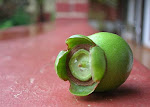
Here is something that landed in my grocery bag last week - a tomato with a beak!

What is it that makes a fruit take up unusual forms?


----------------------------------------------------
LINKS

* http://www.walterreeves.com/food-gardening/oddly-shaped-vegetables/

* http://vegetablemdonline.ppath.cornell.edu/DiagnosticKeys/TomFrt/TomFrtKey.html

Sunday, July 05, 2015

A Butterfly in Srinagar


This beauty was spotted atop Hari Parbat Fort in Srinagar, last month (June 2015).

What is it called?

My search led me to this US website called Discover Life. Despite its user-friendly search options, the focus here seems to be on the Americas, and the number of possible options stands at 120!

Then there is Butterflies of India. It seems like a great initiative by subject-specialists but most of its relevant pages are under construction now.

Even a scientific paper from Sher-e-Kashmir University did not seem to have this on their list...

Update - 27 July 2015

The answer is in - Indian Tortoiseshell Butterfly (Aglais kaschmirensis)

(Many thanks to Dr. Z.H. Khan, Associate Professor at SKUAST-K!)


----------------------------------------------------
REFERENCES & LINKS

* Khan (2011) - Diversity and Distribution of Butterflies in Kashmir Himalayas -- http://connectjournals.com/file_full_text/1192501H_45-55.pdf


Saturday, May 02, 2015

Slippery as an Eel

Japanese Eel (Image source:Wikipedia)

One of the prominent landmarks in Tsukuba Science City is an "Unagi" restaurant on Gakuen-Higashi Odori. The "U" in  うなぎ is displayed in a trailing calligraphic brush-stroke to resemble a long, slippery eel that happens to be the speciality of this restaurant.

I had forgotten all about this eatery and its long wood-smoke chimney's until I came across this wonderful article in the New Yorker: The Poetic Life of the Lowly Eel  (23 April 2015).

What amazed me the most was that until a few years ago, nobody really knew that the common "fresh water eel" began its life thousands of miles away in the great oceans. Every American and European eel is born in the same place in the middle of the Atlantic Ocean, where, at the end of their lives, they return to reproduce and die: the Sargasso Sea. It took a Danish biologist Johannes Schmidt 20 years of research to discover this by searching for for tinier and tinier eel larvae!

Similarly, the spawning grounds of the Japanese eel were found in 1991, near the Mariana Trench, after six decades of searching. Those for the New Zealand longfin eel have yet to be discovered.


Even today we have no idea why eels travels so far out in the open oceans to lay their eggs, or on the impulse that leads millions of tiny larvae to swim back the entire distance, passing through various stages of life in sea as eggs, leptocephali ("slim head") and glass eels, before heading towards freshwater habitats.

This is the sort of thing that makes us wonder at our own mind-boggling ignorance about life on earth!

---------------------------------------
LINKS

New Yorker (23 April 2015): The Poetic Life of the Lowly Eel -- http://www.newyorker.com/tech/elements/the-poetic-life-of-the-lowly-eel


Saturday, February 21, 2015

Caterpillar Snake


(Pic - by Daniel Janzen U-Penn/GrindTV)

Recently, I was stunned to see this photograph -- a caterpillar pretending to be a snake!

Cuckoo's can fool crows into hatching their eggs, hermit-crabs can learn to use discarded shells for protection, and even lung-breathing whales could have evolved over time to life in the oceans. But can an organism that cannot see very well, evolve to mimic one of its numerous predators in the forest?

Can the Theory of Evolution really explain this?

As if to mock this theory, this is what the caterpillar eventually becomes - a drab looking moth (Hemeroplanes triptolemus) that depends on its sense of smell to mate and survive.

(Source - Wikipedia)


------------------------------------------------------------
LINKS

http://www.grindtv.com/outdoor/nature/post/caterpillar-appears-snake-camouflage/

http://en.wikipedia.org/wiki/Hemeroplanes_triptolemus