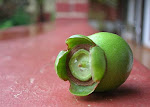
"आपकी मल्लिका आने ही वाली है!!" (Your Mallika will be here soon!)
Every summer folks at our friendly neighbourhood Mother Dairy Fruit & Vegetable outlet tease me about my fondness for this particular variety of mango which happens to share its name with an old Bollywood siren, Mallika Sherawat.
The mango season in Delhi NCR almost always starts with Safeda. In the early summer season these are large, fleshy mangos with whitish bland flesh (hence the Hindi name) which gets sweeter with the rising heat. It sits on vendors carts and market shelves throughout the season even as the other varieties make their guest appearances - Kesar, Dussehri, Totapuri, Mallika, Denga, and Langda.
For many years I used to save the seeds of the ones that were outstanding in taste, texture and sweetness, and carefully try to germinate them in our terrace garden. Despite my careful efforts not one of them turned into a sapling, and I used to wonder why this was the case. It took a post from @ShreeHistory on X to remind me of some long forgotten lessons in Botany.
Mango trees are of two broad types: mono-embryonic and poly-embryonic. In poly-embryonic seeds each seed contains multiple embryos. Most of them are nuclear emproyos produced asexually from the mother's own tissue, making them genetic clones of the mother tree. A farmer just has to plant a seed to reproduce traits.
Most Indian varieties, on the other hand, are mono-embryonic. Each seed contains a single embryo produced by sexual reproduction, a genetic shuffle of two parents. A seed from a Hapus will invariably be a combination of new factors - not the original. So planting this type of mangos is a gamble - you may or may not get the traits you seek.
So the trick here is to do grafting. According to estimates, India has been honing mango cultivars for 6000 years by vegetative propagation. Earliest references to this appear in Kautilya's Arthashastra (300 CE), and in Surapala's VrishAyurveda tradition (1000 CE). The art of grafting, or Kalmi, was raised to new levels during the Mughal period.
The Europeans - especially Jesuit priests - had some hand in developing mango varieties along the Konkan coastline. Hapus or Alphonso is attributed to a Jesuit missionary / horticulturist Nicolau Alfonso, during the 1550s.
Where does all this leave my favourite Mallika? This one is an even more recent vintage. The variety is a hybrid of the South Indian Neelum and and the North Indian Dasheri, and was developed by Indian Agricultural Research Institute (IARI) in New Delhi by Dr. Ramnath Singh, just a couple of decades ago!
-----------------------------------------------
LINKS & REFERENCES
* Mexican mangoes - Ataulfo - variety that arrived aroiund 1779 from the Philippines - slowly getting sweeter by the year - https://en.wikipedia.org/wiki/Ataulfo_(mango)
* Mallika - https://en.wikipedia.org/wiki/Mallika_(mango)