Showing posts with label kerala. Show all posts

Sunday, September 25, 2022

Booze for a Balanced Budget


I have been trying to figure out the relationship between booze and state revenues for a while now.  

States in India seem to have a whole spectrum of different approaches to alcohol sales. On one end of this spectrum you have states like Gujarat that have had an official ban on alcohol sales for decades, and at the other end, there are states like Kerala that actually depend on taxes from alcohol sales for a major chunk of their revenue. The extent of this dependence is not something I had understood until I reeled in a thread on Twitter a few days ago.

On 23 Sep., 2022, @thekaipullai mocked the communist-led coalition government in Kerala for their dependence on alcohol sales and the sale of lottery tickets. Out of Kerala's total state revenue last year, which amounted to INR 1.03 lakh cr (USD 13,733 million @INR75/$), more than 60% came from:

  • Central Govt grants contributed to INR 36,000 cr (USD 4800 m)
  • Alcohol sales contributed INR 13,000 cr (USD 1730 m)
  • Lottery sales, INR 9000 Cr (USD 1200 m)


The point being made here was that the much touted "Kerala Model" is a sham since it stands on state revenues that feeds on the desperation and addiction of its people.

While there can be a debate on the way in which excise revenue is being calculated (or window-dressed), Kerala just happens to be just one of the many states that have turned alcohol sales into a state monopoly, and, in turn, driven up the levels of addiction. 

Wednesday, May 22, 2019

Velu Pillai's Mesopotamia

Me-so-po-ta-mia. A country that almost sounded like the notes of a song. It had a certain ring to it.

As a schoolboy from Hyderabad visiting his grandparents in Kerala during the summer holidays, one got to hear about a number of countries. Across the paddy fields there lived a grand-aunt who had spent much of her life in Malaysia. Many in the neighbourhood were working in the Gulf states - Saudi, Dubai, or Oman. Our chavadi - the airiest hall in the ancestral home -  had large almirah's stuffed with musty, moth-eaten National Geographic's and Readers Digest's from USA, and old textbooks published in Great Britain.

In the western room (Kizhakke-muri) an old, sepia tinted photo adorned one of the walls. It was of a bespectacled man in uniform with a medal pinned to his chest. "That is your valiya-appoopan (great-grandfather)", I was told, "He served the British Indian Army in Mesopotamia during the first World War".

Mesopotamia. In my imagination a country with such a name had to be a grand place. Yet there were no books from Mesopotamia. The country no longer existed in the school atlas either - it was now called Iraq.

I learnt later that the man in the sepia print was my grandmother's father, Velu Pillai. Details of his life were sketchy. He had served in the Army Postal Corps. My grandmother was four years old when her parents left her with relatives in Kerala and went to Mesopotamia. They had returned to India in 1927 with an infant who was born in Baghdad. This little boy would grow up to fight the next World War, serve in the swampy airfields of Burma and retire as a Wing Commander in independent India.

I had always wondered about the life and times of Velu Pillai. How did he travel with his young wife, Karthiyayani Amma across the Arabian Sea to that ancient land between two great rivers? What did he think of the people from other foreign lands to fight somebody else's war. Did he see himself as a cat's paw?

Last week I came across a book that gave me a glimpse of India's role in the First World War: George Morton-Jack's "THE INDIAN EMPIRE AT WAR - from Jihad to Victory - the Untold Story of the Indian Army in the First World War".


The big picture turned out to be quite dismal. Countless Indians had suffered for the white man's greed, his squabble for colonies across the world. 1.5 million Indian servicemen had served in the war - a number equivalent of the empire's military forces from Australia, New Zealand, the Pacific Islands, South Africa, the Caribbean, Canada, Hong Kong and Singapore put together -- a sixth of all the empire's servicemen. No less than 34,000 of them died in some of the most brutal battles of the western front, Gallipoli, East Africa, Iraq and Palestine.

Velu Pillai would have been a part of the Indian Expeditionary Force D which faced the Ottomans in Mesopotamia. They had seized Basra in Nov-1914 and started pushing up the Euphrates and Tigris where they had  repulsed attack by 7000 Turks in Apr-1915 leaving 3000 of them dead in Shu'ayba, some 15 miles west of Basra.

Then the tables had turned. Pushed hard by an ambitious, and stingy, governor-general of India who wanted to retire as the 'Pasha of Baghdad', Force D found itself short of food and ammunition at Kut, by the banks of the Tigris. The besieged 6th Indian Division at Kut dug 30 miles of trenches, suffered 2200 casualties in keeping the Turks out, until they surrendered on 29 April 1916.

Whatever remained of Force D's 6th Division - 10,500 Indian and 2600 British prisoners-of-war - were then sent on a 600-mile death march from Kut through the Iraqi desert, to labour camps in Ottoman Syria outside Aleppo and in the nearby Amanus and Taurus mountain ranges. Only a few had survived the ordeal.

Revenge and retribution came a year later. From mid-December 1916 to March 1917, a completely revamped Force D was let loose by London to avenge the fall of Kut and to steamroll the Turkish Army for 200 miles up the Tigris to Baghdad. Another year of fighting in Europe and the war was over, on terms that were so humiliating for the vanquished that it took another horrific war 26 years later before things settled down.

What happened to the million Indians who returned home after the war? What we do know for certain is that the British continued to play one ethnic group against another most of whom remained loyal foot-soldiers for the British colonial apparatus:
  • In 1919, men of the 54th Sikh, 59th Scinde Rifles and 9th Gurkhas carried out the massacre at Amritsar's Jallianwala Bagh on 13 April. 1650 bullets were fired in 10 minutes to kill some 500 Punjabis and wound 1200 more...some of the casualties were their own colleagues - Indian Army veterans, Sikhs and Hindu Jats who had themselves served the British Indian Army in France and Iraq.
  • India's Commander-in-Chief Charles Monro massed 340,000 men on the Indo-Afghan border for the Third Afghan War, initiated as a jihad by the new Emir Amanullah following the assassination of this father Habibullah, and ending in his swift defeat.
  • In 1921-22 seven Indian battalions with artillery and armoured cars 'suppressed' the rural Moplah Rebellion by Muslim villagers armed with swords; they killed 2400 Moplahs and wounded 1650.
What did Velu Pillai think of all this? How did his experiences change him after he returned home, to serve the maharaja of Travancore as a Dy.Tehsildar? Unfortunately none of his notes or letters survived in the damp and humidity of the chavadi with fungus and termites for company.

--------------------------------------------
REFERENCES & LINKS

* The book - https://www.amazon.in/Indian-Empire-At-War-Victory/dp/1408707705

* Kipling's poem "Mesopotamia" - https://www.poetryfoundation.org/poems/57430/mesopotamia-56d23af3008a7

* Word War I Records - https://livesofthefirstworldwar.org/

* Etymology - Mesopotamia - "Land between rivers" - aka Do-ab!


Monday, April 29, 2019

Pralayam - Kerala after the Deluge

Houseboats waiting to go at 11:30AM


Last year the monsoons were disastrous for Kerala. For the first time since 1924 the state saw all its rivers in spate, most of its agricultural land submerged and thousands huddled in relief camps across the state. 

There had been talk of how it would take years to rebuild and recover from the "Pralayam" - not a mere flooding ("vellapokkam") but a calamity of epic proportions for which a more potent word had been drawn from Sanskrit epics.

Seven months after the floods there is little trace of the disaster that killed over 400 people, displaced 5 million and caused economic losses of over USD 5 billion.

At Kainakary the houseboat business is booming again. These boats are usually allowed into the backwaters only after 11:30 when the fishermen have returned with their catch. Only the larger, double-deck boats have to wait longer because the quays could not be dredged last year due to a funds crunch. The locals are upbeat - this year there has been no shortage of tourists either at the Ayurvedic spas that line the Vembanad lagoon, or the toddy shops or ice-cream vendors on boats.

Not far from the banks of the Pamba river at Othera, recovery is said to have taken place within weeks of the water receding. In the words of a resident relative, "Our house, along with about 200 others, was an island for 10 days. No electricity, no tele-connectivity, or access to supply of clean water. Helicopters hovered around dropping provisions which were piled up at local shrines...and often distributed amongst those who were less than deserving."

I had expected many of the houses to be in bad shape. While on a morning walk along some of the worst affected areas, from Othera to the railway bridge over the Pamba I came across only one houses that had not been repaired. Interestingly, the low-lying areas that had been home to the erstwhile low caste agricultural labourers is now populated by groups of migrant labourers from Bihar, Bengal, Odisha and Assam. Tiny old houses along Parayanthodukuzhi with its fallow paddies and broken boundary walls is now alive with the costumes and languages of the Gangetic plains.

An irrigation project too is underway to bring 33,000 KL of Pamba water, pumped across the undulating terrain, through canals and aqueducts to the fields of Pathanamthitta district.

Will the politics of flood relief have an impact on the ongoing Lok Sabha elections? Quite unlikely say the locals. 

However, one thing is for sure - it is a great time to be in the hardware and paints and waterproofing business in Kerala! 


Toddy Shop at Kainakary duly endorsed by an aspiring MP

Preparing the paddies at Kuttanad


----------------------------
LINKS & REFERENCES


Saturday, August 25, 2018

On Electoral Constituencies

"What are electoral constituencies?", asked my daughter today.

She had in her hand a copy of the Class IX Social Sciences textbook and seemed completely lost. The whole country seemed to be divided into consituencies - panchayat, assembly, Lok Sabha - and the term seemed to have overlapping meanings.

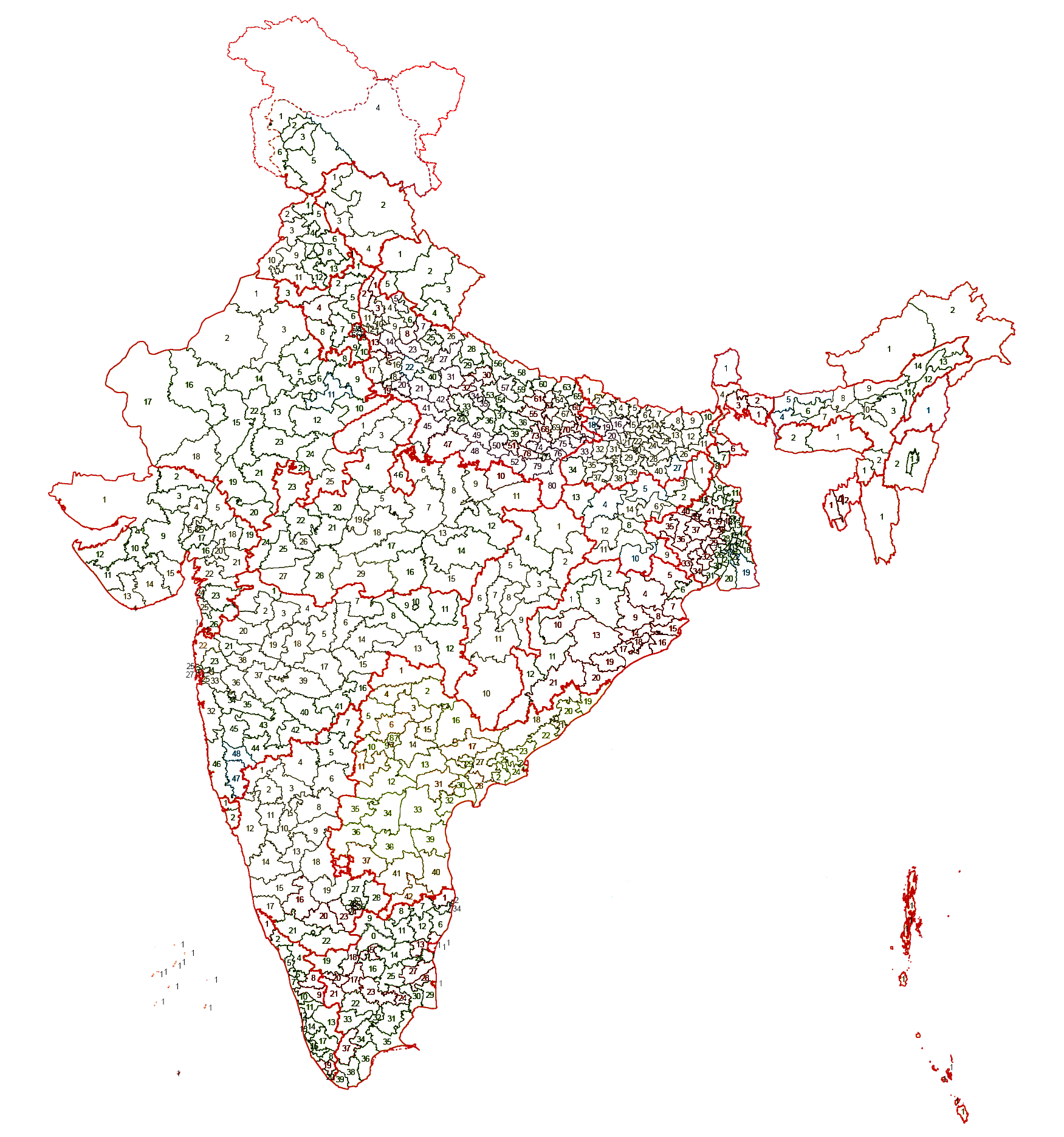
Overlap was the right word, I explained to her. We fished out a map from the net that showed all the 543 Lok Sabha parliamentary constituencies and 4120 state assembly constituencies, and then correlated it to the color-coded assembly constituencies. Each colored patch on the map showed that it had sent one member of parliament to the Lower House and each of them also sent 4-10 MLAs to the respective state assemblies.

Her cousins in Changanassery and Tiruvalla belonged to two separate parliamentary constituencies -  Mavelikkara and Pathanamthitta respectively - but the same electoral units also elected seven MLA each to the Kerala State assembly. Maps from ElectionsInIndia were particularly useful in getting the concept across.

543 Parliamentary Costituencies in India (Image source - Wikipedia Commons)

20 LS constituencies in Kerala (Image: ElectionsInIndia)


This discussion reminded me of an interaction, a few years ago, with a rather notorious MP from northern India. I was working as the Outreach Coordinator to Members of Parliament at the Centre for Policy Research , and had found myself at the home of this MP, responding to his request for inputs on the Nuclear Liability Bill.

This MPs' claim to fame was that he had one of the highest number of charge-sheeted cases in his name. In other words, he was one of the prominent thugs who had deftly gamed the electoral process, had muscled his way into the parliament. For a imposing figure with a piercing stare and an intimidating mien, he had turned out to be surprisingly sharp and genial. He already knew the Nuclear Liability Bill inside out and just wanted to sharpen his arguments with facts and figures, over a table laid out with tea and biscuits.

After our discussion he wanted to know where I was from, and the answer, 'Kerala', led him to his say something interesting. "Not many people understand", he said staring out of the window, "the pressures on an MP. People like me represent more than 3 million citizens, most of whom are illiterate, poor and volatile...It is only when I am seen participating in parliamentary debates that they feel I doing something useful".

The MP had a point. In the age of live TV and Social Media it is not easy to balance the local, ground-level expectations of those who elect you to power, with the broader, national-level perspective you are supposed to have while sitting in the parliament.

------------------------------------------------------------
LINKS

The Election Commission of India - http://eci.nic.in/eci/eci.html

Elections in India - https://www.electionsinindia.com/

Map showing all 543 parliamentary constituencies - https://upload.wikimedia.org/wikipedia/commons/3/3a/Lok_Sabha_constituencies_of_India.png

Tuesday, December 12, 2017

The Power of One


This is one obituary that refuses to leave my mindspace.

It is not often that we see touching, personal tributes to politician who passed away but E. Chandrasekharan Nair seems to have been a very unusual politician indeed. He is being refered to as the driving force behind Kerala's public distribution system which is not just functional (an usual thing in India), but also super efficient in delivering essential provisions (grains, fuel) to those who need it the most.

My own mother is a big fan of ECN. For a citizen who is not below the poverty line (BPL), even she can get 2kg of raw rice, 2kg of chemba (red) rice, 2kg of wheat atta and 0.5L of kerosene - all for just INR 100. "Where else in the world can you walk into a PDS shop and get so much for INR 100?" she asks, "Folks with BPL cards can get foodgrains at INR 1/kg!...even migrant labourers from other states are eligible for this facility!"

In most other states, foodgrains meant for the PDS is regularly siphoned off to private millers who, in turn, package it and sell it as branded stuff. How did one politician manage to fight off the usual lobbies and pressure-groups to put in place a welfare system that actually works?

The key to building an efficient PDS apparantly lies in the government agency that runs it. In this case, ECN was responsible for implementing key reforms as the minister in charge of  Kerala's Department of Food and Civil Supplies, for three long stints (1980-81, 1987-91 and 1996-2001).

Under this department, a public company, Kerala State Civil Supplies Corp Ltd (SupplyCo) runs a vast machinery for efficiently procuring foodgrains directly from the farmers at minimum support prices, of getting the grain processed in contracted mills, and, finally, getting them distributed through 14 district depots, 56 taluk depots and around 1500 retail outlets (Maveli Stores). The sales turnover of this company was nearly INR 4000 crores in 2015-16!


-------------------
REFERENCES / LINKS

- Obituary (NewsMinute) - http://www.thenewsminute.com/article/ex-kerala-minister-e-chandrasekharan-nair-architect-maveli-stores-passes-away-72372
- Obituary (The Hindu) - http://www.thehindu.com/news/national/kerala/e-chandrasekharan-nair-passes-away/article21095877.ece
(2000) - Interview - http://www.frontline.in/static/html/fl1719/17190980.htm
https://en.wikipedia.org/wiki/E._Chandrasekharan_Nair
Maveli Stores - https://en.wikipedia.org/wiki/Maveli_Stores
SupplyCo, Kerala - http://supplycokerala.com/

Sunday, February 19, 2017

Tipu


How does one view a South Indian monarch who stood up to the British? Is he really worthy of all the negative press he has been getting from the newly empowered echo-boxes of the right wing, especially over Twitter and Facebook? These are some the questions that crossed my mind while picking up Kate Brittlebank's book, "Tiger - The Life of Tipu Sultan".

As a Keralan, I have always had a dim view of this father-son duo who invaded Malabar and Kochi, and along the way, slaughtered, enslaved or forcibly converted the locals, apart from the legacy of one of the most odd place-names in the region - Sultan Bathery (Sultan's Battery). It also brought back memories of an odd sight I had seen in the dense forests of Talavadi, in the Western Ghats. A long line of huge Banyan trees marked the remnants of a highway built across the mountains, by Mysorean army to reach the port cities of Kerala. 

The book is a quick, easy read. Right at the outset, it sets the tone to readers' expectations by stating clearly that the focus is on the Tipu the person - a son, a father and a leader - rather than weighty matters related to state policy, military strategy and ethics. 

This works pretty well. For one thing, it confirms that Tipu Sultan's identity as a Muslim was hardly an issue within his own kingdom of Mysore. He lavished funds and patronage to the shrines of all religions - Hindu, Muslim and Jain - located in his territories. His own palace in Srirangapattana stood next to a Vishnu temple dedicated to Sri Ranganatha, and he referred to the head of the monastery at Sringeri Math as "Jagatguru".

Outside his realm, he played the usual policy of Divide and Rule. He allied with the Marathas of Pune and the Nizam of Hyderabad whenever it was convenient. At other times, he actively encouraged infighting within their territories. Tipu instructed his agents in Pune to trigger fights between Hindus and Muslims, to weaken the Marathas - "Let the fire of discord, therefore, be kindled amongst them, to the end that they may, in this manner, waste each other".

There is good reason for his enemies to hate him -- especially after what he did to the Nairs of Malabar, the Coorgis of Kodagu, and the Christians of Konkan. Yet, as the author notes, "Warfare at this time was brutal, and the punishment for those who resisted often cruel. It was common practice to set examples to forestall further opposition". It is certainly not different from military intimidation described today as "shock and awe".

In the end, Tipu does manage to come through as a fairly good ruler, until he put all his eggs in the French basket, and then, ran out of luck. 


Wednesday, August 24, 2016

The Ivory Throne


I was not too keen on picking another 500 page tome. Having just finished "The Gene", I was looking for something lighter, something which did not have its notes and index running into a hundred pages.

I had almost set the book aside when I decided to flip through the book one last time. I saw a map of South India in the 1920s and an old sepia print titled "The Matriarchs of Mavelikkara", and got hooked.

"The Ivory Throne" by Manu Pillai is more than just the "Chronicles of the House of Travancore". It is a refreshing new way of looking at the history of a kingdom that has, so far,  seen only the fawning eulogies of erstwhile aristocrats, or the dismissive narratives of Marxist historians.

Pillai's attention is focused on the life and times of Sethu Lakshmi Bayi. While this is, no doubt, quite interesting, I find myself drawn back to an earlier phase when Kerala saw, within the span of one century (1400-1500), the influence of foreign ships coming from two different directions.

From the East came came Admiral Zheng who sailed from China to Calicut no less than seven times to during the period 1405 to 1430. His fleets had as many as 250 ships manned by 28,000 soldiers. Even after the Ming emperors decided to isolate themselves, there remained in Kerala a fairly large community of Chinese-Malayali's called Chinna Kribala, with one of its stat sailors a pirate named Chinali!

A few decades later, in July 1497, King Manuel of Portugal sent Vasco da Gama to find the fabled spice gardens of India, with a "distinctly expendable crew of convicts and criminals". Ten months later, he was trying to peddle baubles and trinkets at the court of the Zamorin, Manavikrama. Unable to break the Arab monopoly over the spice trade in the first instance, King Manuel sent an armada led by Pedro Alvarez Cabral in 1500.

The Zamorins of Calicut were obviously nor prepared for Cabral's persuasive methods. Stymied by the Arab traders, he decided to let his guns do the talking. A single day of bombardment from the sea, killed nearly 600 people, and then he went about playing one kingdom in Kerala against another.

Once the dust settled, the natives had their fill of internecine wars of attrition ("Kudipaka") while the Europeans had ended up with a trade monopoly, and then some more. It was not until Marthanda Varma took charge of Travancore in 1729 that things started to look up in this part of India.

"The Ivory Throne" leaves me wondering - when will we have more historians piece together this real history of Kerala? What are the secrets that continues to be locked in genetic markers and mitochondrial DNA of the Mallus who come in all colors, shapes and sizes?


-------------------------------------------------
LINKS & REFERENCES

* Interview - The Hindu - http://www.thehindu.com/features/metroplus/society/manu-s-pillai-zooms-in-on-the-life-of-maharani-sethu-lakshmi-bayi-in-his-debut-book/article7900248.ece

* Book - The Ivory Throne - http://www.amazon.in/Ivory-Throne-Chronicles-House-Travancore/dp/9351776425

Sunday, June 12, 2016

Marthanda Varma's Legacy


Padmanabhapuram Palace

A casual visitor driving on NH-47 from Kerala to Kanyakumari (aka Cape Comorin), Tamil Nadu is stuck by two things: firstly, the roads in Kerala are now much, much better, and that despite change in language, climate and topography, close linkages continue to be forged between the two southernmost districts of Tamil Nadu and Kerala.

My last visit to the Cape was more than three decades ago. It was a journey in an Ambassador taxi packed with cousins from Bombay and I have vivid memories of the large ponds and hills along the way, the visit to the Vivekananda Rock and the long line of vendors selling polished sea-shells and packets of multicolored sands.

Almost every accessible site of historical interest seems to have strong connections with one king of Travancore - Marthanda Varma (1705-1758) .

Marthanda Varma was perhaps the most proactive and agressive of Travancore rulers. He had inherited a weak state surrounded by enemies, at a time when the Europeans had just promoted themselves from supplicants and spice traders, to power brokers and conquistadors.

Varma survived numerous assasination attempts before striking back to decimate his enemies, and to make strategic alliances that would make Kerala what it is today.

It was also during Varma's reign that the Padmanabha Swami Temple in Trivandrum became a major repository for state treasure. Recent discoveries put the value of this treasure at more than USD 1 Trillion!

Yet, when you look at the map it is difficult to understand why Varma made his capital city at Padmanabhapuram, a city far from his hilly hinterland in Kerala and one that was vulnerable to attacks from the land and sea.


Perhaps due to this vulnerable location European traders thought it was logical to start their conquest of Travancore from Colachel port. In 1741, Dutch East India Company forces led by Admiral Eustachius De Lannoy landed at Colachel port and marched north-east towards Padmanabhapuram Palace, hoping that a quick, dirty battle would force a surrender leading to a full control over the spice trade.

Vattakottai Fort, Kanyakumari Distt, TN
Unfortunately for De Lannoy, superior weapons and battle tactics were not of much help when the Travancore kind, Marthanda Verma called in reinforcements from his coastal domains. The Dutch army was not only defeated but the captured European soldiers were offered terms which turned out to be a lot more attractive than the incentives being offered by their employer which was also the richest MNC of the time.

De Lannoy became the Chief Strategist of the Travancore army and, over the next 20 years,  went on to oversee the construction and reinforcement of a number of forts Kerala. He was also instrumental in building a defense line that stopped the Mysorean army led by Tipu Sultan from conquering Travancore.

The original question, however, still remains unanswered: Why did the rulers of Travancore place thier capital city so far away from the hinterland?

---------------------------------------------------------
REFERENCES & LINKS

* USD 1 Trillion Treasure in Kerala Temple - http://www.forbes.com/sites/jimdobson/2015/11/13/a-one-trillion-dollar-hidden-treasure-chamber-is-discovered-at-indias-sree-padmanabhaswam-temple/#4a82c6ab21eb
* https://en.wikipedia.org/wiki/Devi_Kanya_Kumari

Saturday, June 11, 2016

Life in the Paddies

Nostalgia drove me to the erstwhile paddy fields of Thrikodithanam in Kerala.

A few decades ago a river of fluroscent green rice saplings stretched as far as a child's eye could see. Neat fields separated by narrow strips of slushy mud, clear streams teeming with Manatthu-kanni (eyes-to-the-sky) fishes and the smell of overturned earth.

All that has disappeared now. As in much of Kerala, paddy fields have been abandoned, filled-in, turned into tiny parcels of land and sold as residential plots. A little patch that now remains of my grandfather's paddy fields is now home to hundreds of unfamiliar insects.

A ten minute walk along the edges of this wild patch revealed these new inhabitants. What are they called?


Wednesday, November 04, 2015

Whataboutery and Me Ne Frego!

"I don't give a damn!"

Mussoluni's famous Blackshirts charged into Indian living-rooms this week. Images of the Italian facists, led by Il Duce with the motto, "Me ne frego!", has now been used to describe the attitude of the BJP government led by Narendra Modi.

The man who brought in the blackshirts to Indian living-rooms is not one of those discredited, fork-tongued politicians from the opposition parties but one of the most credible public intellectuals in India - Arun Shourie. He was using them to describe the audacity with which BJP leaders, including MPs and Cabinet Ministers, are vitiating an atmosphere that is already charged with communal tensions.

Until now, most of the arguments had gone down the whataboutery way:
Q. Why have more than 400 national artists returned their awards following the Dadri killings?
A. What about the anti-Sikh riots of 1984? Why were awards not returned after 2002?... such hypocricy, such double-standards! 
Q. Why is beef banned in so many Indian states?
A. What about the Congress party? - they are the ones who brought the legislations in the first place...the executive is merely implementing the existing law.

Now Shourie has raised the bar. He has brought the focus back on the here-and-now. Modi, he says, is not a helpless 'Under Secretary at the Homeopathy Department'.

By comparing the conduct of Modi to Mussolini, he has brought back public attention to the tacit encouragement being provided to the zealots and bhakts, by accusing the PM of fiddling with inane tweets while burning moral issues are at hand.

Where will all this end? Will this madness end after the Bihar elections? I don't know.

But I do hope they will continue to serve beef-curry at Kerala House.

-----------------------------------------------
LINKS:
* Full text of TV Interview - http://indiatoday.intoday.in/story/arun-shourie-narendra-modi-bjp-nda-government/1/433289.html

* http://indianexpress.com/article/opinion/columns/over-the-barrel-the-dilution-of-brand-india/

* Kerala and its meat -- https://www.youtube.com/watch?v=X6eTduMJl1k

Friday, November 07, 2014

Going Bananas


A recent article in the EPW, titled "GM Crops and Global Trade" points out that - "one company controls two-thirds of banana germ plasm of the world, four companies have 30% global market of seeds, and just six multinationals account for 77% of the pesticide market."

This got me curious.

How is it possible for one company to control two-thirds of banana germplasm? Does this mean that it has a hold over the myriad banana varieties dangling at a fruit-vendor's stall in Kerala?

If something seems out of place, it probably is.

According to the International Musa Germplasm Transit Center (ITC-Belgium), the center is "home to the world’s largest collection of banana (Musa) germplasm". ITC has over 1400 sample of edible and wild species of banana, cryo-preserved at -196C. Most importantly, it is not owned by any company and is therefore "freely available for international distribution upon request".

Perhaps the EPW article meant to convey that two-thirds of banana trade is controlled by one company. But even this is contrary to a recent FAO report which states -

FAO's review of the three largest banana traders (Chiquita, Dole and Del Monte), shows that the combined market share of the top three companies was at its highest the 1980's, when they controlled almost two-thirds (65.3 percent) of global banana exports, while in 2013, their market share was slightly over one-third (36.6 percent).

The global banana market is worth US$ 7 billion. Amazingly, nearly all the trading happens in only one variety of banana: Yellow-skin Cavendish.

Contrast this with the amazing variety of bananas available in South India. Even the humblest fruit-seller would have on display, at least five different types of the fruit on any given day. India's National Horticulture Board lists more than 11 varieties of banana including - Robusta, Rasthali, Poovan, Nendran, Red-Banana (Kappa Pazham), Virupakshi, Panchanadan, Monthan and Karpuravalli!

So, far from controlling two-thirds of banana germplasm, the MNCs have only focused one single variety. It is as though all the florists in the world were stocking only roses or as though all the eateries were serving just burgers.

This also one reason why the supermarkets will never overrun the local  kirana shops and chaya-kada's -- they just cannot offer ten different types of bananas!


-------------------------------------------

REFERENCES & LINKS:

* Singh, Sukhpal (2014): GM CROPS AND GLOBAL TRADE, EPW, 18 October 2014 -- http://www.epw.in/commentary/gm-crops-and-global-agri-trade.html

* ITC Belgium - http://www.bioversityinternational.org/research-portfolio/conservation-use-of-bananas-tree-crops/international-musa-germplasm-transit-centre/

* (Reuters, 27 OCt 2914) -- http://www.reuters.com/article/2014/10/27/us-chiquita-brands-m-a-cutrale-safra-idUSKBN0IG16J20141027

* FAO - The Changing Face of Global Banana Trade - http://www.fao.org/news/story/en/item/224807/icode/

- FAO Full Report (2014) - http://www.fao.org/docrep/019/i3746e/i3746e.pdf

* CGIAR - http://cropgenebank.sgrp.cgiar.org/images/file/procedures/collecting2011/Chapter3-2011.pdf

* National Horticulture Board (NH‌B), India - Banana Varieties - http://nhb.gov.in/fruits/banana/ban013.pdf

Wiki - http://en.wikipedia.org/wiki/Banana
- Enset - http://en.wikipedia.org/wiki/Ensete_ventricosum -- 'False Banana' grown in Ethiopia for its edible roots!

Saturday, November 19, 2011

I Never Knew..

.
As far as experiences go, is  there anything better than a short, sharp trip? After a quick, week-long visit to Kerala, I am convinced that intense road-travel is the best way to know soak in the contrasts that a place has to offer, without getting getting sucked into a vortex of ennui, nit-picking and petty politics.

This particular trip started with Indigo flight 6E-177 from Delhi to Thiruvananthapuram; it included a 650km drive across the length of the state, from Tvm to Kodungallur, Guruvayur and Trissur; a family get-together, and a return flight by the same airline back to Delhi.

All along, I found myself getting surprised time and again, by things I thought would never change, and by questions that never popped up earlier. And it all started at the new airport complex in Delhi.

I never knew the IGI Terminals had transformed so much. A drive down the airport road, past the Tibetan monastery, and suddenly you see that shabby buildings and ugly roundabouts have been swept away and replaced with a swank new building, with better security and much more efficient staff. Even the toilets sensors have little homilies on them! And just in case you feel completely disoriented, all you have to do is to look outside the glass windows to see "Airport Hotel". The relic is still there, perhaps as a reminder of the bad old days.

I had wondered why Indigo flights emerged as top-dog in the Indian skies until I checked in. The answer seems quite straightforward - over the past few years, while the competition has been falunting shorter skirts and pretty faces, Indigo has been hiring smart people and training them well in the art of continuous improvement. Who cares for hot meals and steel cutlery when the flights are handled efficiently and arrive well ahead of schedule!

Back on terra firma, the next big surprise was the highways in Kerala - they have improved so much! Except for a few, relatively short, painful stretches, both the trunk roads - the Main Central and the National Highway - have made road-travel so much more reliable.

And there were the elephant-questions. Until I sat for an hour gawking at the pachyderms, I never knew how leverage their tusks to crack palm fronds, or that they prefer to eat the stem like foot-long pieces of sugarcane, while completely ignoring the green leaves. I noticed this for the first time inside the Guruvayur temple during the Seiveli Puja. It never ceases to amaze me - the sight of five bedecked elephants standing in a confined space, amidst hundreds of people, in close proximity to oil lamps and their long, flickering flames.

Finally, I never knew that Trissur city was built around a huge 'traffic island' hillock, housing the famous Vadakkunathan temple. I always imagined it to be on a flat plain, separated from the Parasumeikkavu temple by the famous "pooram" ground. Even more suprising was the sheer size of the complex with its numerous sub-shrines. Most of these are in bad shape, thanks, no doubt, to the usual suspects - a Dewaswom Board with a damn-care attitude and the local populance which is unable or unwilling to take responsibility for its own heritage.

SAT-PICS:

lat=10.5249864&lon=76.2148941&z=17&l=0&ifr=1&m=b" width="730" height="536" frameborder="0">
The Thrissur Roundabout

lat=10.2799577&lon=76.7230225&z=13&l=0&ifr=1&m=b" width="846" height="525" frameborder="0">
Lakes wedged in between Mukurthi and Silent Valley National Parks

Saturday, September 10, 2011

For A Driver's License

My driving license expired in 2010, while I was in Japan. Since I could not renew the Delhi-issue licence from Tsukuba my application for a Japanese Unten-Menkyo (driving license) was jeopardized and my trips to the issuing centre at Tsuchiura ended on a disappointing note.

The Test Course at Tsuchiura, Japan

The experience, however, gave me the opportunity to understand the protocols in the Japanese system; the seriousness with which DL applications are screened and the manner in which tests are conducted. The effectiveness of such a system are more than apparent in the extremely low incidence of traffic accidents in Japan.

Now, back in India, I found myself going through the motions of getting my licence renewed. It was no simple matter. Despite all the computer networking in India, a driving licence issued in Delhi could not be renewed in Kerala unless you produce an NOC (no objection certificate) from the Delhi RTO (even if you produce one it has to be cross-checked manually, over snail-mails). Its a strange rule because if I intended to go to Delhi for the NOC, I could get the licence renewed there itself! So the only alternative was to go through the motions of applying for a fresh licence.

At the Thiruvananthapuram RTO, the DL process involved the following steps:
  1. Applying for a Learner's Licence qualifying test (45 days waiting time)
  2. Qualifying the LL test and getting a date for the Driving Test (64 days later)
  3. Qualifying the Driving Test & the Road Test (half-day 8:30AM - 12:30PM)
  4. Qualifying the Road Test
  5. Obtaining the Driving Licence by registered post (10 days)
The whole process was painful and frustrating. At the same time, it was a study of contrasts and a great lesson on how a government department can manage a complex exercise in standard-setting with the absolute bare minimum in terms of manpower and investments.

In Japan the Unten-Menkyo centre had a large facility of its own - buildings with waiting areas and vending machines; test-vehicles in all categories; a custom-built ground for testing the candidates, qualified personnel and an arrangement with the bus companies to ferry applicants. On the other hand, in Kerala the onus rests entirely on the driving schools. The test facility at Shangumugham is just an open ground that belongs to another government department. A few shacks on its periphery provide refreshments and a semblance of shelter from the rain under tarpaulin sheets.

The RTO officers arrive after 8:30 AM in a single official vehicle and from then on, everything is "taken care of" by the 20 odd driving schools who flood the ground with about 200 applicants everyday. The officers sit on furniture brought in by one school; they sit in vehicles provided by another for observing the applicants as they go through their H's and 8's; they sip on refreshments others buy for them, and finally, the road-tests are conducted in vehicles provided by the schools.

Test Course at Shankumugham, Thiruvananthapuram, Kerala

Is there a conflict of interest here? Of course. However, I could find no serious evidence of any deviation from the RTO's ultimate objective: to ensure that well trained drivers are issued licenses. For a state government that tops in financial mismanagement, its RTO seems to be doing excellent work with the bare minimum of resources and infrastructure. With just a handful of officers it is able to manage a large volume of applicants with the help of all the registered driving schools in the city.

Unlike in some other states, where you can easily get a driving licence in exchange for a few of bottles of rum, the system here seems to have got completely transformed over the past few years. Touts offering to "fix" things for you without a real test, have completely disappeared. The driving schools do all the running around but the fact that there are so many small players seems to ensure a system with its own checks and balances. The chances of an undeserving candidate clearing the tests are very low indeed.

There is, of course, a lot of scope of improvement. For starters, the RTO could at least construct some waiting sheds for the applicants; it could invite local vendors to set up regular refreshment stalls. In the test procedures it could do away with the test for archaic "hand-signals" which have long been replaced by electronic indicators in all vehicles.

Wednesday, August 10, 2011

God's Own Garbage


In Thiruvananthapuram, there is a new way of disposing household garbage - it is called "toss and scoot". 

Even in the most affluent areas, one can now witness something, which until recently, was rare in Kerala : the unedifying sight of citizens rolling down windows of their air-conditioned cars, to toss out plastic packets full of garbage on to public sidewalks or any blind corner deemed to be "no man's land".

A good example of this practice can be seen on the road going down from the upmarket PTP Nagar to Maruthankuzhi. Also known as Pipeline Road, this is one of the few straight roads in the city, gently sloping down the hill with a Forest Department plantation on one side and the Army cantonment property on the other. It is a lovely, green stretch.  However, a hundred meter's down this road, just beyond a board welcoming you to PTP Nagar, piles of garbage adorn both sides of the road. And just when you're wondering how so much garbage had come to occupy such a large area, a car speeds by, a window rolls down and yet another garbage projectile hits the ground, scattering its contents down the slope. Domestic servants and morning walkers toss in their packets at a more leisurely pace, much to the delight of crows and stray dogs.

The same pattern is repeated in most parts of the city - except in the areas surrounding the Raj Bhavan and Kowdiar. In the narrow lanes of Vazhutacaud, Elipode and Pettah, where you cannot hide behind the anonymity of a faceless, speedy car, the garbage packets are surreptitiously dropped in blind corners or empty plots. In Vattioorkavu  one spot has packets piled right under a Residents Welfare Association (RWA) board pleading in Malayalam - "For God's sake, please don't drop your garbage here!".

In keeping with Wilson & Kelling’s “Broken Window Theory”, a single garbage packet, lying unattended for a couple of days attract many more such packets, and soon, a pile builds up. Some get tossed into open drains and rivulets, increasing the chances of flooding during the monsoons.

Why is it that the allegedly 'most educated people', in the most literate state in the country, are so indifferent and callous to public hygiene? Is it merely a failure of the civic administration or is these pointer's to a deeper societal problem?

The civic administration does have a scheme in place, under the Kudumbasree program. Each of the eighty-six wards under the city corporation has a team of women who set about early in the morning, going from house-to-house collecting garbage. Each household is supposed to hand over segregated the garbage to the workers, who pack them into crates for further processing at their facility at Vilappilsala, 16 km East of the city.
This is, of course, the plan. In practice, the Kudumbasree workers regularly face householders who grudge them even the token monthly charge of Rs.40. Since most of the packets they receive are un-segregated, they go about using their bare hands to pull out kitchen & food waste from piles that invariably contain razor blades, rusty cans, broken bulbs and glass shards. An exasperated worker at Elipode says, "We keep requesting the people to give us segregated garbage, but nobody listens!"

The situation at Vilappilsala processing centre is often the subject of controversies. The plant was commissioned in 1999-2000 and is presently being run by a quasi-government agency - the Centre for Environment & Development. Spread across an area of 43 acres, the Vilappisala facility has the capacity to convert 200 tonnes of biodegradable garbage per day using aerobic reactors as well as mechanical composting. The choice of technology has raised a stink and, in response to vociferous protests from residents in surrounding areas, the government is restricting the inflow to just 100 tonnes per day - half its built capacity. 

According to a paper presented by Edward and Kumar (2009 CET Trivandrum), the problem of Municipal Solid Waste (MSW) disposal in Trivandrum city is typical of the problem faced by all states in India. Lack of financial resources, institutional weaknesses, improper choice of technology and public apathy towards MSW has made this service far from satisfactory. Two years ago, the city produced an average of 145 tonnes of garbage per day and now, there just not enough land available for conventional landfills and processing plants.

Given the precarious finances of the Kerala state government, it may be unrealistic to expect quick-fix, high-tech solutions. What can be addressed incrementally are the institutional weaknesses, but, ultimately, the crux of the problem rests on one single issue: public apathy. 

Perhaps the only cure to this ailment is a sustained, carefully crafted campaign involving  households, RWA's, schools as well as entrepreneurs’ involved in the waste-recycling business. In consultation with the RWA's, each area should have clearly demarcated points for garbage disposal, provided, if necessary with wire-mesh enclosures or nets that blocks free access to scavenging birds and animals.  

Chennai city produces 3500 tonnes of garbage and, after years of experimenting, seems to have come up with an effective solution that involves private enterprise, RWA’s and the municipality. This model may have some lessons to offer to the people of Thiruvananthapuram.

There is no point procrastinating here. The problem is only going to get worse as the population increases. Until careful planning is backed by concerted action, households - even in the most affluent areas - will continue to toss their garbage out of their cars, or delegate this unpleasant task to their domestic servants.

The Trivandrum Corporation, in consultation with the RWA’s, needs to get proactive on this issue. As of now the corporation website provides only a "White Paper" on the subject, with no information or guidelines on what is to be done with domestic waste, including the tricky issue of disposing non-biodegradable waste - especially the more hazardous items like hospital waste, battery-cells, electronic goods, glassware, fluorescent tube lights and bulbs.

Until this happens, the capital city of God's Own Country will continue be the abode of ironies : a city named after the richest temple in the country, home to Technoparks, high-tech hospitals, satellite & rocket scientists, but one that is incapable of coming up with a creative, effective way of managing its own household garbage.

--------------------------------------------------------------
REFERENCES:

Tuesday, June 07, 2011

Laboring in Kerala: Changing Times

.
Is it possible to quantify the economic cost of cultural norms or attitudes?

Take, for instance, the attitude towards physical work in Kerala, India. Even a casual visitor to the state would not fail to notice a strange phenomena: large swathes of fertile agricultural land lying fallow, while able-bodied men hang about in public places, idling, sipping sweet-tea and discussing politics.

At 9.4% (2007) Kerala has one of the highest official unemployment rates in the country and simultaneously suffers a serious shortage of skilled and unskilled labor. The state is the largest producer of rubber, spices and coconuts in the country, and yet, there are not enough farm hands.

This disconnect could have been logically explained if workers were being poorly paid and exploited by the landlords or industrialists; or if agriculture was grossly un-remunerative. The situation, in fact, is quite the opposite. The average daily wage here is the highest in the country at Rs.450/day (strictly 9AM-6PM); the state has the highest literacy rates, the highest health indices and the highest per-capita income in the country. Over the years, militant workers unions have also ensured that is is "normal" to have blatantly extortionist practices like "Nokku kooli" which has effectively shut out manufacturing industries from Kerala.

So here we have a state that has the capacity but not the will to make the best use of its human & natural resources - other than, of course, "softer" options like tourism and ITES services. This bring us to the most critical - but notoriously un-quantifiable - aspect of any society: attitudes and cultural norms.

Youngsters who are loath to be seen with a shovel in own farms gladly travel across the Arabian Sea to sweat out in the desert sun as construction workers. Kerala sends out over 2.5 million people to work overseas (91% in the Gulf region), and they, in turn, prop up the state's economy through their remittances (over 20% of gross state domestic product). Is it because find more dignity, self-respect and social mobility in toiling anonymously in foreign lands rather than subject themselves to hide bound social conventions and caste hierarchies back home?

And now we have an interesting new phenomenon building up: laborers and skilled workers from other states in India, and even neighboring countries are pouring in, to work in Kerala.  Workers from Nepal, Bihar, Orissa, Tamil Nadu, and the North East have now become fairly commonplace, even in the remotest corners of the state. By some estimates there are over half a million such migrant workers in Kerala now. As of now, they engage themselves in work that the locals just don't want to do:  quarrying, road-building, carpentry, construction and rubber-tapping. And much like the early Keralan workers to the Gulf, they are being exploited by local middle-men who routinely cheat them of their wages, sometimes handing out less than half of what a local worker would earn as minimum wages (Rs.450), which is still higher than what they would earn elsewhere in the country.

Will a flood of "domestic migration" to Kerala bring about a change in local attitudes towards work?

-----------------------------------------------------------
NOTES:
  • Kerala's Net State Domestic Product (NSDP) in 2003 was Rs.83,782 Cr (~ US$ 21 billion) of which remittances accounted for 22% (~ US$ 4.6b). This was 1.74 times the revenue of the state, 7 times of the transfers to the state from the central government and 1.8 times the annual expenditure of the Kerala Government. Remittances were also sufficient to wipe out 60% of the state's debt....15 times the export earnings of cashew and 18 times those from marine products (Rajan 2007)

----------------------------------------------------------
REFERENCES:
  • Rajan, S. Irudaya & Zachariah, K.C (2007). The Migration-Development Nexus: Remittances and its impact of the Kerala Economy and Society. ISS, The Netherlands (31 Aug 2007). URL - www.iss.nl/content/download/8303/81035/.../Panel%202_Rajan.pdf
  • Krishnakumar, M.K (2011). Perumbavurile Paradeshikal (Malayalam- The Outsiders in Perumbavur). Mathrubhumi, 5 June 2011
  • Rediff.com (2009). Kerala Remittances Economy Under Threat. 2 Feb., 2009.  URL - http://www.rediff.com/money/2009/feb/02keralas-remittance-economy-under-threat.htm
  • Special Correspondent (2011). COMPREHENSIVE LABOR POLICY SOON. The Hindu. 29 May 2011
  • Staff Reporter (2011). Campaign to end 'Nokkukooli'. The Hindu, Kollam edition, 4 June 2011
  • Current Minimum Wage Rate in India - http://www.paycheck.in/main/officialminimumwages
  • Official Minimum Wages in Kerala - http://www.paycheck.in/main/officialminimumwages/kerala
  • Mathew, A (1986). The Coconut Economy of Kerala. JSTOR - http://www.jstor.org/pss/3517251
  • Philip, Shaju (2010). Kerala's Coconut Economy Takes a Hit. Financial Express, 10 Oct., 2010.

Thursday, June 02, 2011

Monsoons: Arrived On Time!

.
Its a breathtaking sight from the seashore.

As far as the eye can see, a massive wall of dark grey clouds silently approaching the Kerala coast, bringing in a season of torrential rains. It is an event carefully monitored by the Met Department, for, in these clouds, hangs the fate of agricultural production in much of the Indian subcontinent.

Here are some pics from Valiyathura Pier in Thiruvananthapuram, Kerala - 

A turbulent Arabian Sea

 A fishing boat being readied on Valiyathura Pier


--------------------------------------------------------
LINKS:
  • Indian Meteorological Department: Monsoon Updates - http://www.imd.gov.in/section/nhac/dynamic/Monsoon_frame.htm
  • Much awaited southwest monsoon sets in over Kerala, 3 days before normal . The Hindu 30 May 2011. http://www.hindu.com/2011/05/30/stories/2011053058901100.htm
  • South-West Monsoon Active Over Kerala. ToI 31 May 2011. http://articles.timesofindia.indiatimes.com/2011-05-31/india/29603548_1_meteorology-sources-kerala-and-lakshadweep-south-arabian-sea

Thursday, May 19, 2011

Ants in Kerala


I never cease to wonder at the amazing diversity of life in the tropics. Even the smallest patches of land seem to be home to so many different types of plants, insects, reptiles and birds!

The question for the day is this: How many different species of ants can there be in a 11 "cent"* plot in Trivandrum, Kerala?

A few years ago, I would have been content to divide ants into two broad categories - the ones that bite and those that didn't. That was, of course, before the age of WWW and online databases. But even now, the material available in these databases seem to have a limited coverage of the Indian subcontinent - let alone separate eco-zones and sub-zones within countries.

This dilemma was solved recently when a biologist friend handed me just the sort of book I was looking for - "On a Trail With Ants - A Handbook of the Ants of Peninsular India", a self-published book by Ajay Narendra and Sunil Kumar M.

Here is a list of local ant species that have been identified so far -
NOTE: Three broad parts to an ant – head, mesoma, and gaster. The head portion contains the antennae (funiculus), eyes and teeth (mandibles); the legs are attached to mesoma ( middle) segments and the gaster is bulbous portion at the rear and sometimes bears a sting.

1. Weaver Ant (Oecophylla smaragdina)


Weaver-ant soldiers keep a sharp eye on the males (black, winged), preventing them from flying away until the time is just right. Featured in National Geographic of May 2011.

2. Miniscule House Ant (Tetramorium smithi): Subfamily Myrmicinae.: Tiny (2mm) red-ants with a sharp bite

3. Golden Backed Ant (Camponotus sericeus): Lone foragers with workers in different sizes (polymorphic), ranging from 10mm to 4mm

4. Odor Ant (Tapimoma melanocephalum): Sub-family: Dolichoderinae: The most commonly seen ants indoors - its everywhere – clothes, curtains and even laptops! Seems to have supplanted the MHA a few years ago. 1.5 -2mm length; distinct pale yellowish gaster; long antennae

5. Pharaoh Ant (Monomorium pharaonis) : Subfamily Myrmicinae [Note: Id. to be confirmed]. Workers in sizes ranging from deep maroon head and gaster with reddish. Location: Outdoors – around the potted plants.
Pharaoh Ant - assorted sizes on a garden wall

6. Giant Honey Ant (Camponotus irritans)[Note: Id. to be confirmed] <>  Fast moving solitary hunter. Location: Indoors – mainly in the ground-floor bathrooms.

7. White-footed Ghost Ant (Technomyrmex albipes) Subfamily: Dolichoderinae: Shiny black ant 2.5-3mm long, with an oval,  pointy gaster. Recently hopped across from the banana fronds touching my  window to look for food in my dust bin. Location: Outdoors on banana fronds; indoors in the window sill. This ant figures in the PCI list of common Indian pests.
White-footed Ghost Ant

8. Yellow Crazy Ant (Anoplolepis gracilipes) Sub-family: Formicinae: Red transluscent ants, 6.5-7mm long with large gasters. Invasive species, indicates human disturbance in habitat.  <> Location: Indoors and outdoors.


9. Common Godzilla Ant (Camponotus compressus) Subfamily Formicinae: Black, opaque ant having workers in at least three different sizes ranging from 16mm to 8mm. Forage in small groups. Location: Exclusively outdoors.

10. Black Crazy Ant (Paratrechina longicornis) Subfamily Formicinae: About 3.5mm in length this ant’s main characteristic is its long, slender antenna. Location: Mainly indoors.

11. Greater Trap-Jaw Ant (Ondontomachus haematodus): About 15mm long this ant forages solitarily with its mandibles wide open. Location: only in the front-yard.


12. Finned Dolly Ant (Dolichodorus affinis) - Always a loner, this ant was spotted atop a banana tree. About 4mm in size, it is distinctly different with its deep, shiny maroon body - the gaster glints like a jewel in sunlight!

13. Common Red Fire Ant (Solenopsis geminata: Large nests on the steps leading to Parai Kovil, marked by heaps of powdery red soil particles.

14. Arched Two-spined Ant (Polyarchis halidayi)   [Note: Id. to be confirmed]: Atop a sapota-tree, hangs a nest made out of a single folded leaf walled with mud and larval silk. Home to about 20 ants. When disturbed the ants rush out and arch themselves into a defensive position, exposing the underside of their gasters which have a distinct black, metallic silver color.


14. Unidentified...which one is this??


------------------------------------------------------------------------------
*Note: 1 "Cent" =  40.5 sq m

Excerpt from NatGeo  article of May 2011:
Scientists have likened weaver ant communication to a type of language with primitive syntax,. Mathematicians draw upon analysis of ant behavior to devise parallel computing formulas (where multiple problems are solved simultaneously). Ants serve as models of all kinds of studies aimed at figuring out how big, complex jobs get done with small parts and minimum instructions.

------------------------------------------------------------------------------
REFERENCES