Showing posts with label elections. Show all posts

Thursday, January 30, 2020

Delhi Assembly Elections 2020


Something is amiss in the Delhi Assembly elections.

This is supposed to be prestige battle between the ruling Aam Aadmi Party (AAP) and its Bharatiya Janata Party (BJP) which runs the central government. While AAP is trying to showcase its achievements over the past five years under the leadership of Arvind Kerjiwal, the BJP seems to be making a half-hearted attempt, not to win the elections, but to merely to try and increase its vote-share by playing up communal issues.

With just a week to go for the Election Day, one  would expect to see an action-packed campaign trail. And yet, ground realities seem to be quite the opposite. 

Today was a day of many first. I got a chance to use two new lines of the Delhi Metro for the first time, and trudge across two constituencies of East Delhi - Gandhi Nagar and Krishna Nagar. As soon as I got off the metro, I had expected to all the usual signs of a big fight -- posters, billboards, stickers, loudspeakers blaring out speeches, and people campaigning for their candidates. 

Instead, all I got to see after walking for a couple of hours through the lanes and bye-lanes of these two constituencies was the regular bustle of a middle-class locality. People trying to make their way through the traffic snarls, vendors plying their wares and housewives haggling with cycle-rickshaw guys on their way back from shopping. 


The only reminder about the elections came from a couple of electric rickshaws fitted out with posters and loudspeakers playing out pre-recorded jingles and election promises. There seemed to be a polite understanding between both the main parties (Congress is missing in action) - AAP and BJP not to cross swords because, in any case the sound of the loudspeakers could barely be heard over the cacophony of vehicles.


Is this a muted election campaign due to the efforts of the Election Commission? Are the politital parties so short so funds that they are unable to make their presence felt in these high-density districts of Delhi?


----------------------------------------------
LINKS

Delhi Elections schedule - https://eci.gov.in/files/file/11567-schedule-of-general-election-to-the-legislative-assembly-of-nct-of-delhi-2020/

cVIGIL Campaign by EC -  https://eci.gov.in/cvigil/

https://en.wikipedia.org/wiki/2020_Delhi_Legislative_Assembly_election


Friday, October 19, 2018

Afghanistan - An Election of Independents


Tomorrow is Election Day in Afghanistan. 

This is going to be the culmination of a long process of institution building in one of the most trying circumstances. It has a process that has also seen the creation of an independent election commission to oversee a process to bring in 249 representatives from 34 provinces to the Lower House of the Afghan Parliament.

Last week when I landed at Kabul the city presented a familiar, festive sight - colorful stickers, posters, placards and banners filled every possible public space. Posters carried unique logos and numbers, and it took me a while to realise that most of the prospective Members of Parliament were competing as independent candidates. 

According to a WaPo report, there are 2,565 candidates vying for 249 seats, including 417 women candidates. The IEC aims to set up more than 19,000 polling stations in 33 provinces. Out of Afghanistan's estimated total population of 30 million, 8.8 million people have registered to vote. Kabul city alone has more thans 800 candidates competing for 33 seats! 
An overview from AFP

Unlike in India, the system here is that of a single non-transferable vote valid in one constituency. Each voter casts just one vote for one candidate in a multi-candidate race. Posts are filled by the candidates with the most votes, and so in this case, candiates who get the maximum number of votes get to become MPs. 

Voters in cities like Kabul would be extra careful tomorrow - they would have to sift through a ballot 'paper' that looks more like a newspaper centrespread, and choose one candidate out of hundreds.

While most of the posters feature men in sharp suits or in traditional attire, it is interesting to note that there are a significant number of women candidates in the fray. This is not surprising given the fact that the Afghan constitution guarantees 68 seats - or 27% of the total - for women MPs, regardless of their vote share.

A lot of hopes and aspirations are hinged on this elections process, and everybody hopes that it passes off peacefully.


--------------------------------------------
LINKS & REFERENCES

The Independent Election Commission (IEC) of Afghanistan- http://www.iec.org.af/

Report by Washington Post - https://www.washingtonpost.com/world/asia_pacific/a-look-at-afghanistans-parliamentary-elections-on-saturday/2018/10/19/354e4b0c-d367-11e8-a4db-184311d27129_story.html?noredirect=on&utm_term=.ff58f1765639

BBC - https://www.bbc.com/news/world-asia-45836521

https://www.washingtonpost.com/world/asia_pacific/the-taliban-has-vowed-to-disrupt-the-afghan-elections-candidates-are-out-in-force-anyway/2018/10/16/d57bf1a4-ccf7-11e8-ad0a-0e01efba3cc1_story.html?utm_term=.9e059fd98606

Saturday, August 25, 2018

On Electoral Constituencies

"What are electoral constituencies?", asked my daughter today.

She had in her hand a copy of the Class IX Social Sciences textbook and seemed completely lost. The whole country seemed to be divided into consituencies - panchayat, assembly, Lok Sabha - and the term seemed to have overlapping meanings.

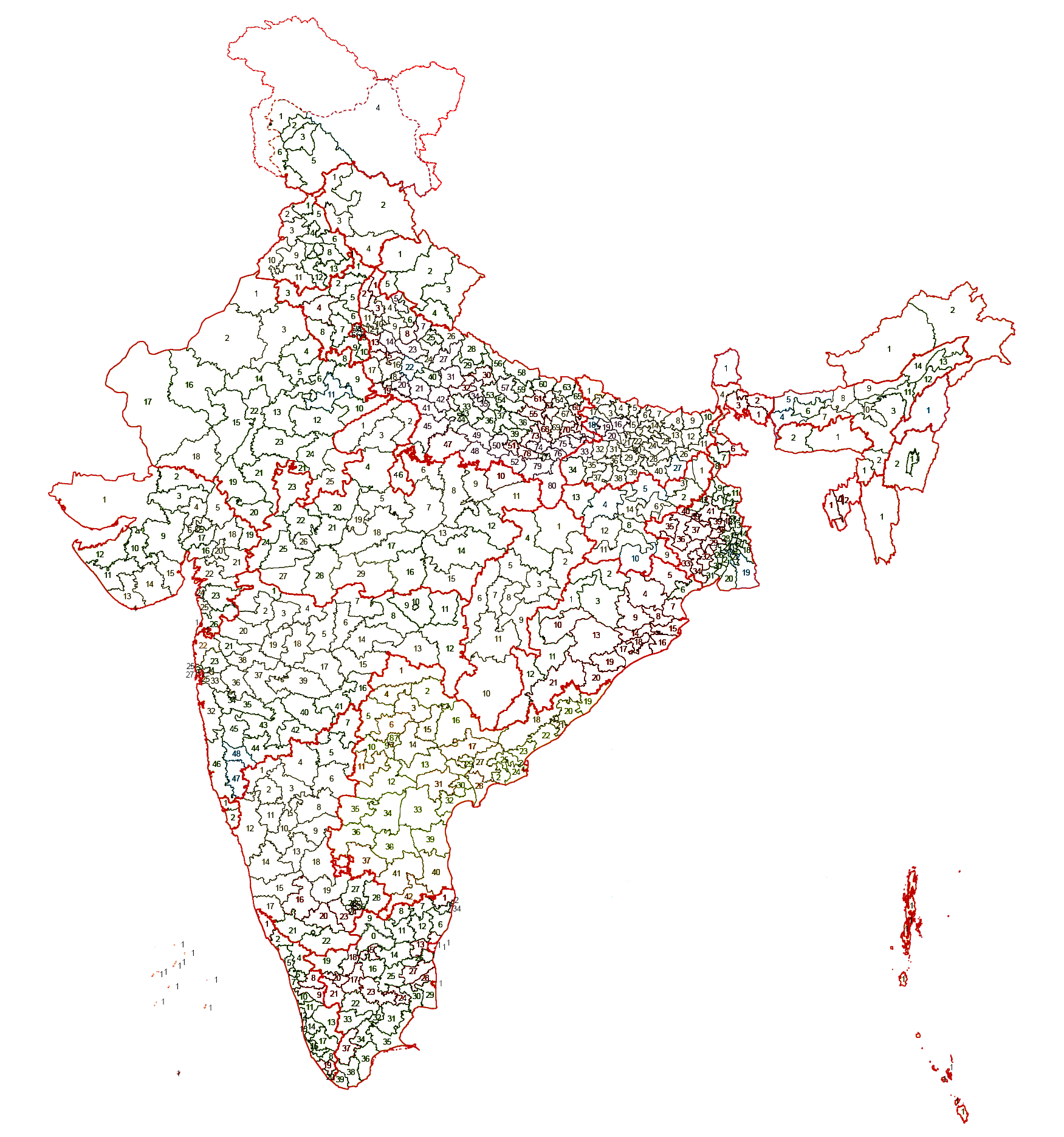
Overlap was the right word, I explained to her. We fished out a map from the net that showed all the 543 Lok Sabha parliamentary constituencies and 4120 state assembly constituencies, and then correlated it to the color-coded assembly constituencies. Each colored patch on the map showed that it had sent one member of parliament to the Lower House and each of them also sent 4-10 MLAs to the respective state assemblies.

Her cousins in Changanassery and Tiruvalla belonged to two separate parliamentary constituencies -  Mavelikkara and Pathanamthitta respectively - but the same electoral units also elected seven MLA each to the Kerala State assembly. Maps from ElectionsInIndia were particularly useful in getting the concept across.

543 Parliamentary Costituencies in India (Image source - Wikipedia Commons)

20 LS constituencies in Kerala (Image: ElectionsInIndia)


This discussion reminded me of an interaction, a few years ago, with a rather notorious MP from northern India. I was working as the Outreach Coordinator to Members of Parliament at the Centre for Policy Research , and had found myself at the home of this MP, responding to his request for inputs on the Nuclear Liability Bill.

This MPs' claim to fame was that he had one of the highest number of charge-sheeted cases in his name. In other words, he was one of the prominent thugs who had deftly gamed the electoral process, had muscled his way into the parliament. For a imposing figure with a piercing stare and an intimidating mien, he had turned out to be surprisingly sharp and genial. He already knew the Nuclear Liability Bill inside out and just wanted to sharpen his arguments with facts and figures, over a table laid out with tea and biscuits.

After our discussion he wanted to know where I was from, and the answer, 'Kerala', led him to his say something interesting. "Not many people understand", he said staring out of the window, "the pressures on an MP. People like me represent more than 3 million citizens, most of whom are illiterate, poor and volatile...It is only when I am seen participating in parliamentary debates that they feel I doing something useful".

The MP had a point. In the age of live TV and Social Media it is not easy to balance the local, ground-level expectations of those who elect you to power, with the broader, national-level perspective you are supposed to have while sitting in the parliament.

------------------------------------------------------------
LINKS

The Election Commission of India - http://eci.nic.in/eci/eci.html

Elections in India - https://www.electionsinindia.com/

Map showing all 543 parliamentary constituencies - https://upload.wikimedia.org/wikipedia/commons/3/3a/Lok_Sabha_constituencies_of_India.png

Wednesday, March 27, 2013

Visualizing India's Electorate


Data visualizers are now turning their attention to Indian politics!

Here is an interesting presentation by S. Anand of Gramener.com --


Not all slides are communicate  clearly but, on the whole, one does get a flavor of the complications involved in Indian electoral politics.

Anand's blog is also very cool: http://www.s-anand.net/

-----------------------------------

REFERENCES / LINKS

* Four Color Theorem - (1976) by Kenneth Appel and Wolfgang Haken. It was the first major theorem to be proved using a computer. Wiki -- http://www.s-anand.net/