Showing posts with label democracy. Show all posts

Tuesday, July 25, 2023

Global Rankings: Hunger, Democracy and Human Rights


Every year a a bunch of 'independent research bodies' publish 'global rankings'. More often than not, in India, these rankings become a subject of newspaper headlines, op-eds, TV debates and opinion pieces that dominate the public discourse for a while. At times rankings are also raised in the parliament, steering not only public policy one way or the other.

It was only last year that I caught a glimpse of the sleight of hand practiced those who prepare these rankings. The Global Hunger Index released last year ranked India at 107 (of 121 countries). Having witnessed first-hand the tremendous effort that went into ensuring the distribution of food stockpiles during the Covid years, these rankings seemed odd. It took only a bit of digging into the GHI charts to realise that the core issue was nutrition - not the availability or access to food. But, hey, 'hunger' sounds sexier.

Democracy is another bugbear. The Economist Intelligence Unit (EIU) claims that Indian democracy has been in decline ever since Mr. Modi first took office in 2014, with its international ranking falling from number 27 in the world (just below Belgium) to number 46 (two spots below South Africa). The EIU now labels India a “flawed democracy” characterised by “serious deterioration in the quality of democracy under leader Narendra Modi”. Then there is the American government-funded think tank Freedom House which finds India to be only “partially free”, with an overall freedom rank of tied-85th in the world.

These rankings were taken to be the gospel truth until people started asking a simple question - on what basis where these rankings created? How does one compare a complex multi-enthnic, multi-lingual, multi-everything country like India, with, say, Luxembourg?

This year, Prof. Salvatore Babones, from the University of Sydney published a paper that examined how India fared on rankings related to democracy and human rights. A quantitative, comparative sociologist, Babones noticed that the rankings presented by agencies such as Freedom House, Sweden's V-Dem and the RSF Press Freedom Index, stood on rather shaky ground. 

The paper published by Babones has its focus on Sweden’s university-based Varieties of Democracy Institute (V-DEM) which ranks India at 108 in the world for electoral democracy (two places above Myanmar) and 97th in the world for liberal democracy (one place above Papua New Guinea). It claims that India is no longer a liberal democracy at all, but is now an “electoral autocracy” on a par with Russia!

On what basis are these rankings created? Turns out that behind the facade of 'higher mathematics' lies ideologically coloured opinions of carefully selected 'experts':

(1)  Freedom House  "index of freedom"  is based on a survey with a series of questions aimed at 'experts on India' (not necessarily Indians) . It has questions like - is the media free? are the elections fair? is the election commission unbiased? - all qualitative impressions summed up into a number

(2) Swedish V-Dem ranks India is an electoral autocracy alongside Russia and Turkey . This institute sends questionnaire to social science professors (the list is secret and it leans to the Left). This survey contains 5 parts - 2 objective parts: one about universal suffrage and whether officials are elected. All countries including Vietnam and Hong Kong get perfect scores here but not India. Why? Because 2 of 550+ Members of Parliament were selected from the Anglo-Indian community until 2019! The second set is a rating on technical criteria - is the electoral roll complete? was there any violence at polls? has any party been prohibited? Below a certain score countries are ranked as autocracies! Nothing in the survey looks at the obvious questions - are elections competitive? can the opposition realistically win? 

(3) RSF Press Freedom Index - again a survey - 'safety of journalists' -- has the govt ever jailed a journalist? -- 'they search of reasons to justify a score'.

It is great to see independent minded academics calling the bluff of these self-styled surveyors and purveyors of the "Charisma of Numbers".

--------------------------------------

REFERENCES & LINKS

* YT Interview - The India Forum - https://youtu.be/AqSuXuWQyPg 

* V-Dem Sweden - https://en.wikipedia.org/wiki/Democracy_indices_(V-Dem)

* (14Sep'22) The Print - https://theprint.in/opinion/why-indias-democracy-ranking-should-be-taken-with-a-grain-of-salt/1127765/


Tuesday, October 02, 2018

Oil Wars


It takes humor to make truth palatable.

What is it that actually triggered the first World War? What lies behind USAs grand plans to "bring Democracy to the Middle East"?

Robert Newman uses the stand-up comedian's routine to teach us a thing or two about history and realpolitik.

Clearly worth 45 minutes of your time.

----------------------------------------------------------
Books Mentioned:

* Knight, Ian (1999): MARCHING TO THE DRUMS - https://www.amazon.com/Marching-Drums-Eyewitness-Accounts-Massacre/dp/1853673722

* Heinberg, Richard (): THE PARTY'S OVER - Oi, War and the Fate of Industrial Societies - https://www.amazon.com/Partys-Over-Fate-Industrial-Societies/dp/0865715297

* Brow, Lester (): WHO WILL FEED CHINA? -- https://www.amazon.com/Who-Will-Feed-China-Environmental/dp/039331409X

Saturday, August 25, 2018

On Electoral Constituencies

"What are electoral constituencies?", asked my daughter today.

She had in her hand a copy of the Class IX Social Sciences textbook and seemed completely lost. The whole country seemed to be divided into consituencies - panchayat, assembly, Lok Sabha - and the term seemed to have overlapping meanings.

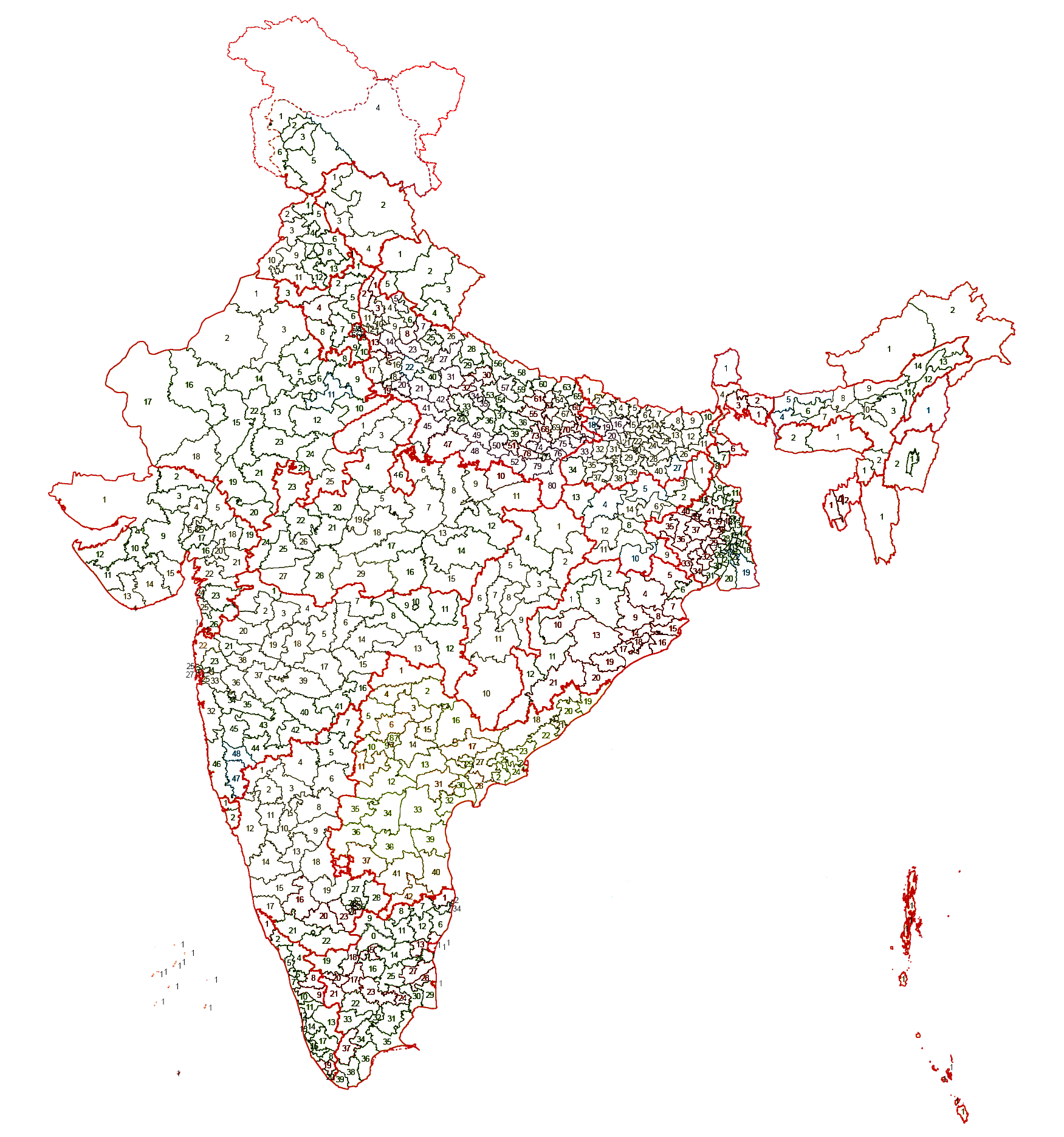
Overlap was the right word, I explained to her. We fished out a map from the net that showed all the 543 Lok Sabha parliamentary constituencies and 4120 state assembly constituencies, and then correlated it to the color-coded assembly constituencies. Each colored patch on the map showed that it had sent one member of parliament to the Lower House and each of them also sent 4-10 MLAs to the respective state assemblies.

Her cousins in Changanassery and Tiruvalla belonged to two separate parliamentary constituencies -  Mavelikkara and Pathanamthitta respectively - but the same electoral units also elected seven MLA each to the Kerala State assembly. Maps from ElectionsInIndia were particularly useful in getting the concept across.

543 Parliamentary Costituencies in India (Image source - Wikipedia Commons)

20 LS constituencies in Kerala (Image: ElectionsInIndia)


This discussion reminded me of an interaction, a few years ago, with a rather notorious MP from northern India. I was working as the Outreach Coordinator to Members of Parliament at the Centre for Policy Research , and had found myself at the home of this MP, responding to his request for inputs on the Nuclear Liability Bill.

This MPs' claim to fame was that he had one of the highest number of charge-sheeted cases in his name. In other words, he was one of the prominent thugs who had deftly gamed the electoral process, had muscled his way into the parliament. For a imposing figure with a piercing stare and an intimidating mien, he had turned out to be surprisingly sharp and genial. He already knew the Nuclear Liability Bill inside out and just wanted to sharpen his arguments with facts and figures, over a table laid out with tea and biscuits.

After our discussion he wanted to know where I was from, and the answer, 'Kerala', led him to his say something interesting. "Not many people understand", he said staring out of the window, "the pressures on an MP. People like me represent more than 3 million citizens, most of whom are illiterate, poor and volatile...It is only when I am seen participating in parliamentary debates that they feel I doing something useful".

The MP had a point. In the age of live TV and Social Media it is not easy to balance the local, ground-level expectations of those who elect you to power, with the broader, national-level perspective you are supposed to have while sitting in the parliament.

------------------------------------------------------------
LINKS

The Election Commission of India - http://eci.nic.in/eci/eci.html

Elections in India - https://www.electionsinindia.com/

Map showing all 543 parliamentary constituencies - https://upload.wikimedia.org/wikipedia/commons/3/3a/Lok_Sabha_constituencies_of_India.png

Wednesday, September 19, 2012

Who was Kihota Hollohan?


At the core of numerous 'landmark judgments' passed by the Supreme Court of India, are individuals who stood up against the system and ended up re-defining the Indian Constitution.

Mr. Inder Golak Nath protested against the Punjab government for delaring his land 'surplus', and fit to be taken over by the state. His legal battle went on for years until the Supreme Court not only ruled in his favor but also decided on 27 Feb., 1967, that the Parliament's power to amend the Constitution could not be used to curtail fundamental rights.

Another landmark case was filed in 1970 by Swami Keshavananda Bharati, head of a monastry (muth) in Kerala. He was objecting against attmempts by the Kerala state government (under land reform acts) to restrict control over the monasty's property. This case too went on to address the much grander issue of the Parliament's power to amend the Constitution. It marked the beginning of something that has been called the "basic structure" of the Constitution which cannot be altered by any government, under any circumstances.

Now we come to Kihota Hollohan. A legal battle between this gentleman and Mr. Zanchillu also resulted in a Supreme Court judgement (1992) that not only has a bearing on how elected representatives behave in the Parliament and Legislative Assemblies, it unwittingly also prevents prevents the legislature from performing one of its principle functions: scrutiny of the executive. It does this through an anti-defection law which rests on the assumption that  'elections are won by political parties rather than persons'.

Whatever be the pros and cons of the anti-defection law, one curious thing about Kihota Hollohan is that there is hardly any information about him or about his opponent, Zanchillu, in the legal tomes that rest in cyberspace. Nothing in Manupatra; nothing in indiankanoon.com .

So far, the only bit of information I could find is that Mr. Hollohan was the Nagaland state minister for social security and welfare, in 2003.

Wonder what was it that Zanchillu did to so upset him...

.........................................................................
REFERENCES

North East Enquirer (7 July 2003) - http://www.nenanews.com/NEE%20July%207%20-%2021,%2003/oh17.htm

Supreme Court of India: Shri Kihota Hollohon vs Mr. Zachilhu And Others on 18 February, 1992 - URL - http://indiankanoon.org/doc/542383/

Scribd: A Case Analysis on Kihota Hollohon - http://www.scribd.com/doc/47535196/Case-Analysis-of-the-Case-of-Kihoto-Hollohon

Khanna, Kartik and Dhvani Shah (2012): ANTI-DEFECTION LAW: A DEATH KNELL FOR PARLIAMENTARY DISSENT? NUJS Law Review 2012; URL - http://www.nujslawreview.org/articles2012vol5no1/kartik-khanna-and-dhvani-shah.pdf