Saturday, February 16, 2019

Ribosomes - Making Sense of Blobology


This is not a book I would ever pick on an impulse. The cover itself  is quite intimidating - a confusing, colorful blob of tangled ribbons. On first glance it looks like a tome for the lab nerds, for those seeped in structural biology, the followers of specialized science journals, and certainly not the general reader.

I picked this book only because on the dark cover, I noticed blurps from three writers I admire - Siddharth Mukherjee, Richard Dawkins and Bill Bryson. The stock comment ' I could not put this book down' from one of them pointed towards the possibility the book could be read - and understood - by folks like me, those who are not specialists but merely curious.

I was not at all disappointed.  The author,Venki Ramakrishnan is the 2009 winner of the Nobel Prize in Chemistry, and his book, "Gene Machine" is a personal story of a physicist turned biologist who helped decipher the secrets of the Ribosome.  Even if the topic sounds esoteric, the book is a down-to-earth narrative of a boy from Baroda who made it big.

Yet it is not the typical story of a south Indian vegetarian in USA. You get the impression of a adventurous, outgoing guy riding a series of lucky breaks. Perhaps the first of these came through a HoD at Baroda-U who got a letter from Ohio University seeking prospective students. Nineteen year old Venki is then offered a graduate scholarship without the usual GRE scores. He lands up in the America in the midst of the anti-war protests of 1971, and immediately after graduation, gets married to Vera Rosenberry, a talented illustrator of children's books, and a single mother.

In the initial chapters, Venki has a nice way of explaining his work with analogies. In the late 70s everybody knew that the ribosomes were responsible for protein synthesis, but nobody knew how -

"Imagine you are a Martian peering at the earth from above. You observe tiny objects on the surface that move mainly in straight lines, ocassionally turning at right angles...you could tell tht they consume hydrocarbons and emit carbon dioxide along with some pollutants and some heat. But you have absolutely no idea what these objects are, let alone how they work. Only by knowing the detailed construction of the object would you be able to see that it is made of hundreds of components that work together and that it has an engine connected to a crankshaft that make the wheels turn..."

Venki's search takes him from the university to his first job with the Oak Ridge National Lab in Tennessee and then to Brookhaven on the East Coast. Along the way, X-ray crystallography becomes the main tool for deciphering the structure of the various complicated components of the ribosome at the MRC Laboratory of Molecular Biology at Cambridge, UK.

The book also helps you catch a glimpse into the petty politics of those engaged in cutting edge science, of the walled garden that is open only to those from 'elite' institutions, and the manner in which the race for a Nobel Prize brings out the worst in many scientists.

--------------------------------------------------------

LINKS

Good Reads - Gene Machine - https://www.goodreads.com/book/show/39088590-gene-machine

Tuesday, February 12, 2019

Crumbs


This is an old print advertisement from the United Nations World Food Programme (WFP). On the bottom corner of this haunting image of people reacing out to the last crumbs on the plate, the fine print simply says, "A little from you can mean a lot. Make a contribution."

I do not know if people actually noticed the illustrations on the rim of this plate, or if the message got them to make a contribution, but I was reminded of this last sunday.

One of our neighbors had set up a shamiana to celebrate Basant Panchami and Saraswati Puja, a festival that marks the arrival of spring. As is the norm, a community kitchen was set up and hot food (puri's, kichri, curries and chutney) was being served as "prasaad", a holy offering.

I had just finished eating the food on my plate when I noticed a Jain neighbor sitting next to me. He was carefully picking out each an every crumb from his plate, leaving it absolutely clean.

Feeling a bit ashamed I started cleaning up my plate too, and asked him what prompted him to eat so carefully. He laughed at the very idea that I found it unusual and said, "According to Jain tradition, wastage of food is considered one of the worst sins...so for us, the first rule is to take only the quantity of food we really need, and then to remember that the holiest prasaad is the last sprinking of water used to clean-up our used plates...even the water used to clean a plate is not be wasted"!

Now that is something to think about...which are the other cultural habits or religious traditions that encourage people from wasting food?

A little from each of us can certainly mean a lot.

------------------------------------------------
LINKS

Why to Jains have strict food habits? -- http://www.jainism.com/blog/why-do-jains-have-strict-food-habits

Jainism - https://en.wikipedia.org/wiki/Jainism

Saturday, February 09, 2019

Prime Lens - Back to Basics


A kit lens makes you lazy. This is the first thing you learn when you step out of your comfort zone in photography.

I have been photographing with an 18-105mm lens for more than 10 years now and thanks to the convenience of zooming in and out, I had all but forgotten the basics of photography. I knew I needed to get back to the basics, to detox, to relearn, and a fixed-focus 'prime lens' seemed the best way forward.

The ones I could afford were shortlisted to the Nikkor 50mm 1.8 lenses which came in two types 'D' and 'G'.  The 'D' was a older version without an inbuilt focusing motor, and it came for less than half the price of the 'G'. Since I was using a camera body that already had a motor the former seemed better value for money - especially when it came at an an extra discount during the recent Amazon Sale.

So last month, I set aside my kit lens for the first time, and twisted into its place a brand new 50mm 1.8D. The Nikon D90 now felt like a strange new animal - lighter, faster and sharper than ever before, and yet completely unfamiliar. Despite clocking nearly 50,000 'shutter actuations' on the D90, I realised that  knew very little about the nuts and bolts, the basics of photography: focal lengths, F-stops and apertures.

They say the 50mm lens shows you the world the way your eyes see it, by "rendering images that closely match the true perspective of the human eye". Sounds nice... but when you look through the 50mm lens for the first time you feel like a horse with blinkers plodding through a tunnel. The world shrinks. Instead of just zooming you now need to use your feet and composition becomes a bit of a struggle.

The 50mm lens is also a bit puzzling with all its numbers and dials packed into a tiny ring. So here is a collection of links that has helped me re-learn photography -


Understanding Exposure and F-Stops:

And just in case you too are weighing the pros and cons of a prime lens, these might help -


Friday, February 08, 2019

Black Sheep and Deccan History

I love the way history is being re-examined and re-written by a new band of writers. Until a few years ago I only knew of William Darlymple as a somebody who could tranform meticulous research into narratives that appealed to a wider audience. I often wished we had Indians writers who could go beyond the colonial period and breathe some life into it.

In this context I was glad to see Sanjeev Sanyal's "Land of Seven Rivers", and Manu Pillai's "Ivory Throne".

My first book this year was the much acclaimed second book by Manu Pillai -  "Rebel Sultans". This one chronicles the deep linkages South India once had with what is now called the Middle East - especially Iran, Iraq and Arabia.


Despite the fact that I grew up in Hyderabad, I knew practically nothing about Deccan history. I was aware of a few names and places,  of the fabulous collections at the Salar Jung Museum, vaguely remembered visiting the Golkonda Fort a couple of times, and often noticed the Falaknuma Palace from the school playgrounds.  But until I read this book I never knew that Nizams who built all this -  the Quli dynasty -  traced its origins to a family that once ruled the Levant - the House of Black Sheep, also known as the Black Sheep Turkmans.

Who were the Black Sheep Turkmans?  It was aparently a title - "Kara Koyunlu" - of a monarchy that ruled over vast areas of present-day Iran, Turkey, Armenia and Azerbaijan from 1394 to 1498. After more than a century of rule this ruling family was ousted by a rival clan known as the House of the White Sheep. Ousting a royal family in the Middle Ages usually meant only two things - death or blinding of all the male heirs. A young boy from the House of Black Sheep ran away to India to escape this fate. He first enlisted as a mercenary in the Deccan Bahmani Sultanate, and then went on to set up his own feifdom at Golkonda in present-day Hyderabad.

The "Rebel Sultans" is also a window into the colorful history of the rest of the Deccan. It tells you how Aurangabad was originally the city of Khirki by an Ethiopian-born military leader named Malik Ambar. It tells you that contrary to popular narratives, the Battle of Talikota was not a war between a Hindu kingdom and a coalition of perfidious Muslim warlords. The kingdom of Vijayanagara which was utterly destroyed after this war had its own share of double-dealings, political miscalculations and hubris.

The book also has many tantalising threads that need to be knitted together. It leaves me with a wish to know more about Timur the Lame, the Turkman raider who later inspired his clansman Babur, to raid India for its riches after having been beaten out of Samarkand. I want to know more about the Kakathiyas who were perhaps the most egalitarian rulers in medieval India, and I need to  have a better understanding of philosophy and preachings of Eknath, who, like Kabir, bridged differences across castes and religions.

--------------------------------------------------------
LINKS

- Amazon - "Rebel Sultans"

Thursday, January 10, 2019

Raqqa


I just finished watching "City of Ghosts", a film about RBSS - a group titled "Raqqa is Being Slaughtered Silently" - that has been resisting the occupation of the Syrian city by the the Islamic State.

Unlike Hollywood war movies, this is not about something that happened in the distant past, coloured in shades of American bravado and machismo. It is the here and now of the situation in Syria. It is the story of how ordinary citizens of Raqqa, a city in Syria rose up in revolt in 2013 against Assad, a leader who they considered a tyrant for 40 years, until the radical Islamic State swiftly came in to fill the power vacuum.

The narrative follows a small group of nervous war refugees - teachers, journalists, students - fleeing from IS and the Syrian government. Seeing the rest of the world disconnected with the harsh reality back home they decide to set up a social network - a website, FaceBook page, Twitter -  to send updates from friends back home on the way in which ISIS was enforcing its vision of the Islamic Caliphate in Raqqa. Summary executions, beheadings, mutilation and rape, all in the name of Allah.

Once the counter-narrative begins to bite, ISIS responds to RBSS by hunting down nd executing its citizen correspondents in Syria, and by trying to assassinate it leaders in Turkey and Germany.

In 2017 the Assad Government finally managed to crush IS in Raqqa after a prolonged battle that reduced much of the city into rubble.

It has no been an entirely happy liberation. RBSS now has to contend with the "old" tyrant whom its founders perhaps opposed in the first place. So it now keep track of the shortcomings of the reconstruction effort, of insufficient funds coming in for rebuilding a city and of disease outbreaks in refugee camps. The devil may be gone but the deep blue sea remains.

This is the sort of film that makes your wonder about the Middle East and the so called "Arab Spring".

Was it really worthwhile to oppose the Assad regime that provided relative security and prosperity to a country for four decades? Has anything been achieved by the countries that encouraged "democratic movements"?  Or has it merely filled their own homes with unwanted refugees from countries they wanted to democratize?


Friday, November 30, 2018

At the Mazar


At first glance, Mazar may not seem like much of a city. From the far distance it looks like a a dusty patch of low buildings set in a large desert plain bordering snow-peaked  mountains. It does not have the teeming crowds of Kabul or the towering pines of Herat, or for that matter any tree-cover worth mentioning.

Yet, to me it turned out to be a city of superlatives: it had the largest and neatest airport  had seen in Afghanistan; the widest roads, tastiest breads, the most amazing array of carpets sold by the sharpest traders, and the loveliest Sufi shrine I have ever seen.


Just as the Italian military has a strong presence in Herat, it is the ISAF German forces that dominate this area. A large base sits right next to the airport with its helicopters hovering in and out, but unlike in Kabul the show of force and dominance is not in your face; it is subtle and understated. Once you step out the airport there are long straight roads lined with numerous gas-stations. 


Apparently this part of northern Afghanistan has been a source of oil and natural gas. Until the Soviet withdrawal in 1989, natural gas produced from the Sheberghan gas fields was exported to the Soviet Union, but also supported the operations of a fertilizer plant, a power station and a textile mill in Mazar-e-Sharif. Remnants of a Russian pipeline can still be seen in the outskirts of the city, along with remains of war munitions - rusted, hollow tanks, APCs and MiG aircraft chassis.

The Mazar of today seems like a flat expanse of mud-walled buildings and wide roads that radiate out from the grand mausoleum that gives this city its name - the Tomb of the Prince, the Shrine of Ali or the Blue Mosque.

It is a lovely, sprawling complex that gives you an immense sense of space. You step off the crowded streets into a garden complex that leads you through large gates, into a vast expanse of marble tiled courtyard.  

Looking around the bustling market that surrounds the Mazar it is difficult to imagine how, until just a few years ago, this city had been witness to brutal cycles of violence. Today there is a sense of foreboding that the Taliban may sweep in to fill in the power vacuum, once again.

For now you can walk around the cold marble floors of the Blue Mosque, walk around the sanctum filled with incense, and pray that this bustling city with it cheerful people is not sucked into yet another round of senseless violence.

-------------------------------------------------------------------
LINKS:

* Gas Pipeline (2013) - http://mom.gov.af/en/news/20123
* A brief history of natural gas in Afghanistan - http://mom.gov.af/en/page/4750
* Mazar-e-Sharif International Airport - http://www.germancooperation-afghanistan.de/sites/default/files/2017-Airport-EN.pdf


Friday, November 09, 2018

Herat - City of Spires and Pines


Ancient cities have a life of their own. We read stories about them and build a certain picture in our imagination. Ground realities however turn out to be something else.

Herat is no different. To a visitor coming from Kabul it gives you a glimpse of what cities in Afghanistan could be. Relaxed, dignified, and aware of its own stature and place in history at the crossroads of civilizations.

This was once a city of fire-worshipping Zoroastrians, an area famous for its great wines until the Arabs took over after 650AD. Here ruled the Macedonians led by Alexander, the Turks, Chinese, Mongols and, of course, the Persians. It was also one of the few cities of the Islamic world to be ruled for an extended period by a woman- Queen Gawhershad - remembered today as the builder of the grand towers of the Musalla Complex.

In present day Herat, the first thing that struck me is the pine trees. Almost all the roads are lined with towering old pines. Having seen these trees only above the "pine-line" in the Himlayas, I always thought they needed steep slopes to grow big and strong, so it was bit surprising to see them all lined up in a city that was as flat as a chappati

Unlike Kabul which is sectioned by 2000m high 'hills', and urban settlements that have grown along a meandering river, Herat has a clear grid-like layout. A straight road brings you from the airport, right into the city centre. The security footprint here is more subtle - fewer warplanes in the airport, hardly any buildings barricaded  with T-walls and barbed wire. There are no military blimps watching you from the skies or  helicopters constantly buzzing overhead, rattling the window-panes.

The streets and markets are bustling with men and women. Fruits seem larger, jucier and more colorful; the saboos naan a lot tastier; streets are less cluttered and far less dustier, the air crisp and clean. Children crowd around street vendors; strange looking, colorful three-wheelers fashioned out of motorcycles trundle on the streets, looking as though they are going to take off any minute into the skies.


And yet you are constantly reminded that this city is not peaceful as it looks. Violence and robbery on the streets is not rare. A colleague was recently coming out of a restaurant, chatting on his mobile when a car stopped in front of him. He thought the driver needed directions, until he saw a pistol aimed at his head. Within seconds, his mobile was snatched, his purse taken out of his pocket and car was gone.

Things may not be what they seem, but I would like to think that the people of Herat hold one of the keys to peace and prosperity in this war-torn country.


Friday, November 02, 2018

The Hindukush


"When we were children we used to play here and drink water straight from the river - it was so clean!"

The best years of Kabul are often described in past-tense. People talk of the glory days of the kings, of a city that was once a hub of trade and commerce across Asia, of dogged resistance to 'foreign invaders' who could never ever conquer Afghanistan..

The elderly in Kabul have happy memories of the city in the 1950s - those wonderful days when water was clean, when the country was peaceful and winters were what they ought to be - freezing cold. It is amazing to think that this country, proud its aversion to foreign invaders, was also the home of invaders who left an indelible mark on the history of Northern India.

Driven by the zeal of a new religion, Mahmud of Gazni was the first plunderer to make a career out of invading infidels in India. He systematically raided and plundered kingdoms in east of the Indus river to west of Yamuna river, no less than seventeen times between CE 997 and 1030. After a brief pause of two centuries, another ruler emerged from Ghor, nested in the Hindukush mountains. The Ghurid empire led by Mu'izz al-Din was influential in creating the Delhi Sultanate.

Then came Timur-the-lame and his army as they crossed the Hindkush range, to launch the 1398 invasion of northern Indian subcontinent, plundering and killing all the way. Such was the number of slaves who were forced to cross the freezing cold of the Afghan mountains that Ibn Battutta refers to them as the "Killer of Hindus", or Hindukush.


Inspired by stories of Timur, one of his descendants, Zahir-ud-din Mohammed - aka Babur ('tiger') - decided to follow suit. As a young man of 21 years, he had taken control of Kabul in 1504. Having failed time and again to regain control over the Ferghana Valley, he turned his attention south-eastwards. In 1526, he made his move into north India, won the Battle of Panipat, ending the last Delhi Sultanate dynasty, and starting the era of the Mughals.

The slave trading operations continued during the Delhi Sultanate and through the Mughal era. It became a standard practicee to send thousands of slaves every year to Central Asia to pay for horses and other goods.

Looking at the condition of Afghanistan today you wonder... after all those centuries of plunder and flogging of slaves across the Hindukush: Where has all the loot gone? 


Friday, October 19, 2018

Afghanistan - An Election of Independents


Tomorrow is Election Day in Afghanistan. 

This is going to be the culmination of a long process of institution building in one of the most trying circumstances. It has a process that has also seen the creation of an independent election commission to oversee a process to bring in 249 representatives from 34 provinces to the Lower House of the Afghan Parliament.

Last week when I landed at Kabul the city presented a familiar, festive sight - colorful stickers, posters, placards and banners filled every possible public space. Posters carried unique logos and numbers, and it took me a while to realise that most of the prospective Members of Parliament were competing as independent candidates. 

According to a WaPo report, there are 2,565 candidates vying for 249 seats, including 417 women candidates. The IEC aims to set up more than 19,000 polling stations in 33 provinces. Out of Afghanistan's estimated total population of 30 million, 8.8 million people have registered to vote. Kabul city alone has more thans 800 candidates competing for 33 seats! 
An overview from AFP

Unlike in India, the system here is that of a single non-transferable vote valid in one constituency. Each voter casts just one vote for one candidate in a multi-candidate race. Posts are filled by the candidates with the most votes, and so in this case, candiates who get the maximum number of votes get to become MPs. 

Voters in cities like Kabul would be extra careful tomorrow - they would have to sift through a ballot 'paper' that looks more like a newspaper centrespread, and choose one candidate out of hundreds.

While most of the posters feature men in sharp suits or in traditional attire, it is interesting to note that there are a significant number of women candidates in the fray. This is not surprising given the fact that the Afghan constitution guarantees 68 seats - or 27% of the total - for women MPs, regardless of their vote share.

A lot of hopes and aspirations are hinged on this elections process, and everybody hopes that it passes off peacefully.


--------------------------------------------
LINKS & REFERENCES

The Independent Election Commission (IEC) of Afghanistan- http://www.iec.org.af/

Report by Washington Post - https://www.washingtonpost.com/world/asia_pacific/a-look-at-afghanistans-parliamentary-elections-on-saturday/2018/10/19/354e4b0c-d367-11e8-a4db-184311d27129_story.html?noredirect=on&utm_term=.ff58f1765639

BBC - https://www.bbc.com/news/world-asia-45836521

https://www.washingtonpost.com/world/asia_pacific/the-taliban-has-vowed-to-disrupt-the-afghan-elections-candidates-are-out-in-force-anyway/2018/10/16/d57bf1a4-ccf7-11e8-ad0a-0e01efba3cc1_story.html?utm_term=.9e059fd98606

Saturday, October 06, 2018

Apostille of Fake Degrees


Last week I signed up for a UN assignment in Afghanistan. It was the culmination of a long drawn out selection process - online applications, verification of credentials and interviews. I need to be in Kabul for two months for the independent evaluation of an FAO project.

Having visited, worked and stayed in a few countries over the past 23 years, I thought I was familiar with the formalities involved in international travel. In this case, instructions from FAO were quite clear: "Approach Embassy with all relevant documents - Passport, photographs, degree certificate photocopy and original , signed contract document, MOFA reference number. Ticket is not necessary for visa".  

At the Afghan Embassy visa counter however, the officer flipped through my documents and asked me a question that left me quite stunned. "How do we know", she asked with genuine concern, "That your degree certificates are not fake?"

I tried telling her that, in the first place, I would not be selected by the UN for an assignment if I had fake degrees. I had two Master's degrees - the first from IRMA and the other from Tsukuba University, Japan. Both could easily be verified online on the official alumni pages. Also, I had got the second degree on a full scholarship from the World Bank - a fact that could be easily verified on a Google search since my entire Master's thesis was available online. 

The visa officer was unmoved. "Rules are rules", she insisted, "If your highest degree is from Japan, it has to be endorsed by the Japanese Embassy in India. All Indian degrees have to be verified by the Indian Ministry of External Affairs (MEA)". She also added helpfully that applicants got it done at Patiala Courts where extra fees was charged for 'fast service'.

One of the lessons I had learnt is that there is no point arguing with with a Visa Officer. I walked out of the Afghan Embassy, crossed the road, and checked at the Embassy of Japan. They did not have any facility for "endorsing" certificates from Japanese universities. All they could do was to check with their registry and give me a letter saying that the university seal was genuine. This process would take at least three working days, and cost Rs. 2300. 

What next? I had no idea that MEA had anything to do with certification of education documents. Outside the Japanese Embassy, I set my files on a concrete blast-barrier and googled "India MEA education certificate endorsement". I got this page and learnt a new word: apostille.

It was a two-step procedure. First, the degree certificate had to be endorsed by a state government authority, and under Step-2 "MEA legalises the documents on the basis of the signature of the designated...authorities. Hence it does not take responsibility of the contents of the documents". MEA charged Rs.50 per document for this service. As expected, there was no mention of the time-frame involved.

Strapped for time, I now headed towards Patiala House Courts Complex, into the den of brokers, middlemen and lawyers dressed in 50 shades of black. In one of the many hole-in-the-wall offices, I presented by predicament to one of the broker-lawyers.  He feigned deep concern, quickly gauged my desperation level, and quoted his fees: Rs. 3000. 

So, for a government service worth Rs.50, I had to shell out Rs. 3000. Within this margin lies the thriving new economy of the apostilles. An education certificate from IRMA, an automomous education institution in Gujarat, is endorsed by a Sub-Divisional Magistrate in another state, Delhi, who proclaims it as genuine. Based on this, MEA legalises it 'without taking any responsibility of the contents of the documents'.


Come to think of it, this is a racket no different from that of the Public Notaries who blindly attest any document with a Government of India seal. The only difference is that you get a fancy sticker with a flurry of seals and signatures behind an education certificate.

Why would any Embassy encourage this kind of daylight robbery? Is this merely the game of passing-the-buck between bureaucrats of different countries?  A friend who has worked in Afghanistan for over a decade said this rule was introduced in 2013 to avoid fake people with fake degrees from getting posh jobs in Afghanistan. It seems there are many such guys already in the country.  Also, it seems Afghan nationals too have been using fake certificates to enter the job market. He also added that brokers charged anything from Rs. 5,000 to Rs. 10,000 for a one-day service.

The latter was confirmed by a lawyer at Patiala Courts. There are thousands of Afghans studying in India, and it seems their government does not accept any education certificate from India unless it is attested by by MEA and the Ministry of Human Resources Development (MHRD)! 

No wonder the brokers at Patiala Courts are laughing all the way to the bank.

------------------------------------------------------------
REFERENCES & LINKS


* Afghan Embassy - Visa Rules - http://newdelhi.mfa.af/consular-services-4/visa/visa-information-indians/working-entry-visa-wev

* MEA, India - Procedure for Attestation of Education Degrees - https://www.mea.gov.in/apostille.htm

Apostille Convention - https://en.wikipedia.org/wiki/Apostille_Convention

Tuesday, October 02, 2018

Oil Wars


It takes humor to make truth palatable.

What is it that actually triggered the first World War? What lies behind USAs grand plans to "bring Democracy to the Middle East"?

Robert Newman uses the stand-up comedian's routine to teach us a thing or two about history and realpolitik.

Clearly worth 45 minutes of your time.

----------------------------------------------------------
Books Mentioned:

* Knight, Ian (1999): MARCHING TO THE DRUMS - https://www.amazon.com/Marching-Drums-Eyewitness-Accounts-Massacre/dp/1853673722

* Heinberg, Richard (): THE PARTY'S OVER - Oi, War and the Fate of Industrial Societies - https://www.amazon.com/Partys-Over-Fate-Industrial-Societies/dp/0865715297

* Brow, Lester (): WHO WILL FEED CHINA? -- https://www.amazon.com/Who-Will-Feed-China-Environmental/dp/039331409X

Friday, September 07, 2018

ERR_INTERNET_DISCONNECTED

Sitting in our metro cities it is difficult to imagine a world of alternate realities. The internet and our access to it, is perhaps one such world. One where screens suddenly blank out and you end up with a digi-dinosaur hopping over cactus.

At a panel discussion organised by the Indian Express yesterday, a group of experts sat on the stage to discuss what seemed like a rather vague and tenuous topic - "Is Internet Shutdown a New Order for Law and Order"? The fact that this event - IE Thinc - was sponsored by Facebook made me all the more skeptical about its relevance. 

The panel had an interesting mix:  a young bureaucrat responsible for an internet shutdown at Ranchi; a representative from the Intenet Freedom Foundation, one from the Cellular Operators Association of India (COAI), and an economist. Except for the last one, who seemed long winded and disconnected like most economists, the other three made sense. 

I was surprised to know that the Government of India is very secretive about sharing data on internet shutdowns. Data accessed from other sources (mainly UN) indicate that there have been at least 254 shutdowns in 19 states during the period 2012-2018. 

While the initial intent of many had been to prevent riots and loss of lives from the the rumours spread on Facebook, Whatsapp etc., internet shutdowns were now being implemented for reasons that could only be described as flippant and irresponsible. In the most recent case, in Udaipur, Rajasthan, the internet was shut down for a few days to prevent cheating in a government recruitment exam!

Considering how internet shutdowns affected the lives of millions of citizens - loss of business, access to basic services, education, payments and so on - what was the legal basis for such disruptions? Here are some of the laws/rules enumerated:

  • Article 19(2) - places "Reasonable restrictions" on freedom
  • Section 144 CPC - "Unlawful Assembly" -- used against freedom fighters during freedom struggle to confiscate Gandhi Caps, now used to shut down the net.
  • Rules for Temporary Suspension of Telecom Services, 2017 -- just requires an SP+ officer to issue order
  • Section 95 CPC - banning of books
  • Section 6.2 of Telegraph Act - used for phone/network tapping

I am glad I decided to attend this event. If not anything else, it was a sobering reminder that it takes very little to turn the smartphone in our hands into a useless lump of plastic and metal.

------------------------------------------------------------------
LINKS:

- Rules for suspension of telecom services, 2017 - http://www.dot.gov.in/circulars/temporary-suspension-telecom-services-public-emergency-or-public-safety-rules-2017
- Internet Freedom Foundation - https://internetfreedom.in/
- Report on IE event -7 Sept., 2018 - https://www.financialexpress.com/industry/iethinc-debates-implications-of-internet-shutdowns/1305181/

Saturday, August 25, 2018

On Electoral Constituencies

"What are electoral constituencies?", asked my daughter today.

She had in her hand a copy of the Class IX Social Sciences textbook and seemed completely lost. The whole country seemed to be divided into consituencies - panchayat, assembly, Lok Sabha - and the term seemed to have overlapping meanings.

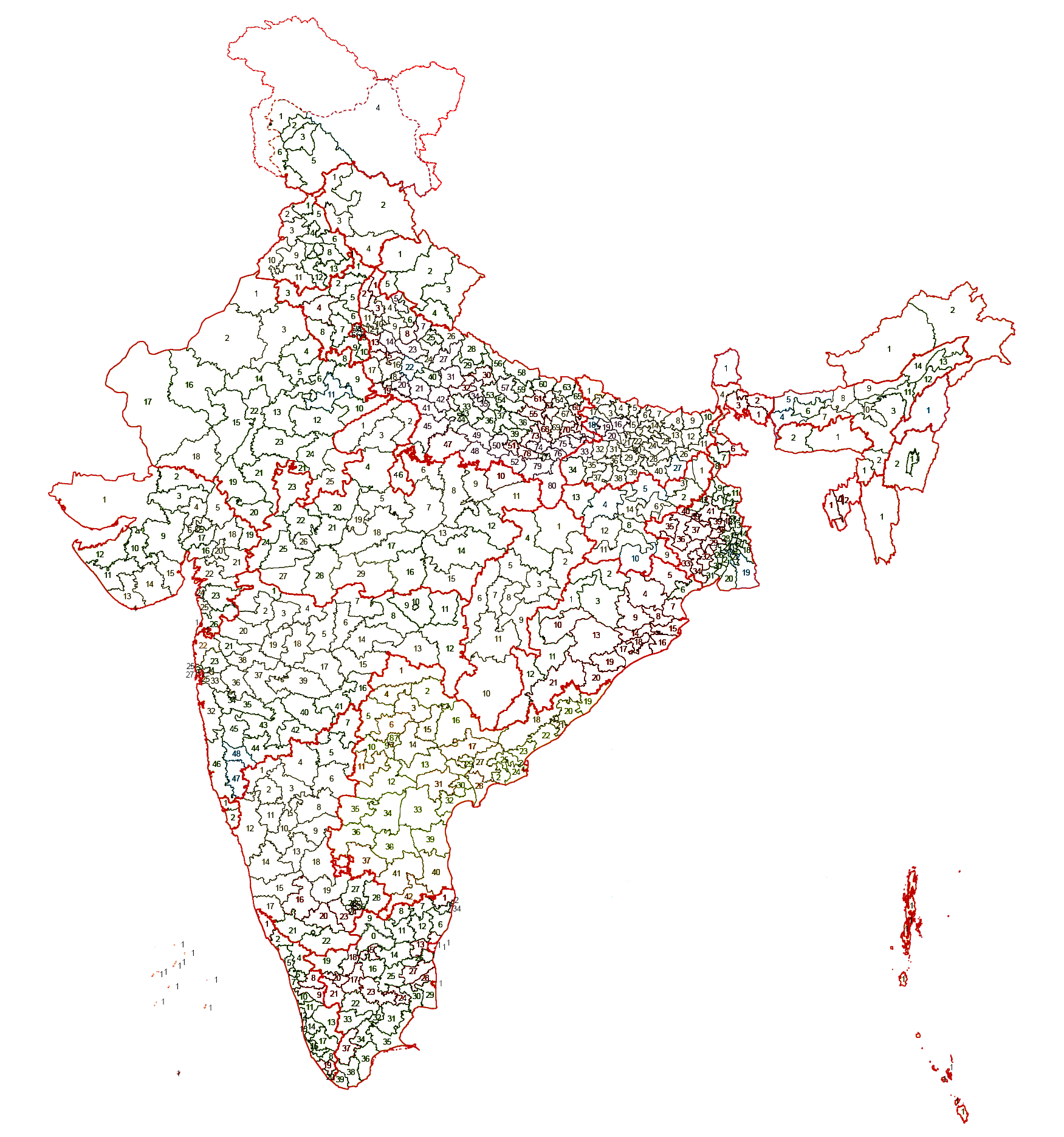
Overlap was the right word, I explained to her. We fished out a map from the net that showed all the 543 Lok Sabha parliamentary constituencies and 4120 state assembly constituencies, and then correlated it to the color-coded assembly constituencies. Each colored patch on the map showed that it had sent one member of parliament to the Lower House and each of them also sent 4-10 MLAs to the respective state assemblies.

Her cousins in Changanassery and Tiruvalla belonged to two separate parliamentary constituencies -  Mavelikkara and Pathanamthitta respectively - but the same electoral units also elected seven MLA each to the Kerala State assembly. Maps from ElectionsInIndia were particularly useful in getting the concept across.

543 Parliamentary Costituencies in India (Image source - Wikipedia Commons)

20 LS constituencies in Kerala (Image: ElectionsInIndia)


This discussion reminded me of an interaction, a few years ago, with a rather notorious MP from northern India. I was working as the Outreach Coordinator to Members of Parliament at the Centre for Policy Research , and had found myself at the home of this MP, responding to his request for inputs on the Nuclear Liability Bill.

This MPs' claim to fame was that he had one of the highest number of charge-sheeted cases in his name. In other words, he was one of the prominent thugs who had deftly gamed the electoral process, had muscled his way into the parliament. For a imposing figure with a piercing stare and an intimidating mien, he had turned out to be surprisingly sharp and genial. He already knew the Nuclear Liability Bill inside out and just wanted to sharpen his arguments with facts and figures, over a table laid out with tea and biscuits.

After our discussion he wanted to know where I was from, and the answer, 'Kerala', led him to his say something interesting. "Not many people understand", he said staring out of the window, "the pressures on an MP. People like me represent more than 3 million citizens, most of whom are illiterate, poor and volatile...It is only when I am seen participating in parliamentary debates that they feel I doing something useful".

The MP had a point. In the age of live TV and Social Media it is not easy to balance the local, ground-level expectations of those who elect you to power, with the broader, national-level perspective you are supposed to have while sitting in the parliament.

------------------------------------------------------------
LINKS

The Election Commission of India - http://eci.nic.in/eci/eci.html

Elections in India - https://www.electionsinindia.com/

Map showing all 543 parliamentary constituencies - https://upload.wikimedia.org/wikipedia/commons/3/3a/Lok_Sabha_constituencies_of_India.png

Friday, July 13, 2018

On Dogs Lovers and Power Illiteracy


Stray dogs protecting their turf (Pic source: DNA 14Dec17)

I have always found it difficult to understand the dynamics and the power of "Noble Intentions". How is it that when two sets of well meaning people, both trying in their own way to create a better society, end up making it more dysfunctonal?

Let me illustrate this with an example: stray dogs in our cities. 

Most people are wary of stray dogs, and see them as a threat, and a health hazard, while there is another set of folks, the 'Dog Lovers' who see nothing wrong in having stray dogs share our roads, parks and public spaces. If anybody gets bitten it is because they 'provoked' the dog, and therefore deserved what they got. 

Does their love for dogs extend to other animals as well? Not quite. Nobody would raise a finger, let alone filing a police case, if a harmless rat snake was beaten to pulp, or if pigs drowned in the sewers. But dogs? They are a 'man's best friend', and therefore, special.

Quite unlike the folks who get bitten on the streets, the Dog Lovers are superbly networked, and well organised. They are loud and vocal; they have the ready attention of not only the local newsreporters but also the sympathies of the Supreme Court. So when they take up cudgels on behalf of the strays, filing police reports against those who are violent towards stray dogs, naming and shaming people, all that the opposition can do is to roll over, and play dead.

How did the Dog Lovers come to weild so much power and influence? Why does our overstretched police force take on the unikely role of protecting stray dogs? The answer is simple: the law requires them to do so. 

As per Indian law, street dogs cannot be beaten, killed or driven away or displaced or dislocated. Under the Animal Birth Control (ABC Dogs) Rules, 2001  enacted under Section 38 of the Indian Prevention of Cruelty to Animals Act 1960 (A Central Act), stray dogs can only be sterilized, vaccinated, and then returned back to their original locations. 

What happens when the state ABC department does not have the capacity (funds, personnel, infrastructure) to deal with an explosion in the population of stray dogs? Nobody seems to know, or care.

In NOIDA along there are an estimated 13,600 stray dogs. A few months ago, a child got severely mauled by a pack of stray dogs . When alarmed citizens got together to drive away strays and ended by beating a stray dog to death, police cases were promptly filed against them. So, at present, the very thought of messing with the Indian legal system, with its backlog of cases, is enough to deter any sensible citizen from messing with stray dogs. It is better to get bitten than to get stuck in the Indian courts.

How did a small band of Dog Lovers manage have such a disproportionate influence on the law of the land? A part of the answer lies in what has been articulated so well in Eric Liu's TED Talk - "Why Ordinary People Need to Understand Power"


Liu rightly points out that power illiteracy all pervasive and that citizens have depressingly low levels of civic knowledge, civic engagement, participation, and awareness. They are naive about all the forms of power that are at play: money, people, ideas, information, misinformation, the threat of force, the force of norms.

Those few who do understand how power operates in civic life, those who understand how a bill becomes a law, how a friendship becomes a subsidy, or how a bias becomes a policy, or how a slogan becomes a movement, the people who understand those things wield disproportionate influence.

Clearly, Dog Lovers in India belong to the power literate elite who weild a disproportionate influence in our cities. In many ways they themselves are like the proverbial dog in the manger - they will not ease the burden on state ABC departments, nor will they stop barking at those who act against stray dogs.

------------------------------------------
BTW

Kerala, seems to be among the few states where stray dogs do not enjoy a special status. It has citizens groups that actively participate in anti-stray dog campaigns and support the culling of strays. Across India, only the High Courts of Kerala and Karnataka have taken the position that local municipal laws prevail over the PCA ActIt is not a state of affairs that pleases the stray-dog lovers.

Thanks to this awkward state of semi-rebellion the state sees a lot of parodies centered around the helplessness of the civil society. In this one, a local alpha stray-dog, "Tiger Sabu" is being interviewed by a nervous TV news anchor, a few days after demonetization: 


------------------------------------------
REFERENCES & LINKS

* Jaagruti - Indian street dogs and their rights - https://jaagruti.org/information-to-empower-you/indian-street-dogs-and-their-rights/
* Noida - child mauled by stray dogs - https://timesofindia.indiatimes.com/city/noida/child-mauled-by-stray-dogs-in-greater-noida/articleshow/59198467.cms
* Animal Welfare Board of India - https://awbi.org/
* (4 Jan 2018) Hindu: Stray dog victim still in ICU - http://www.thehindu.com/news/cities/Delhi/stray-dog-attack-victim-still-in-icu/article22362867.ece
* (1 Apr 2018) ToI: Noida: Residents, security guards booked for thrashing stray dog to death- https://timesofindia.indiatimes.com/city/noida/noida-residents-guards-booked-for-thrashing-stray-dog-to-death/articleshow/63565399.cms
http://www.dnaindia.com/delhi/report-plaints-on-noida-s-stray-dog-menace-fall-on-deaf-ears-2567534
Eric Liu's TED Talk - "Why Ordinary People Need to Understand Power" -  https://www.ted.com/talks/eric_liu_why_ordinary_people_need_to_understand_power

Monday, July 09, 2018

Digital Media and its Echo Chambers


The Japanese have a phrase to describe Indians - インド人 "Oshaberi Indo-jin", which translates politely into 'Chattering Indians'. A term reserved for insensitive folks who talk for the sake of talking, without consideration to others.

Nowhere is this more painful than at public lectures, seminars, workshops and conferences. At international events, it is often a nightmare for the organisers that unfolds at three levels: First, the embarassment about key speakers not arriving on time, leading to announcements that the event is delayed because so-and-so got held-up at an "important meeting"; Once the meeting starts, it is about speakers who ignore the clock and carry on blaberring, ignoring frantic signals to cease, and finally, the pain of enduring a Q&A session. Here again the organisers plead for short, pointed questions from the audience, and what they get instead is long speeches from folks who refuse to let go of the mikes.

Last Friday, I participated for the first time, in a seminar where the organisers tried a novel way of dealing with the Q&A problem. This was an event organised jointly by IIC, CPR and the Niti Aayog called Metamorphoses - part of series that calls itself "a modest effort to try and bridge the gap between digital technologies, which are transforming our lives, and our understanding of their multiple dimensions".


Despite the absence of one of the main speakers, the event started more or less on time. As expected, the event had its panel of heavyweights on stage: the Principal Scientific Advisor to the Prime Minister, along with representatives from Twitter, the Silicon Valley, and think tanks. The format for Q&A came with a digital twist. 

A slip of paper placed on each chair in the hall had a certain number to which you had to send an SMS, if you had a question for any of the panelists. A representative from IIC/CPR would then choose from the messages received, and convey selected questions, to the panelists on stage.

Much like the Twitter algorithm discussed in the seminar, this Q&A format created an echo chamber in which the panel received only sanitised, insipid questions that gave an illusion of public engagement. The organisers may have suceeded in sticking to timelines while nipping out presky mike-grabbers and their long-winded questions, and but it also robbed the event of its human touch. A podcast may have served their purpose just as well.


SMSs at the Q&A Session@IIC, New Delhi


After this event, I now have a greater appreciation for the "Explained" events organised by the Indian Express. It starts with a public advertisement in a newspaper (not a mere mailing list), attracts SMS confirmations from a fairly broad spectrum of the public (not just retired bureaucrats), and their Q&A sessions are orderly without being overbearing. 

It also helps to have an alert moderator on stage, who also directs a team that passes wireless mikes to the audience. Since the norms are enforced with an even hand, the post-event discussions turn out to be lively and spirited, giving you a much deeper understanding of the issues discussed. 

When it comes to organising real public engagements, perhaps it is time IIC, CPR and Niti Aayog learned a thing or two from folks at the Indian Express. We could all then step out of our echo chamber's and have a discussion that is really worthwhile.

-----------------------------------------------------------
LINKS:

* Centre for Policy Research and its Metamorphoses - https://metamorphoses.in/
* Explained by the Indian Express - https://indianexpress.com/section/explained/


Thursday, June 28, 2018

A Tale of Two Retailers

A 3in1 phone-lens at Miniso - solid Value for Money

"Oh, Miniso?", said the sales-person at Muji, "You could call them our 'poor cousins'. Our prices are higher because we sell high quality products".

We have all heard this quality spiel before. Every fruit vendor in Delhi uses that line to sell his wares. At Muji, apart from sounding contrived and utterly unconvincing, it also presumes that the Indian customer is a fool.

Miniso and Muji are two retail brands with a lot in common. Both proclaim their Japanese pedegree in design aesthetics and quality while getting most of their products manufactured in China; both have 'affordable quality' as their USP, and both represent the changing face of Japanese FDI in India which is trying to diversify from its hitherto narrow focus on the automobile sector.

In their approach to the Indian market, however, Muji and Miniso could not be more different. 


Muji @DLF Mall of India, NOIDA

Muji is a company that started in the early 1980s in Japan. It is 
positioned as a "reasonably priced" brand, keeping the retail prices of its 'no-brand' products "lower than usual" by the materials it selected, streamlining its manufacturing processes, and minimising packaging. However, in India, it has chosen to tie-up with the Reliance conglomerate and positioned itself as an upmarket brand. 

Miniso, on the other hand, is a relatively young company, started in 2011 by Miyake Junya, a Japanese designer, and a Chinese entrepreneur, Ye Guofo. Unlike Muji, its sells quality products at prices that are actually reasonable by Indian standards.


The difference between the two retailers is quite telling at the DLF Mall of India, in NOIDA. Here, Muji has take up a large space on the first floor ('International Boulevard') while the Miniso outlet is about a fourth in size on the lower ground floor, at the same level as other budget shops, BigBazaar and Store99. While the Muji store exudes a lavish sense of space and luxury, Miniso is cramped with overflowing shelves and narrow aisles. 

Perhaps the biggest difference is that while Miniso is full of customers stuffing their baskets and lining up at the payment counters, Muji remains desolate in comparison. A handful of people saunter in as though they are visiting a museum, and most of them walk out without making a purchase.


Miniso @ Mall of India, NOIDA
What expains this difference? The price-tag could be one. In India, Muji's products have drifted far from their motto of being "reasonably priced". Most of the products in fact come with a two price-tags, and, amazingly, the Japanese JPY price is less than the equivalent INR price! For instance, a simple ruler carries a Japan price of JPY150 (INR93)and its India price is INR150! 

It is when I asked the Muji guys about this that I got the Miniso-is-our-poor-cousin comment. When I ask them about the rush in Miniso stores compared to Muji, their answer was - "Oh, that must be because this is NOIDA, where people cannot afford Muji quality!". 

Having lived in Japan for two years, and interacted with the impeccably polite and tactful staff at Muji stores at Tokyo and Tsukuba, one thing is certain: For all the investments they are making in India, staff training in India is far below Muji standards.

This summer, while Muji tries to weave a snooty cocoon for itself and attempts to attract customers with "upto 50% discount", Miniso, the 'poor cousin', has already expanded to 19 stores in NCR Delhi alone, and is laughing all the way to the bank.

------------------------------------------------------
LINKS & REFERENCES

* (2017) - How Miniso became a mega success - http://knowledge.ckgsb.edu.cn/2017/05/31/c-suite-interview/miniso-mega-success-interview-ye-guofu/

* (2017) ET - Japan's investments in India is getting diverse - https://economictimes.indiatimes.com/news/economy/finance/japans-investments-in-india-getting-diverse/articleshow/58863341.cms