Sunday, May 22, 2022

Trek to Indrahar Jot

It had been more than two years since Covid-19 scuttled my annual treks into the Himalayas. So when a friend set up a new WA group titled, "Ab-ki-baar-Indrahar" (This time, Indrahar), the first thing I did was to look up the place on Google Maps. 

At an altitude of 4342m it did not seem like a big deal. After all, our last trek was to Kugti Pass on the Pir Panjal Range at 5050m. Indrahar Jot is further south within the Dhauladhar range, the first snowbound mountain ranges that you see as you approach the Himalayas from the  Punjab plains. I had imagined this to be be an easy trek. It was not.

This trek was a reminder - if any were needed - that each mountain range has its own personality and quirks. The most striking thing about this trail is that despite being located in an area that receives good rainfall, there are no natural streams along the entire route. Water is available for free at only one point near the snow-line, and that too from a PVC pipe carrying glacier meltwater!


Our trail started from Gallu Temple, just a few kilometres away from Mcleodganj, the home of the Dalai Lama and the Tibetan Government-in-exile. A few hours of walking through forest trails carpeted with rhododendron leaves brought us to the barren Triund ridge. Until this point you could see plenty of casual touristy visitors dressed in summer clothes, many accompanied by children, and a few with their jarring bluetooth speakers in full blast.

At this time of the year, mornings are nice and bright in Triund but the weather turns foul in the afternoon. Mountain peaks that are clearly visible in the morning light get enveloped in heavy clouds by noon. We did not know that the weather would change so suddenly, and so ended up losing half-a-day on this ridge, huddled in a stone cottage, sheltering from howling winds, hailstones and stinging raindrops sweeping down from the slopes of the Dhauladhar mountains.


Few venture beyond Triund to Laka glacier or Lahesh Cave, and even fewer go further on to Indrahar Jot, the pass located close to Moonpeak. We pitched our tents near the Snowline near the Laka glacier, removed non-essential stuff from our backpacks and carried on across the glacier towards the rocky steep slopes leading to the pass. Climbing is difficult on this stretch and descending even more so - especially when the stones turn slippery from fresh rain and sleet. 

One important thing to remember on this trail, apart from the dearth of spring-water, is that the climbing window here is rather small. We missed half a day stuck at Triund, so even though we started before 0600 and pitched our tents at Snowline by 0730 it was already past 0830 when we started the final leg. This was about three hours too late because by the time we reached close to the pass it was already past 1330 and heavy clouds were blocking the path ahead. Not wanting to get stuck in blinding fog and rain, we had to turn back about 500m away from the ridge. 


Perhaps the most memorable thing about treks like these are the amazing people you get to meet along the way. On our way to Triund we met Mr. A who was climbing on a prosthetic leg; At Snowline there were two cheerful 65+ year's old German ladies, both avid trekkers on their way back home to Auroville after spending a week in the mountains. Then there was Nitin Vashisht a sprightly young fellow from Dharamsala who cheerfully sped past us at Snowline, climbed up alone to the top of Indrahar, right through the cloud cover, and  met us a few hours later on his way back when we were still resting at Lehesh Cave!

The most unexpected meeting was with Santosh Babu, a Tamilian working as a government Revenue Inspector in Chennai who also served as a part-time instructor with the Bharat Scouts and Guides. A compulsive mountaineer, he had trained himself at the IISM Gulmarg and set aside two months every year to climb mountains. He had already crossed the Hanta Pass and Keliheni Pass. This year, Babu has set his sights on the Moonpeak (4750m), the highest point up the Indrahar Jot ridge. In 2023 he planned to scale the Manaslu in Nepal, and then hoped to get a sponsorship of about INR 3,000,000 required to climb Mt. Everest!

It is hard to believe that just a few days ago I was trudging across a Himalayan glacier, sweating from the strain, struggling to catch my breath...and here I am now, back on the hot, sultry plains, sitting in an apartment in Noida, and sweating profusely without doing anything! 

-------------------------------------------------------------

REFERENCES / LINKS

* India Hikes - Indrahar Pass Trek -  https://indiahikes.com/documented-trek/indrahar-pass-trek

* Wiki page - https://en.wikipedia.org/wiki/Indrahar_Pass


Thursday, April 28, 2022

Vatapi Ganapati


"Vatapi Ganapati" is a much loved composition in Carnatic Music, one of the two branches of classical music in India. Composed by the great poet-composer Mutthuswami Dixitar (1775-1885), it is a hymn praising a specific idol of Ganapati,  worshipped in a small shrine in Tiruchenkattankudi Utrapatishwaraswamy Temple, in Thiruvarur district in the Tamil Nadu state of India.

The name of this place may seem long and complicated to those who are unfamiliar with South Indian languages, but so is the distance covered by this Ganapati. Vatapi (present day Badami), is a place located about 1000 km away from this coastal town. According to the g-maps, it would take a brisk walker about 190 hours or a week to cover this distance. 

How did a temple idol get its name from a place so far away? 


Anirudh Kanisetti's answers this question (and many others) through his fascinating new book titled, "Lords of the Deccan". For the vast majority of us who had been brought up on passing references in our history books to this part of this country, Kanisetti's book is a revelation, an eye-opener to the array of kingdoms that had ruled this vast area in central India from 500 to 1200 CE. 

Is is the story of the powerful dynasties that ruled this part of the country before the Islamic invasions - the Chalukyas, Pallavas, Rashtrskutas, and the Cholas. It is also a rather sad commentary on the shortage of written records that tells us about the life and times of those who built some of the massive temples of South India. Among these is the Kailashnatha temple at Ellora that was 'built' top-down by cutting through solid rock on a cliffside, after carefully chipping away more than 200,000 tonnes of granite stone!

Coming back to the story of Vatapi Ganapathi, it turns out that this idol was actually war booty that was brought here more than 1300 years earlier by the Pallava kings of Kanchipuram.  Tiruchenkattankudi was the birthplace of Paranjothi, the commander-in-chief of the Pallava king Narasimhavarman I (reign: 630–668 CE). 

Contrary to the Hindutva tropes about Hindu temples getting destroyed by exclusively by Muslim invaders, it is interesting to know that ever since temple building became a popular symbol of power projection after 500 CE, it was fairly common for Hindu kings to loot and destroy the temples of their rivals. 

Some other nuggets are even more surprising, such as the extent to which foreigners, especially West Asians, were welcomed by the kingdoms of ancient India. Muslim Persians and Arabs, as well as Zoroashtrians, Jews and Christians of diverse ethnicities, had not only settled in large numbers in the port cities but also rose to high positions in the civil and military hierarchies:

One fascinating example is a Persian Muslim known to us a Madhumati, son of Sahiyarahara (a Sanskritised version of Muhammad, son of Shahryar). In the tenth century, Madhumati was appointed the Rashtrakuta governor of the entire region of Sanjan, including much of northern Konkan.

Long before "Globalisation" became a buzzword, the Rashtrakutas, Pallavas and Cholas were already convinced of the strategic, political and economic benefits of encouraging meritocracies that were multi-ethnic, multilingual and cosmopolitan!

Friday, April 01, 2022

Rubber and the Path to Preserving Biodiversity


 "El Sendero de la Anaconda" or the Path of the Anaconda, must be one of the most impressive documentaries I have seen recently. It is gentle, persuasive storytelling that weaves history, science and adventure to tell us about our fragile ecosystems, and the urgent need to preserve it for the future generations.

Strange as it may sound, the film does not feature any Anaconda snakes, let alone any other exotic creatures of the Amazon forests. It is instead the story of a student tracing the path taken by his teacher about 80 years ago. It is also the story of how rubber got tangled with the fate of this planet.

The teacher in this story is Prof. Richard Evans Schultes, and his student is a Canadian author named Wade Davis. Schultes is considered the father of modern ethnobotany, who is perhaps more famous among junkies of this world for his greatest popular book, "The Plants of the Gods: Their Sacred, Healing, and Hallucinogenic Powers" (1979).

A few decades before he popularised hallucinogenic concoctions such as ayahuasca, he was roped in by the US government for an important project during the second world war. In 1940, 95% of the world's rubber supply was grown in roughly 12 million acres of plantations of South East Asia.  Within six weeks of the attack on Pearl Harbour, the Japanese had seized control of literally the entire world's supply. The supply of rubber had become so crucial to the war effort that an alternative source had to be found. This source lay in the original mother lode of the rubber tree - the Amazon forests. 

However the problem was that South America is also home to the most potent fungal disease affecting this tree -- the South American Leaf Blight. It is because of this disease that the British created large rubber plantations in South East Asia (SEA), far from the Amazon basin, in areas where the fungal disease had not yet taken root. Prof. Schultes was given the task of finding a species of the rubber tree that was resistant to fungal disease,  so that rubber production could be jacked up from 50,000T a year in the Americas, to over a million tonnes, to break the Asian monopoly.

Prof. Schultes' mission in 1943 was to travel up the Vaupés River, somehow find a way overland to the headwaters of the Rio Apaporis, and then to determine the quantum of rubber that could be  extracted from the area...but as he moved overland, coming to the confluence of the Macayá and the Ajajú, he found himself the mountains of Chiribiquete, the fountain of the rivers of Colombia, where - 

An area the size of the full moon probably had 300-400 million individual rubber trees, of three different species, producing high quality latex...among them was a tree resistant to the blight and high yielding...it was like looking for a needle in a haystack...and he found it! - in the Leticia, in the homeland of the Ticunas, he found what the rubber barons would call "the real bleeders"...and with this he laid the foundation of an America based rubber industry.

All this effort came to naught however with the discovery of synthetic rubber. The US State Department took over this project, and in a fit of bureaucratic insanity, destroyed the clonal gardens. Later, better sense prevailed with the realisation that synthetic rubber just could not replace natural rubber completely.

However two developments were not anticipated - one - the radial tyre that must have natural rubber in the sidewall and the belt for strength, but even more importantly, the development of the modern airline industry. On every plane you have ever flown on, those tires are cut 100% from a tree. Only natural rubber has the qualities that allow it to go from the sub-zero temperatures of high altitude to the shock and impact of hitting the tarmac at 250 kmph, within a period of 10 minutes. Because of this we use more natural rubber than ever before and it still is derived from SEAsia from trees that are essentially genetic clones of the original seeds Wickham took out in 1877.

So, in a sense, we are now back to square one. Nearly all the rubber plantations in SEA continue to be vulnerable to fungal blight -  a single act of biological terrorism, or the accidental introduction of the spore to SEA will completely disrupt the industry. 

Hence a global effort to create a 'Path of the Anacondas' - an ecological and cultural corridor extended all the way from the Andes to the Atlantic, covering eight countries in the upper Amazon basin - Brazil , Colombia, Peru, Ecuador, Venezuela and the three Guineas.

Now, what exactly is a "cultural corridor"? Wade Davis explains this beautifully: 

Children in the Northern Americas are raised to think of mountains a piles or rock, while those in the South grow up with the belief that mountains are the abodes of spirits. These belief systems manifests itself in culture with profound ecological consequences.

Culture is not trivial; culture is not decorative; culture is not the songs we sing, the prayers we utter. Ultimately culture is about a body of moral and ethical values that we place around each individual human being, to keep at bay the barbaric heart that history so sadly teaches us lies within all of us. And so the maintenance of cultural integrity is the maintenance of civilisation itself. Cultural diversity is not an academic conceit -  it is a fundamental indication of the way things are meant to be.

"El Sendero de la Anaconda" conveys its story very effectively indeed with an engaging narrative, superb photos and drone-videos, and a haunting music score. It leaves two questions unanswered  - what happened to that fungus-resistant strain of the rubber tree discovered by Prof. Schultes ? Why has it not been used to replace all the old plantations in SEA and elsewhere?

---------------------------------------------

LINKS & REFERENCES

* Wendt, Paul (1947): The Control of Rubber in World War II - https://www.jstor.org/stable/1053336

* UNESCO World Heritage List - Chiribiquete National Park - https://whc.unesco.org/en/list/1174/


Thursday, March 24, 2022

Silvia's World

"You are not just the drop in the ocean. You are the mighty ocean in the drop." - Rumi


It is difficult to associate the mighty oceans with the word 'vulnerable'. 

After all there are few things as humbling as standing on a beach, facing an immense expanse of blue, watching the waves come crashing down, the sting of the salty spray in your eyes, and your body getting tossed around like around like a twig in the surf.

My own introduction to the world of oceans started with a visit to Kanyakumari where, on a clear day, it is possible to see the three different hues of blue that make the Arabian Sea, the Bay of Bengal, and the Indian Ocean. The expanse was however too vast to be covered in small fishing boats so we always saw this world through the eyes of great explorers - the books written by David Attenborough, the tele-series by Jacques-Yues Cousteau, and the paintings of Katsushika Hokusai.

So when one of the most respected marine biologists of the world, Silvia Earle, tells us that the oceans are dying, it  does sound a bit incredulous, almost unbelievable. Silvia is however familiar with this sort of reaction - she has been observing the oceans for over 80 years now. Her dissertation in 1954 was on brown algae; in 1964 she was part of a pioneering International Indian Ocean Expedition, and has seen first had the transformation being brought about by human interventions by way of commercial fishing, oil-spills, nuclear tests, and global warming.

Perhaps this is the ultimate Tragedy of the Commons where the stakeholders are not just communities that share a resource but entire countries and continents. With support from TED, Silvia launched Mission Blue, for setting up marine protected "hope spots" across the globe. In 2014, less than 3 percent of the oceans were protected, and Mission Blue aimed to bring this to 20 percent by 2020. 

Has it worked?

I have not been able to find data on this from the one institution that is supposed to be tracking this issue - the United Nations Conference to Support the Implementation of Sustainable Development Goal 14 (conserve and sustainably use the oceans). Under "Deliverables" it simply states - 'Designation of 30 new Hope Spots by 2020'. The Mission-Blue website however claims that over 44 percent  (40 million sq.km) of the Global Ocean is under Hope Spot designation.

It is not clear if the designation of a zone as a Hot Spot leads to its protection under international covenants. There is also no sign of reduction in the quantum of marine products consumed, which stood at 174.6 million tonnes in 2020.

Silvia has spent a lifetime trying to convince the world about the importance of conserving the oceans. If the UN reports are anything to go by, it seems much work remains to be done.

-------------------------------------

LINKS & REFERENCES

https://www.esri.com/arcgis-blog/products/story-maps/sharing-collaboration/mission-blue-stories-inspire-action-to-explore-and-protect-the-ocean/

https://www.iucn.org/theme/marine-and-polar/our-work/marine-protected-area

https://www.iucn.org/news/secretariat/201609/new-ocean-hope-spots-vetted-iucn-and-mission-blue-ignite-global-support-ocean-protection

https://www.greenfacts.org/en/fisheries/l-2/06-fish-consumption.htm#0

Mission Blue - https://mission-blue.org/

TED Video - My Wish - Protect Our Oceans - https://www.ted.com/talks/sylvia_earle_my_wish_protect_our_oceans?language=en 

4 Ways to Get People to Care - https://ideas.ted.com/4-ways-to-get-people-to-care-about-the-ocean/ 


Sunday, March 13, 2022

Enterprising Enterprises

 I am not fluent in Oriya language, and yet, last week, I found myself tuned in to a series of bilingual interviews titled "Startup Story".

The key to my interest in these interviews was one person - Subroto Bagchi. For the past 20 odd years, I have been keeping track of this remarkable entrepreneur and public-spirited leader, who is perhaps best known as one of the founders of Mindtree

In the mid 2000s he had made a commencement speech titled, "Go Kiss the World", at IIMB which had become something of a phenomenon, and one of the first 'viral' forwards I had seen on the internet. It describes his own humble beginnings in Khoraput, a remote district in Odisha where his father served as a government employee. A quote from this speech that stayed with me was this - “You should leave your newspaper and your toilet, the way you expect to find it”. A simple lesson he had learnt from his father about showing consideration to others. 

Over the years Bagchi moved on from Mindtree to become the Chairperson of the Odisha Skill Development Authority (OSDA), an organisation focussed on the issue of livelihoods - providing skill training to children who are unable to continue their schooling due to various socio-economics reasons.

This series of interviews seems to be part of that effort, to showcase success stories emerging from Odisha, to inspire a generation of youngsters to become job-creators instead of job-seekers:

1. Amarendra Sahu, NestAway Co-founder & CEO Amarendra Sahu - https://youtu.be/O4M_3e7lvEQ

2.  Amiya Samantaray , Phoenix Robotix Founder & CEO - https://youtu.be/ESFPsZPz65Y

3. Arvind Pani, Co-Founder  & CEO of Reverie - https://youtu.be/ESFPsZPz65Y

4. Nusrat Sanghamitra, CyGenica CEO & CSO - https://youtu.be/vg2xtJ8KOsM

5. Gautam Kumar, Co-Founder & COO FarEye - https://youtu.be/dJ8kl3NR_-4

6. Asish Mohapatra, Co-Founder and CEO of Business Unicorn - https://youtu.be/Z5u89fn4eJQ

7. Amit Acharya, Co-Founder and CEO of Zetwork, a Global Unicorn - https://youtu.be/JQ1ac5-hmZQ

8. Soumendra and Samarendra Mishra - Co-Founders of OVO Farms - the largest producers of eggs in Eastern India - https://youtu.be/w3NP6q8UQh0

Among the ones I have seen so far, the one I liked best is Episode 7, the interview with Amit Acharya, the founder of Zetwer, a global company that offers design and production services for manufacturing of consumer goods and precision parts.


Each interview could be considered a masterclass on how such interviews ought to be conducted - gentle, engaging, gradually drawing out the thoughts and experiences of the interviewee, rather than the agenda-driven, aggressive interviews that seem to have become the norm on news channels and the social media. 

Most of the episodes are about an hour long and in each of them the language is constantly switching between Odiya and English. While Odiya is not much of a problem for those who are familiar with Bengali. The producers of this series, OdishaLIVE could certainly improve the reach of this series by adding the option of subtitles in multiple languages. 

This is one series that needs just a little nudge to transcend the language barriers. 

----------------------------------------------


Saturday, March 05, 2022

Thucydides in Ukraine


It seems nobody actually thought the cornered bear would attack, but last week, it did.

Perhaps it was assumed that all the snarling and swiping was nothing more than political and military posturing, that the 200,000 troops amassed by Russia along Ukraine's borders would just complete their 'exercises' and go home...but nothing of that sort happened. Instead, what we have now is a full blown war - an invasion that has already turned a million people into refugees, thousands have been killed, buildings blown to bits, and countries struggling to prevent a nuclear war.

These developments have also been a revelation, and an unravelling of myths, at many levels. 

First of all there is this myth about "rules based global order". When a big country invades a smaller, weaker country, the only rule that works is the Thucydides dictum - "The strong do what they can, and the weak suffer what they must". When USA invades other countries - Serbia, Iraq, Afghanistan - it is packaged as a noble venture, to promote democracy, to usher in a free market economy,  as a saviour to the uncivilised, and so on. Turns out that this is a game other bullies can play as well.

Then there is this myth of "free speech". The Western media seems to have convinced itself that they alone know the difference between propaganda and news. BBC, CNN, and DW can barely hide their glee when news channels from other other side of the fence are banned or expelled. 

'Experts' from the western media hold forth on why blonde fair-skinned European deserve to be treated more humanely than the hapless people fleeing wars - initiated by their own governments -  in Africa and Asia. The levels of hypocrisy and racism has been just breathtaking!

It was also amazing to learn that over 20,000 students were trapped in the war-zone. While the government has managed to evacuate most of them, a few hundred still remain trapped in the war-zone. It seems a vast majority of them were studying medicine, revealing shortcomings in our own education system which seems to be better equipped at churning out engineers.

Then there is geography. Until last week I was aware of only a few cities - Kiev from Odgen Nash's famous poem - "The Muddlehead" from Petushkee, Odessa from Alister Maclain's files and novels, and, of course Chernobyl. The humanitarian crisis currently unfolding has made us aware of places far away, on the frozen steppes of Eurasia - Kharkiv, Zaporizhzhia, Donetsk, Mariupol, Kheson...


As the father of political realism, Thycydides may have been right about the fact that relations between countries are dictated by just two factors - fear and self-interest. It seems not much has changed since 450 BCE.

----------------------------------------------------

REFERENCES & LINKS


* Perhaps the clearest articulation of India's position - DBV Varma - "The Putin Pushback"

Sunday, February 20, 2022

On Winds

Winter has switched to spring quite abruptly this year. 

Within a span of a week cold foggy mornings gave way to bright sunshine all day prompting us to pack up our jackets and sweaters a month ahead of the Holi festival -  the traditional end-date for winter in this part of the country. There is however one lingering sign of winter that still remains - a cold, steady wind that blows before sunrise and after sunset.

Winds have a language of their own. They always remind me of a passage in Michael Ondaatje's classic, "The English Patient":

"There is a whirlwind in southern Morocco, the aajej, against which the fellahin defend themselves with knives. There is the africo, which at times has reached the city of Rome. The alm, a fall wind out of Yugoslavia. The arfi...which scorches with numerous tongues. These are permanent winds that live in the present tense.

There are other, less constant winds that change direction, that can knock down horse and rider and realign themselves anticlockwise. The bist roz leaps into Afghanistan for 170 days - burying villages. There is the hot, dry ghibili from Tunis, which rolls and rolls and produces a nervous condition. The haboob - a Sudan dust storm that dresses in bright yellow walls a thousand meters high and is followed by rain. The harmattan, which blows and eventually drowns itself into the Atlantic..."

One of the winds named here - the Ghibili - has been immortalised by the Japanese anime legend, Hayao Miyazaki, who has named his production house, The Studio Ghibili Collection, and churned out some of the most endearing animation movies we have seen. 

Recent research has also revealed that the great Amazon forests owe their nutrition to winds that emerge from the Sahara desert. Molecular level analysis combined with remote sensing technology tells us that an estimated 22,000 tons of phosphorus from Saharan dust is deposited on Amazon soils every year!  Even more astounding is the discovery that much of this phosphorus comes from one specific area in the Southern Sahara, the Bodélé Depression in Chad, an ancient lake bed where rock minerals composed of dead microorganisms are loaded with phosphorus!

Do the winds that blow through Delhi have their own names? Have they inspired any creative genius, or carried vital nutrition into distant ecosystems? We don't know yet.  Perhaps the answer, my friend, is blowing in the winds...the answer is blowing in the winds.

--------------------------------------------------

REFERENCES & LINKS

* Nature (4 Jan., 2021) - Dust arriving in Amazon Basin over the past 7500 years came from different sources

* NASA Satellite reveals how much Saharan dust feeds Amazon's plants - https://www.nasa.gov/content/goddard/nasa-satellite-reveals-how-much-saharan-dust-feeds-amazon-s-plants

* The Studio Ghibili Collection - Hayao Miyazaki - https://ghiblicollection.com/

* Demons of the African Air - https://www.irishtimes.com/news/demons-of-the-african-air-1.90392


Thursday, February 17, 2022

Hijabs in Udupi

 It is amazing how news of a certain type suddenly blows up.  

A couple of weeks ago, in a hot, humid coastal South Indian town called Udupi, schools finally reopened after the long Covid break. Most students and teachers seemed relieved to be back - except at Government Pre-University College, Kundapura. 

Out of over 590 students studying at this school, about six muslim girls out of 75 decided that they would not adhere to the normal school uniform, and instead wear the hijab. The school objected and stopped these students from entering its premises, and within a few days this became national and international news!

Suddenly everybody seemed to be hyperventilating about the constitutional rights of minorities, and alleged oppression by the Hindu Right. Prominent 'thought leaders' on the social media claimed that 'traditional dress', fundamental rights and cultural identifies were being trampled. 

I have had numerous muslim classmates in Hyderabad and Thiruvananthapuram, and I never saw them in school wearing hijabs. Coming to think of it, I was not even sure of the various grades of this outfit - the hijab, chador, niqab and burka -  until a few weeks ago. And now it turns out that the students who are insisting on wearing a hijab are actually wearing a much more conservative (and regressive) covering - the niqab.

Having travelled widely in that area since the 1980s I can vouch for the fact that the hijab was rarely seen in the southern states until very recently. The traditional dress worn by girls of all religions here has been the ones that are suitable for the local climate - long skirts/pavada and blouse, or light cotton sarees. 

Why has it suddenly become necessary for a small section of people to demand an exemption for long-standing rules? Was this a deliberate attempt to provoke a reaction? 

Amongst all the discussion and debates I have come across so far, this one from "India This Week" seemed closest to ground realities.  


Unlike the shrill debates you see on the TV channels, often dominated by extremists of all hues, this one offers the unique perspective of educated muslim women who have themselves been working for years to increase the literacy levels amongst the poorest sections of the society. 

It is a pity that sane voices like these are getting drowned out. 

--------------------------------------------------

LINKS & REFERENCES

* Islamic Dress Post - https://vintageindianclothing.com/2015/04/20/the-islamic-dress-post/

* Muslim Style in South India - https://core.ac.uk/download/pdf/2786886.pdf

* 900 Cannot Suffer Because of Six Students - https://www.indiatoday.in/india/story/hijab-row-udupi-govt-school-students-urge-management-to-start-classes-as-exams-near-1912725-2022-02-14

* Indian Girls are Fighting to Wear Hijab in College - https://www.bbc.com/news/world-asia-india-60079770


Saturday, February 12, 2022

Boy Soldier


We ran for hours, deeper into the forest. The path had ended, but we kept running until the sky swallowed the sun and gave birth to the moon...

This must be one of the most harrowing real-life stories I have read so far.

It is about a twelve-year-old boy who loves reggae music, dancing, and hanging out with his friends. All of a sudden his world is turned up side down by an armed gang that attacks his village. The villagers scatter and run for their lives, leaving the boy gets separated from his family. While trying to escape a civil war, he ends up getting forced into becoming a combatant himself - part of a gang of teenage boys wielding machetes and AK-47s, marauding villages, killing innocent people as a form of revenge, or simply for fun - the oppressed becoming oppressors themselves.

I stood holding my gun and felt special because I was part of something that took me seriously and  I was not running from anyone, anymore...We were simply told to follow the path until we received instructions on what to do next. We walked for long hours and stopped only to eat sardines and corned beef with fari, sniff cocaine, brown-brown, and take some white pills...

A few years later, while this war of attrition is still dragging on, a UNICEF vehicles roll into their camp. The younger boys are taken away to a rehab centre where most of the children are just not able to adjust to a life without drugs and guns. Most of them revert back to fighting, but one, somehow escapes because of one dedicated, thoughtful nurse. This is is the story of that one boy - Ishmael.

"None of these things are your fault", she would always say sternly at the end of every conversation. Even though I had heard that phrase from every staff member - and frankly I had always hated it - I began that day to believe it...

Ishmael Beah's memoir, "A Long Way Gone", is centred around Siera Leone of the 1990s. A country with a population of just over 8 million, and an area that covers double the size of Kerala. Here the mistrust between various tribes and political factions boils over into a full blown civil war. 

Mourning the dead wasn't part of the business of killing and trying to stay alive...Little did I know that surviving the war that I was in, or any other kind of war, was not a matter of feeling trained or brave...

This is the story of just one among the 300,000 children across 20 countries who end up as soldiers on the frontlines of war. According to the UN, up to 40 percent of these are girls. Come to think of it,  perhaps it is a miracle that even a few of them manage to get back their childhoods, and return some semblance of a normal life.

This book is a small but vital window opening into a world we do not know much about. A place where brutality is on a loop, and where peace is an aberration, an abnormal state of affairs. 

-------------------------------------------------------------------

REFERENCES & LINKS

* UNICEF - Children recruited by armed forces or armed groups - https://www.unicef.org/protection/children-recruited-by-armed-forces

* Sierra Leone on the CIA World Factbook - https://www.cia.gov/the-world-factbook/static/b0a107fb587d45dbfc17e74a6dd39c4f/SL-summary.pdf

* HRW - Child Soldiers -  https://www.hrw.org/topic/childrens-rights/child-soldiers

* UN -  https://www.un.org/youthenvoy/2015/02/4-10-child-soldiers-girls/

* https://en.wikipedia.org/wiki/Sierra_Leone

Saturday, February 05, 2022

A Mug That Cheers


"Do you see how the edges are curved? It fits out lips better..." - Ayse Birsel, TEDxCannes


One thing I discovered this winter is the joy of holding a beautiful, ceramic mug, and sipping a hot drink on a cold winter day. The drink could be anything hot - tea, coffee, rasam, or just plain warm water - what matters is the comfort of holding such a mug, cupped in your hand, while sitting at your table or just staring out of the balcony, and letting your thoughts wander as the world going by.

This is not something I had given much thought to earlier - after all, a mug is a mug is a mug, and it is different from a cup! We have always had on kitchen racks an assortment of mugs - the small ones for chai or coffee, the slightly larger, bright red ones that we got for free with branded coffee powder, the monogramed ones we got from various places, and a few larger more stylish singles - the last survivors from the lovely sets we had got as thoughtful gifts from friends. 

Our specifications got a little more stringent this winter. The standard flat-bottom mug just would not do! - it had to have a rounded bottom that could be cupped comfortably in both hands; it had to hold more than 350ml; it had to be stable, and not topple over easily when perched on a tray in transit; the mug had to be balanced - not too heavy, or too light,  and of course, it had to look good and feel good in your hands;  something you would feel like picking up - just for the joy of it.

------------------------------------------


Focus

 This is an interesting talk - Focus: the Hidden Driver of Excellence | Daniel Goleman.

Speaking to an audience at a Google office, the Prof. Goleman is essentially about our need to get more control over our own ability to focus out attention.


While much has been said academics and practitioners alike about the importance of Emotional Intelligence, and about the role of specific parts of the human brain - especially the Amygdala - that are hard-wired to cut out the clutter and focus on factors that are important for our survival, he makes one interesting point: It is possible train ourselves to ramp up cognitive control. 

Ideally, this training should start at an early age.  Goleman illustrates this point by describing the famous "marshmallow experiment" at Stanford on four-year-olds, and the research on how a school in a hardscrabble neighbourhood, transformed the outlook of children by helping them practice deep breathing through innovative games.

A video well worth an hour of your time. 

---------------------------------------

REFERENCES & LINKS

* Book - Focus: the Hidden Driver of Excellence | Daniel Goleman - https://www.amazon.in/Focus-Hidden-Excellence-Daniel-Goleman/dp/0062114964

* Floor Effect - https://www.statology.org/floor-effect/

* Daniel Goleman - https://www.danielgoleman.info/

Saturday, January 29, 2022

The Economist and its Spin-Doctors


The latest economist (15 Jan., 2022) makes makes a claim that seems absurd at many levels - "In an index of societal discrimination against minorities compiled by Bar Ilam University in Israel, India scores worse than Saudi Arabia, and no better than Iran".

Saudi Arabia and Iran are both self-proclaimed theocratic states with a population of 35 million and 84 million respectively, where religious minorities do no have the right to practice their religion openly; where proselytising by non-muslims is punishable by death...and these are the countries is being weighed against India!

This bit is part of a carefully crafted editorial note titled, "India - Stop Inciting Murder", which, in line with the Economist's long tradition of taking a condescending view of everything outside the Anglo-Saxon horizon, picks four recent instances of extremism displayed by one of the many lunatic fringes in India. This list includes news about the Hindu right-wing utterances and actions against muslims - the "religious parliament" of sadhus at Haridwar; "Sulli Deals" auction site 'selling' muslim women, and namaz in public areas of Gurgaon. Each of these incidents has attracted condemnation and discussion on the media.

A closer look also reveals that this is a carefully chosen list of one-sided reports from the English language media. There is, of course, no mention in the report of the legal action and arrests that have taken place in each of these instances. Perhaps presenting a balanced view would blunt the edge of their wordplay that seeks to paint the whole government as being inimical to 200 million muslim citizens of India.

It is true that the top leadership of NDA has been tardy in responding to reports of discrimination against minorities, especially Muslims. It is also true that there is a whole ecosystem of Modi-baiters, especially in the English language media that swings into coordinated action to blame the government for everything wrong under the sun. They only end up discrediting themselves.

What is interesting in this case is the attempt to build a case against India using a study conducted by an Israeli University. Even a cursory look at the actual study would show you that the "Index of societal discrimination" is itself based on a mathematical model that stands on shaky data. The study covered 771 minorities from 183 countries, and uses secondary and tertiary sources - government reports, academic articles, news reports, and reports from NGOs. The only mention of Saudi Arabia and Iran in this report is in a table tucked away in the annex. 

Strangely, even the data presented in the annex contradicts the claim being made by the Economist: 

According to this 'research', there has no record of "Targeting Minorities" in Iran and Saudi Arabia during the study period (24 years!). How on earth did the Economist editor deduce from these scores that "India scores worse than Saudi Arabia, and no better than Iran" ? 

I have always been a fan of the Economist, and will continue to be one. No other international magazine presents a world-view that you would find in its pages. Yet it is good to be reminded that the magazine's world-view is flawed, and that it often loses its own self-proclaimed goal - "...to participate in the severe contest between intelligence, which presses forward, and an unworthy, timid ignorance obstructing our progress".

This just goes to prove that the Economist is as fallible as the leftist next door, with opinions coloured by preconceived notions, biases, lazy analysis, and plain stupidity.

---------------------------------------------------------------

REFERENCES & LINKS

Article - https://www.economist.com/leaders/2022/01/15/hindu-bigots-are-openly-urging-indians-to-murder-muslims

The Economist (15 Jan., 2022) - https://www.economist.com/weeklyedition/2022-01-15

Saturday, January 22, 2022

Nutmeg & Mace


On the banks of Manimala river in Tiruvalla, Kerala, there is a place called Thottabhagom. Perhaps the area gets it name (~ 'garden areas') from its exceptionally fertile soil, enriched by the occasional flooding of the river. 

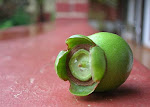
One of the common trees on these fertile river banks is the Jathi-ka Maram, better known as the Nutmeg tree (Myristica fragrans), the source of two important spices - Mace, and, of course, Nutmeg. During the summer months, hundreds of fruits can be found strewn under the tree, often hidden under tufts of grass and dried leaves. The ones that are found get carefully laid out on straw mats, its fleshy portions are cut away revealing a seed that looks like a piece of art, with its deep red pericarp delicately covering a large oval seed like a lace glove. 

As children we did not think much of this tree because there were others that offered instant gratification - mangos, guavas,  rose-apples, tamarind and mangosteens. It is only much later that we learnt just how much these spice seeds meant to people in far away places, of how thousands had been killed, and sold into slavery so that a few europeans could enjoy trade monopolies, and enrich their own cities.

The greed for nutmeg and mace brought the Dutch to the Banda Islands south the Malaccas in the 14th century. Here they first tried to get exclusive deals from the local traders, and when that failed, they decided to solve the problem with their won version of the "final solution" - by exterminating the entire population of these two islands. Then for about a century they ensured that all the nutmeg trees were uprooted and destroyed on the nearby islands. This ensured that they could enjoy profits of over 400 percent of the investments for each voyage.


This story, and its wider ecological and economic impact has been brought out in the latest book written by Amitav Ghosh - "The Nutmeg's Curse - Parables for a Planet in Crisis". As with Ghosh's earlier books this too weaves a narrative based on extensive research of the origins of global trade in these spices, the depredations of the colonial period, of how it shaped capitalism as we know it today which sees the earth as a resource to be exploited at will.

The fruit itself becomes a metaphor for the larger picture - 

...Taking the nutmeg out of its fruit is like unearthing a tiny planet...Like  a planet, the nutmeg is encased within a series of expanding spheres. There is, first of all, the fruit's matt-brown skin, a kind of exosphere. Then there is the pale, perfumed flesh, growing denser towards the core, like a planet's outer atmosphere. And when all the flesh is stripped away, you have in your hand a ball wrapped in what could be a stratosphere of fiery, crimson clouds..."

One question that this books leaves unanswered is on the Dutch monopoly. For a tree that grew widely in South India, with records in the Sanskrit texts going back at least to the 6th century, how could the Dutch establish a monopoly in the first place?  

----------------------------------------------------

REFERENCES & LINKS

https://penguin.co.in/book/the-nutmegs-curse/

* https://www.thehindu.com/life-and-style/food/the-wonders-of-nutmeg-fruit/article19369859.ece

* WebMD - https://www.webmd.com/vitamins/ai/ingredientmono-788/nutmeg-and-mace

Tuesday, January 11, 2022

Covid-19: Winds of Change


 How things change in one year!

At the beginning of 2021 everybody seemed perplexed that the much anticipated first wave of Covid-19 had somehow swept past India without causing much damage. 'The virus cannot survive the pollution levels here!', sniggered the wags and carried on with their lives. 

People were just beginning to take it easy when the second wave - the Delta variant - blindsided us in March 2021. Suddenly all the hospitals were struggling to cope with a deluge of patients and distraught families. Just about everybody seemed to be desperately looking for oxygen cylinders, medicines, oxygen concentrators and reliable test kits. By July, nearly half a million people had died on the official records with speculation rife on the scale of unreported deaths.

When Delta gave way to Omicron there was much talk on how the healthcare system had been geared up to meet the challenge. Skeptical as always, I thought this was bluster - just the sort of pep-talk expected from politicians to keep a lid on panic levels. It took a first-hand experience for me to realise how wrong I was!

We started 2022 on a positive note from our RTPCR test labs. It had started with a throat irritation and telltale signs of a fever. When a number of friends who attended a Christmas party started testing Covid-positive, we knew that ours was not the winter usual viral. The tests only confirmed this but what surprised me is the way in which the healthcare system had actually been geared up to cope with this new wave.

Within an hour of calling a private testing lab (SRL), a sample collector was at our doorstep (~INR 900 / ~USD 12 per test). The RTPCR reports arrived online a day later, on a Saturday. It is mandatory for the private labs to send a copy of the reports to the state health department also gone to the UP government health department, and we were pleasantly surprised to see how the SoPs clicked into place. 

On Monday morning a young government doctor visited us to collect first-hand data, to check if home-isolation was being strictly followed, and to hand over free kits of medicines. A team was sent across to spray and disinfect the apartment tower and, for the next week, we got at least one call a day from the 'Central Covid Control Room' to check if the infection had aggravated in any way. Thankfully, it did not. The infection was as mild as it could be - fever for a day, a sore-throat for two.


As per the new guidelines, at the end of a seven-day isolation period, it is no longer mandatory to take another RTPCR test but we  got tests done anyway using the new Rapid Antigen Tests that were now easily available on Amazon. Interestingly, these tests were no longer being imported from Germany, South Korea or China but made locally by a company called MyLab and sold for just INR 250 (~ USD 3.5) each. Clearly a lot of thought has gone into the design and production of these kits, each of which contains a sterile swab, a pre-filled extraction tube, test-card, instruction manual (English/Hindi) and a disposal pouch. 

One of these days I hope to understand more about the kind of technology and production systems that it takes to prototype and scale up production of these kits ("with immunochromatographic nitrocellulose assay...which uses highly sensitive antibodies to detect Covid-19 nucleocapsid proteins.."), to the current levels of 10 million sets per week!

-----------------------------------------------------------

REFERENCES & LINKS

* https://www.cnbc.com/2021/07/23/coronavirus-how-india-is-doing-now-after-delta-variant-spread.html

* MyLab - wiki - https://en.wikipedia.org/wiki/Mylab_Discovery_Solutions#cite_note-1

* Pune start-up makes affordable, accessible Covid-19 test kit (March 2020) - https://www.financialexpress.com/lifestyle/health/pune-start-up-makes-affordable-accessible-covid-19-test-kit/1908524/

* Producing 10 million kits per week - https://www.reuters.com/business/healthcare-pharmaceuticals/indias-mylab-can-ramp-up-covid-19-test-production-100-mln-units-per-week-ceo-2021-05-21/


Monday, December 27, 2021

Sikkim - Hypertense Taxpayers?

A few days ago, an old friend, a physician, shared a graph that got me puzzled.

It showed an NHFS-5 graph plotting percentage of men with diabetes and hypertension across Indian states. While he was concerned about Kerala being represented as a large dot far ahead of all the other states on these two ailments, it was a smaller green dot caught my attention - Sikkim.

How did this tiny north-eastern Himalayan state full of people who always seemed so healthy, relaxed and friendly top the charts for hypertension in India? 


Maybe I was being nostalgic about a trek in Sikkim more than a decade ago, of endless bowls of Thukpa washed down with Dansberg beer. That was a business trip to the main hospital in Gangtok, and these lifestyle diseases certainly did not figure prominently then. What had changed over the years? - was this something to do with the diet? 

Another graph presents a different different picture. This one maps a state-wise per-capita collection of the Goods and Services Tax (GST), and the big surprise here is that Sikkim was the leading state with an average contribution of INR32,568 from each of its ~ 600,000 citizens!


Perhaps this is a pointer to the rapid industrialisation that has taken place in Sikkim over the past decades, with all its attendant health problems. Or maybe there is no correlation at all between these two unrelated  indicators.

One thing is for sure - the numbers need to be examined more closely.


Tuesday, December 21, 2021

Misheard: I Love Goat Cheese! :)

What happens when the sublime meets the ridiculous? Maybe one of the things you get is goat cheese.

Carmina Burana (Songs of Beuren) is supposed to be one of the great compositions of western classical music. Written in the 13th century it was was famously set to music by the German composer, Carl Orff, in the 1930s and went on to become hugely popular as a score that set the mood for dramatic or cataclysmic situations. In India most people remember it as the background music for an advertisement featuring an aftershave lotion - Old Spice - with images of a surfer riding tumultuous waves, a pretty face, and a face splashed with a liquid that was supposed to be the 'mark of a man'.

Recently some creative genius on YouTube (or was it Tiktok?) posted a video with the title "You'll never listen to this song the same way again!". Sure enough it transforms this classic to a hilarious meme with these lyrics - 

I love goat cheese, Give me cookies!

They'll give us Gonorrhoea

This octopus, Let's give him boots!

Send him to North Korea!

As if to add to this cheerful confusion, a university choir has actually recorded  a performance  using these 'alternate' lyrics. So it takes a bit of digging to get the the original lyrics, and to figure out the specific lines that have been parodied. Perhaps these are the lines that go with the one who loves goat cheese - 

Sors salutis, et virtutis

michi nunc contraria,

est affectus, et defectus 

semper in angaria.

(English:  Fate is against me; in health and virtue, driven on and weighted down, always enslaved)


This is of course only one in a long series videos featuring misheard lyrics. There is one Russian folk song that has been doing the rounds as a Malayalam song, and Shakira's popular theme 2010 Football World Cup song, Waka-Waka, that does sound like Hindi slag for taking a bath at Charminar!


-----------------------------------------

* O'Fortuna - Misheard lyrics - https://youtu.be/pQEfxhvAy0c 

* Original - André Rieu - O'Fortuna - https://youtu.be/EJC-_j3SnXk 

* Original Lyrics + translation - https://en.wikipedia.org/wiki/O_Fortuna

* Story behind Carmina Burana - https://www.classicfm.com/composers/orff/guides/story-behind-orffs-carmina-burana/ 

* Russian song misheard in Kerala - https://youtu.be/_zEbRrV-flw


Sunday, December 05, 2021

Revisited: Gupta Period Sculptures

Lighting changes everything. 

Last week I visited the Indian Museum in Kolkata after more than a decade, and I was struck by the way in which an improvement in the display of exhibits could bring about a qualitative change in the way people relate to them. It make you stop and observe more carefully, to spot variations in style that were missed out earlier, and to spend more time marvelling at the milieu, the social and cultural environment that enabled these artists to flourish. So much so that even a random visitor like me could begin to see clearly, for the first time, the differences between the various schools of art.

I was fascinated in particular by the earthliness and realism of sculptures created during a period that is known as the Golden Age of Indian Art - the Gupta Period (~ 100 to 500 CE). Quite unlike the idealised, supra-human versions of gods that are popular in modern iconography, here we see figures that look like  earthly, familiar, just like the the ordinary people who were walking past these exhibits in the museum. Sometimes the similarity is so striking it is hard to believe that these sculptures were created more than 1800 years ago!

Take for instance this panel of three pillars excavated from Bhuteshwara, near Mathura, in North India. On one side we have three lovely ladies  representing three Yakshis, and on the reverse you see scenes from the Jataka stories about the life of Bodhisatvas in their various incarnations.


Also unlike my visit a decade earlier, this time I was armed with the power of the internet on my mobile, so it did not take long to expand on the display tags, and learn that one panel depicted the Jataka tale  about Sibi, a king once celebrated for his righteousness.  This story is told in just three blocks on a single pillar - a little bird seeks refuge from a hawk, perched on the lap of the king; the hawk demands compensation from the king for having to give up its food, so the king cuts a part of his own to flesh to feed the hawk. 


The other two pillars seem to be from other stories though, featuring elephants and monkeys. Wonder where I could find some more details, not only about about the stories that have been sidelined here but also about the Gupta Period in general.


--------------------------------------------
REFERENCES & LINKS

* Indian Museum, Kolkata - Virtual Gallery -  https://indianmuseumkolkata.org/cmspages/virtual-gallery
* Google Arts and Culture - Life of Buddha in Indian Art - https://artsandculture.google.com/exhibit/the-life-of-buddha-in-indian-art/uwLycg_jrsTeKg


Tuesday, November 23, 2021

Kolkata Diary


I am now in a South Kolkata state-of-mind. 

It took me a couple of days to get used this, and it is so, so different from the mental framework you need elsewhere in North India. For starters, you don't wake up to smoggy, cold mornings, wondering whether it is safe to take in a deep breath. The air is relatively cleaner, the sun rises earlier, and ebb and flow of social interactions is lot more relaxed, friendlier and jovial.

Thanks to the Covid lockdowns, I had not been in this city for more than two years, and I wondered how things had changed in the interim.

As has been my habit for more than a decade now, I started my day around 05:45am with a walk to the lake, aka Rabindra Sarobar. The streets were slowly coming to life in the twilight - flower sellers stringing up garlands, milk-vans doing rounds of the kirana shops, and sweepers cleaning up the roads, oblivious of protests from crows and sparrows. Further down from Dhakuria, on both sides of the narrow roads of Jodhpur Park, people filled up water from roadside taps, sipped chai at tiny dhabas, or bargained with the fish-vendors.  

Everything seemed just the way it was before, until i crossed the railway lines I found my usual entrance to the Lake Park barred by a locked gate. This was new - why had they closed this particular entrance to the park? I went across to a group of men sitting under a tree and asked them if there was another open gate nearby. A portly, bearded old man just laughed and said, "Andar jana he? - bas tapki maaro!" (want to get in? just hop across!) :)

Turns out that the gate was designed for doing a tapki, with easy, well-worn footholds for climbing across the 10ft gate. Welcome back to Kolkata, I said to myself, a place where unreasonable rules are meant to be broken.

Another unreasonable rule that is always broken in Kolkata is about footpaths. They are not exclusively for pedestrians. Here footpaths are an egalitarian public space meant for anybody who seeks a livelihood, and pedestrians get just enough space to file past the shops. On the busiest streets it is quite normal to see more than half the footpath width taken up by an endless row of tiny shops, and eateries. This has been going on for so long that even trees adapt themselves to the shape of these little shops, as is the case with this teashop enveloped by a banyan tree near the Jadavpur University crossing.


The hustle and bustle at these shops is a bit misleading though. People are still recovering from the Covid lockdowns. "People mostly come to just look at the wares", said one shopkeeper at Gariahat market, "It is a lucky day when we manage to sell half of what we used to sell before covid!". The same sentiment was repeated at Bedwin Rolls, an eatery famous for its mutton rolls but there is nothing remotely mutton on the menu now. "At INR 800+ a kilo, we just cannot afford it...usually a kilo works out to be enough for 10-12 rolls, but each would have to be priced at INR 150 for us to make a profit...and nobody wants a mutton roll at that price."

Unlike in NCR Delhi, few shops have had to close down entirely. Most of the small shopkeepers here seem to have adapted by changing the menu or product mix. There are more boards that display availability of oxygen and medicines, and, as expected, home-delivery services seem to be thriving now. For some reason jewellery shops are thriving too.  It seem the arrival of the big boys like JoyAlukkas, has had no impact on the numerous, tiny jewellery shops that dot the lanes of Dhakuria. Ditto for beauty saloons. The one nearest to us is "Rita's Parlour - Your Beauty is Our Duty"! :)

Yet, one big surprise is that hardly any shops accept digital payments. Again unlike in NCR, Tamil Nadu or Kerala, where just about every street vendor offers you the option of paying by PayTM, PhonePe or GooglePay, each and every shop I visited here insisted on a cash payment. 

Why is Kolkata / West Bengal bucking the national trend? 


Monday, November 15, 2021

Affordable eBikes

Something unusual happened today - I stopped to gawk at a bicycle. 

It was a mildly smoggy winter morning in Noida, and I was driving down one of those long, flat, tree-lined service roads running parallel to the expressway when I went past a man riding a bicycle. On the face of it this was nothing out of the ordinary - the bicycle was one of those black, clunky, mass-produced models and the man seemed like a factory employee, with his head covered in a muffler, a small bag on his back, going down the road - except for the fact that he was not pedalling his bicycle!


I did a double-take, noticed a neat white bracket behind his seat, and realised that this one was running on a battery - an ordinary bicycle in its new avatar as an electric bike.

Having never seen such a thing before, I pulled up a little ahead, and requested him to stop. The cyclist gladly obliged, and with the pleased look of a man accustomed to such attention, explained that he had got this fitting at a workshop in Badarpur, Delhi. It had cost him about INR 15,000 and that the battery lasted him quite comfortably for his 40 km commute everyday.


These units are manufactured by new company called Accelero Cycles India Ltd., and sold under the brandname "eBik". Founded by a youngster named Anant Jain, this startup aims to make 'affordable, eco-friendly, motorised mobility for everyone'. 

How will ACIL take on established companies like Hero Cycles which has come out with a range of electric bicycles under the brandname "Lectro"? Is there sufficient demand for retro-fitted budget cycles? Does the enterprise have a network of service centres? As of now not there is not much information about this company in the public domain. 

The answers to these questions may unfold in the days to come, but one thing is sure - as of now, the company has at least one happy brand ambassador on this side of Yamuna!


--------------------------------------------------------------

REFERENCES & LINKS

* eBik - https://ebik.in/product.html