Showing posts with label spices. Show all posts

Saturday, January 22, 2022

Nutmeg & Mace


On the banks of Manimala river in Tiruvalla, Kerala, there is a place called Thottabhagom. Perhaps the area gets it name (~ 'garden areas') from its exceptionally fertile soil, enriched by the occasional flooding of the river. 

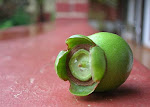
One of the common trees on these fertile river banks is the Jathi-ka Maram, better known as the Nutmeg tree (Myristica fragrans), the source of two important spices - Mace, and, of course, Nutmeg. During the summer months, hundreds of fruits can be found strewn under the tree, often hidden under tufts of grass and dried leaves. The ones that are found get carefully laid out on straw mats, its fleshy portions are cut away revealing a seed that looks like a piece of art, with its deep red pericarp delicately covering a large oval seed like a lace glove. 

As children we did not think much of this tree because there were others that offered instant gratification - mangos, guavas,  rose-apples, tamarind and mangosteens. It is only much later that we learnt just how much these spice seeds meant to people in far away places, of how thousands had been killed, and sold into slavery so that a few europeans could enjoy trade monopolies, and enrich their own cities.

The greed for nutmeg and mace brought the Dutch to the Banda Islands south the Malaccas in the 14th century. Here they first tried to get exclusive deals from the local traders, and when that failed, they decided to solve the problem with their won version of the "final solution" - by exterminating the entire population of these two islands. Then for about a century they ensured that all the nutmeg trees were uprooted and destroyed on the nearby islands. This ensured that they could enjoy profits of over 400 percent of the investments for each voyage.


This story, and its wider ecological and economic impact has been brought out in the latest book written by Amitav Ghosh - "The Nutmeg's Curse - Parables for a Planet in Crisis". As with Ghosh's earlier books this too weaves a narrative based on extensive research of the origins of global trade in these spices, the depredations of the colonial period, of how it shaped capitalism as we know it today which sees the earth as a resource to be exploited at will.

The fruit itself becomes a metaphor for the larger picture - 

...Taking the nutmeg out of its fruit is like unearthing a tiny planet...Like  a planet, the nutmeg is encased within a series of expanding spheres. There is, first of all, the fruit's matt-brown skin, a kind of exosphere. Then there is the pale, perfumed flesh, growing denser towards the core, like a planet's outer atmosphere. And when all the flesh is stripped away, you have in your hand a ball wrapped in what could be a stratosphere of fiery, crimson clouds..."

One question that this books leaves unanswered is on the Dutch monopoly. For a tree that grew widely in South India, with records in the Sanskrit texts going back at least to the 6th century, how could the Dutch establish a monopoly in the first place?  

----------------------------------------------------

REFERENCES & LINKS

https://penguin.co.in/book/the-nutmegs-curse/

* https://www.thehindu.com/life-and-style/food/the-wonders-of-nutmeg-fruit/article19369859.ece

* WebMD - https://www.webmd.com/vitamins/ai/ingredientmono-788/nutmeg-and-mace

Friday, June 21, 2019

That Hing Thing

Asafoetida (Hing) - resin chips and powder

If you want to make popadoms you need asafoetida, aka Hing.

This bit of trivia caught my attention while watching an edition of National Geographic's "Food Factory" featuring the famous women's cooperative - Sri Mahila Grih Udyog - makers of the iconic popadom brand, Lijjat Papad. You might say that this is nothing noteworthy. After all no Indian kitchen would be complete without a tiny plastic bottle containing what is perhaps the most pungent powder conceivable. In South India perhaps the most popular brand is LG - not the Korean conglomerate but a staid company started by Laljee Goshoo in Mumbai. You just cannot make Sambaar curry, or Rasam, or Dal, without a pinch of asafoetida.

A popular Indian brand

The interesting point is that all the asafoetida sold and consumed in India is imported! Lijjat Papad uses Hing (asafoetida) imported from Afghanistan. Other companies like LG import the product in raw form, mix it with gum arabic, and rice-powder / maida and sell it as "compounded asafoetida" which contains less than 50 percent of the actual stuff. Even in this adulterated form it is an expensive spice - 50g packet sells for INR 75 which comes to about INR 1500 (USD 22) for a kilogram.

Another curious thing is that asafoetida is not officially considered a "spice". For some reason it does not even figure on the Indian Spice Board's list of spices imported into India. The Ministry of Commerce lists it under the category "resins and gums" (ExIm HS code 1301-9013). Most of the asafoetida in the Indian market is imported from Afghanistan and Iran. There are two main varieties of asafoetida ie. Hing Kabuli Sufaid (Milky white asafoetida) and Hing Lal (Red asafoetida). Tajikistan too is now emerging as an important supplier of quality asafoetida.

The earliest know reference to asafoetida comes from an ancient Sumeran medical recipe dating back to 2100 BCE. So it hardly surprising that this resin figures prominently in the Ayurveda treatise - Charaka Samhita - compiled in circa 300 BCE.  According to this source, the Bhagavata Purana compiled in the 10the century, notes that the Hing plant grows in the abode of Shiva. Considering that the plant grows in cold mountainous regions of Iran and the Western Himalayas, it is surprising how a steady supply of this resin has been reaching all corners of India over the past three millennia..

Asafoetida is extracted from the Ferula plants (esp. Ferula asfoetida) which have large taproots, 12.5-15 cm in diameter at the crown when they are 4-5 years old. Just before the plants flower, in March-April, the upper part of the living rhizome root is laid bare and the stem cut off close to the crown. The white sap that extrudes from the exposed stem-base is then collected, dried and sold to traders. The plant grows only in arid, cold areas and efforts to cultivate them in Himachal, Ladakh and Kashmir are yet to succeed.

Farmers in these states would certainly be pleased to see the efforts succeed. After all, there are only a few plants that grow with little care and yield such high prices in the market.

Exports from Afghanistan

For some reason, the FAO-UN does not list asafoetida as a noteworthy export from Afghanistan, but independent research suggests that this is indeed a significant export item from Afghanistan. In 2014-15, the country exported red asafoetida worth USD 21,940,223 (312.281 tons) and white asafoetida worth USD 12,259,302 (218 tons).

Is USD 33 million worth of exports insignificant? Certainly not if you consider the fact that the top export item from Afghanistan is raisins (red, black, big, abjosh) and its total value is just a bit more at ~ USD 36 million. Other famous dry-fruit or spice exports - Almonds and Cumin is worth just USD 26 million and USD 1.6 million respectively!

So why is it that asafoetida fails to get mentioned in the trade charts?

I don't know. Yet.

----------------------------------
REFERENCES & LINKS

> https://in.finance.yahoo.com/news/amazing-lijjat-papad-story-rs-80-rs-800-crore-130350826.html
> WIPO article - https://www.wipo.int/ipadvantage/en/details.jsp?id=3619
> Lijjat Papad -  https://en.wikipedia.org/wiki/Shri_Mahila_Griha_Udyog_Lijjat_Papad
> https://www.thedollarbusiness.com/magazine/from-afghanistan-with-love/46065
. India imports 25% of the world's asafoetida
> http://gernot-katzers-spice-pages.com/engl/Feru_ass.html
> https://www.ncbi.nlm.nih.gov/pmc/articles/PMC3459456/
> https://www.indianetzone.com/1/asafoetida.htm
> Plants mentioned in the Bhagavata Purana (600-1000AD) -  https://shodhganga.inflibnet.ac.in/bitstream/10603/118519/21/21_glossary%20of%20plants%20found%20in%20the%20text.pdf
> Afghanistan - Commodity Exports - http://www.fao.org/faostat/en/#rankings/commodities_by_country_exports
- Hing does not figure in the top-5 exports by value -- the only spice that figures here is "Anise, radian, fennel, coriander" -- USD 26million (2016)
- Top export item by value was Raisins - 19T for USD 56million
> Spices Board -  http://www.indianspices.com/sites/default/files/Major%20Item%20wise%20Import-2016.pdf
> Import Policy - ExIm HS code 1301 90 13 --  http://dgftcom.nic.in/exim/2000/itchs2017/chap13.pdf
> Afghanistan Exports - https://atlas.media.mit.edu/en/profile/country/afg/
> (2015) Paper - India-Afghanistan - Overview of Economic Relations - http://www.renupublishers.com/images/article/1461872860AEV2N2d.pdf

* Oldest Medical Document - Sumeria 2100 BCE - https://www.ncbi.nlm.nih.gov/pmc/articles/PMC200079/pdf/mlab00211-0009.pdf
* Shah NC and Amir Zare (2014): Asafoetida (Heeng): The Well Known Medicinal Condiment of India & Iran -  http://www.thescitech.com/admin/includes/abstractpdf/2014-10-0453469a75d73f8.pdf