Showing posts with label horticulture. Show all posts

Saturday, June 20, 2026

Mallika Darling


"आपकी मल्लिका आने ही वाली है!!" (Your Mallika will be here soon!)

Every summer folks at our friendly neighbourhood Mother Dairy Fruit & Vegetable outlet tease me about my fondness for this particular variety of mango which happens to share its name with an old Bollywood siren, Mallika Sherawat.

The mango season in Delhi NCR almost always starts with Safeda. In the early summer season these are large, fleshy mangos with whitish bland flesh (hence the Hindi name) which gets sweeter with the rising heat. It sits on vendors carts and market shelves throughout the season even as the other varieties make their guest appearances - Kesar, Dussehri, Totapuri, Mallika, Denga, and Langda.

For many years I used to save the seeds of the ones that were outstanding in taste, texture and sweetness, and carefully try to germinate them in our terrace garden. Despite my careful efforts not one of them turned into a sapling, and I used to wonder why this was the case. It took a post from @ShreeHistory on X to remind me of some long forgotten lessons in Botany.

Mango trees are of two broad types: mono-embryonic and poly-embryonic. In poly-embryonic seeds each seed contains multiple embryos. Most of them are nuclear emproyos produced asexually from the mother's own tissue, making them genetic clones of the mother tree. A farmer just has to plant a seed to reproduce traits.

Most Indian varieties, on the other hand, are mono-embryonic. Each seed contains a single embryo produced by sexual reproduction, a genetic shuffle of two parents. A seed from a Hapus will invariably be a combination of new factors - not the original. So planting this type of mangos is a gamble - you may or may not get the traits you seek.

So the trick here is to do grafting. According to estimates, India has been honing mango cultivars for 6000 years by vegetative propagation. Earliest references to this appear in Kautilya's Arthashastra (300 CE), and in Surapala's VrishAyurveda tradition (1000 CE). The art of grafting, or Kalmi, was raised to new levels during the Mughal period.

The Europeans - especially Jesuit priests - had some hand in developing mango varieties along the Konkan coastline. Hapus or Alphonso is attributed to a Jesuit missionary / horticulturist Nicolau Alfonso, during the 1550s.

Where does all this leave my favourite Mallika? This one is an even more recent vintage. The variety is a hybrid of the South Indian Neelum and and the North Indian Dasheri, and was developed by Indian Agricultural Research Institute (IARI) in New Delhi by Dr. Ramnath Singh, just a couple of decades ago!

-----------------------------------------------

LINKS & REFERENCES

* Mexican mangoes - Ataulfo - variety that arrived aroiund 1779 from the Philippines - slowly getting sweeter by the year - https://en.wikipedia.org/wiki/Ataulfo_(mango)


* Mallika - https://en.wikipedia.org/wiki/Mallika_(mango)


Tuesday, November 09, 2021

Celosia


A few decades ago, one of my professors used to be fond saying, "Nothing in nature exists without a purpose!".  His point was that while humans may not have figured it out yet, but every colour, texture, movement and behaviour in nature tells you a story of evolution and adaptation.

I keep thinking about this while looking at a solitary Celosia plant that has bloomed on our terrace. It started out in one form, and now, it looks completely different. It appeared unbidden, out of a forgotten corner, needing no special attention, and soon after the tiny saplings put on their striking variegated leaves, the squirrels found them tasty and ate up most of the new leaves. 

The Squirrels were of course not the only ones who found celosia so yummy.  It seems celosia and plants of the Amaranth family have long been consumed as vegetables in Asia, Africa and South America. So much so that in Nigeria celosia is called 'soko yokoto', meaning "make husbands fat and happy"!


On our terrace, the squirrels spared one single plant, and this is the one that has been changing costumes over the past four months, like a stage artist working overtime. Soon after the plant reached a foot high, a tiny bloom appeared which seemed to take away all the purple colour from the leaves. A month later, after the monsoons it became velvety and curly, spreading out wider to get the classic cockscomb look.

As of now the stem looks gaunt, but this bloom shows no signs of fading away. In fact it now seems to be in a mood to give back some colour back to its leaves, which now look narrow and spindle-like, a far cry from the rounded, multicoloured ones of the initial days.

Why does this plant go through such a transformation? Which are the insects it attracts as pollinators? 

As usual, when you try to figure out something, you only end up with more questions.. :P

----------------------------------------------------------

LINKS & REFERENCES

Celosia - https://en.wikipedia.org/wiki/Celosia_argentea_var._cristata

Amaranth - super feed, super weed - https://www.phillyorchards.org/2018/04/17/amaranth-super-feed-super-weed/

Wednesday, February 20, 2019

Cactus Combos


A yellow blob of thorny fractals?

This eye-catching cactus caught my attention at an IFFCO Kisan outlet selling indoor plants. It sat on a shelf with other succulents but combination seemed rather unusual. The lower green part looked as though it had been shorn of its thorns while the bright yellow or pink portion did not look as though it had emerged from a flower.

Sure enough it turns out that this is grafted combo of two different species of cactus - the yellow portion belongs to  Gymnocalycium mihanovichii while the lower, green one belongs Hylocerus, a family better known for producing edible pitayas, aka "Dragon-fruit".

The interesting bit is that Gymnocalycium completely lacks chlorophyll. It was originally found in Paraguay growing under bushes with little exposure to sunlight. Somewhere along along the way it got to grafted to other cactus species that does have chlorophyll creating a novel variety which is now being marketed as 'Moon Cactus'!

--------------------------------------
LINKS:

IFFCO Kisan Urban Garden - https://www.ikug.in/indoor-plants

https://worldofsucculents.com/what-are-grafted-cacti/

https://en.wikipedia.org/wiki/Hylocereus

http://www.llifle.com/Encyclopedia/CACTI/Family/Cactaceae/11929/Gymnocalycium_mihanovichii

https://www.youtube.com/watch?v=4bvZrCDJSh4

Saturday, August 01, 2015

Odd Tomato


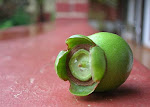
Here is something that landed in my grocery bag last week - a tomato with a beak!

What is it that makes a fruit take up unusual forms?


----------------------------------------------------
LINKS

* http://www.walterreeves.com/food-gardening/oddly-shaped-vegetables/

* http://vegetablemdonline.ppath.cornell.edu/DiagnosticKeys/TomFrt/TomFrtKey.html