Last Sunday an Indian satellite sitting 36,000 kms away kicked out the cablewala from our home. Perhaps its too early to say whether Tata-Sky is more dependable than the neighborhood cable-TV network but as far as technology goes, I’m truly impressed.
When I flick the remote now, there is a time lag before a picture appears on the screen. This might take some getting used to…but I guess that’s not bad for signals that go up and down 36,000kms!
I was also impressed by the way Tata-Sky is managing this whole operation. The advertising is neat; they have smart people on the customer-service lines; and the installation process is perhaps the best I have seen from a mass-media company.
We called the customer service line last week. A couple of days later, on a Saturday afternoon, a delivery boy came up with the Set Top Box (STB) kit and collected the payment; Rs. 2999 plus Rs. 550 for scratch-card worth three months of subscription (wonder why they call it “free”). The installation Techies turned up the next day with the dish assembly kit, coaxial cable roll, a portable TV, the contract docs and assorted tools.
Since the dish is installed on a roof that belongs to somebody else they first get you to sign a form that doubles as a no-objection certificate. They then clamber on to the rooftop along with the STB kit. As soon as a site is agreed, an extension cord is rolled down 25m to the ground floor to activate the drills. Once the base is screwed down, a compass and an inclinometer is used to fix the dish at 160 degrees South-East at an angle of 56 degrees.
The parabolic dish assembly has 20 components, including some unfamiliar things like “flanged nuts” and “AZ-EL brackets”. But the critical thing here is a device called the “Feedhorn” or the LNB (Low-Noise Block-down converter). This one picks electromagnetic waves from INSAT-4A and shifts the signals from the downlinked C-band (3500 MHz) and/or Ku-band (~11 GHz) to the L-band range (1600 MHz). The final Radio Frequency output from the STB to the TV is at 470 MHz.
The transformation of TV antennas has been quite amazing. Just until 10 years ago Directional Antennas dominated our rooftops. Aluminum rods shaped like stylized fishbone pointed towards a TV transmission tower in the city. When cable TV arrived they were left to the crows and pigeons or to some scrap-dealer interested in carting it away. The cablewala ruled for a decade. His roof had the biggest dishes; he decided your “bouquets” and charged as he pleased. His coaxial cables were strung haphazardly across streets and buildings, adding to the mess of overhead MTNL telephone lines and power cables. Where are these fellows now? They seem to have quietly disappeared into the night with their ladders and crimpers.
The old black coax cable has been tossed out; a new white one is in. The range of services and options certainly surpasses whatever the cablewala had to offer. But is the system durable? Can the dish & STB survive the heat and dust of Delhi? Will the entry of Reliance make the DTH industry as price-competitive as the mobile industry?
In any case, if this is the future, I like it :-)
Wednesday, March 14, 2007


Sunday, March 11, 2007
Bangkok Notes II: A Day Well Spent
If your enthusiasm to explore Bangkok is stymied by a shortage of time; if you prefer tramp alone through the underbelly of a city rather than endure the robots that organize conducted tours, please take a look at Wikitravel’s “One Day in Bangkok”.
http://wikitravel.org/en/One_day_in_Bangkok
I found it very useful. The itinerary takes you through the medieval districts of Rattanakosin, through its winding canals to gleaming golden pagodas; through the touristy sites along the Chao Phraya River, for a grand finale at the legendary pubs of Patpong.
At Wikitravel, Jpatokal covers quite a lot of action for one day. But if you have the enthusiasm you can actually squeeze out much more – especially if have at hand a copy of Nancy Chandler’s quirky, hand-painted guide-map.
My day started at Sukhumvit Soi. I walked out of my hotel, past Cowboy Soi to the BTS Asok station. A 100B rail pass goes a long way and my first ride took me from Asok-Sukhumvit through Nana, Phloen Chit, Chitlom and Siam to Ratchathewi.
Jpatokal’s directions are perfect – you come down from Ratchathewi, cross a small bridge across the Saen Saep canal and hop on to a boat speeding westwards. The canal is murky & narrow but is wide enough to let two boats through. They have plastic curtains to protect you from being drenched by boats speeding past in the opposite direction. But unless you stand and look over the sheets you are likely to miss interesting sights along the way - Jim Thompson’s House (the Yank who made Thai Silk so famous), Bo-Be Market, the back-streets and the towers of Siam business district.
There is no point asking the boat guys for a ticket to Golden Mount terminus. The local name is something else. So just buy a 10B ticket and get off the boat when you are nearest to a large golden pagoda.
It’s a nice view from the top of Golden Mount aka Wat Saket. Thousands of brass bells chime in the wind and you get a nice overview atop Rattanakosin of the urban sprawl of Bangkok. From here, instead of taking a taxi I walked all the way to the National Museum, the Grand Palaces and Wat Po.
The pavements are wide open and there are plenty of refreshment stalls along the way. There is a nice bookshop at the Democracy Monument circle – this is where I picked up my Nancy Chandler Guide, and some Thai instrumental music CDs.
Despite all warnings I fell for a tout - a smooth-talking fellow just outside the Museum. I was reading the map to get my bearings when he approached me with the friendly nonchalance of a passerby. He assured me that everything in Bangkok shuts down for a lunch break and that I could use time to see how his ancestors lived in the “real-original” city across the river. He even haggled fares with a tuk-tuk driver but when I reach the boat station at Phra Pin Klao, a mammoth white boat lay waiting on the quay for gullible Firangs. Dark windows, tables set for a 2000B lunch and no sign moving across the river. I hurried back to the museum and found it wide open -- no lunch break.
The museum has around seven sections in different buildings so it takes a couple of hours to see everything. Unlike the museums in India, everything seems to be manned by student-volunteers. It’s nice to see them in their bright yellow-T’s, explaining intricacies of Mekong-delta art & architecture. Other students are busy restoring old paintings and copying intricate motifs. The Museum café is a good place to grab a coconut ice cream.
From here you walk past Thammasat University – a hotbed of all those angry student protestors you see on TV – to the Grand Palace area. This area is jam packed with tourists. After visiting the Emerald Buddha Temple and a couple of palaces, I got a bit tired of the crowds and all the gold and grandeur.
A walk along the peripheral walls of the Palace leads you to Wat Po where you have a large reclining Buddha. Interesting… especially those 108 auspicious symbols on his 20 feet wide “feet”. But a more practical place to visit at Wat Po is the Massage School. It is tucked away in the rear, at the end of an elaborate Chinese garden dotted with statues of hefty warriors glaring down at you.
The school is sparse – a reception counter, and a hall lined with about 20 cots. The students – again in yellow-Ts - start the massage after a few minutes of deep prayer. A 30-minute ‘dry-massage’ for 250B is worth a thousand grand palaces! The pier at Tha Tien was not easy to find. It sits on a rickety wooden platform; tucked away behind shops selling spices, dry fish and mementos. The Chao Phraya River Express boats take you on a cool, breezy trip downstream, past Wat Arun (Temple of Dawn) and new hotels to Tha Oriental (N1). This pier is rickety and partially flooded but once you are on terra firma, the road leads to straight the Oriental Hotel.
http://wikitravel.org/en/One_day_in_Bangkok
I found it very useful. The itinerary takes you through the medieval districts of Rattanakosin, through its winding canals to gleaming golden pagodas; through the touristy sites along the Chao Phraya River, for a grand finale at the legendary pubs of Patpong.
At Wikitravel, Jpatokal covers quite a lot of action for one day. But if you have the enthusiasm you can actually squeeze out much more – especially if have at hand a copy of Nancy Chandler’s quirky, hand-painted guide-map.
My day started at Sukhumvit Soi. I walked out of my hotel, past Cowboy Soi to the BTS Asok station. A 100B rail pass goes a long way and my first ride took me from Asok-Sukhumvit through Nana, Phloen Chit, Chitlom and Siam to Ratchathewi.
Jpatokal’s directions are perfect – you come down from Ratchathewi, cross a small bridge across the Saen Saep canal and hop on to a boat speeding westwards. The canal is murky & narrow but is wide enough to let two boats through. They have plastic curtains to protect you from being drenched by boats speeding past in the opposite direction. But unless you stand and look over the sheets you are likely to miss interesting sights along the way - Jim Thompson’s House (the Yank who made Thai Silk so famous), Bo-Be Market, the back-streets and the towers of Siam business district.
There is no point asking the boat guys for a ticket to Golden Mount terminus. The local name is something else. So just buy a 10B ticket and get off the boat when you are nearest to a large golden pagoda.
It’s a nice view from the top of Golden Mount aka Wat Saket. Thousands of brass bells chime in the wind and you get a nice overview atop Rattanakosin of the urban sprawl of Bangkok. From here, instead of taking a taxi I walked all the way to the National Museum, the Grand Palaces and Wat Po.
The pavements are wide open and there are plenty of refreshment stalls along the way. There is a nice bookshop at the Democracy Monument circle – this is where I picked up my Nancy Chandler Guide, and some Thai instrumental music CDs.
Despite all warnings I fell for a tout - a smooth-talking fellow just outside the Museum. I was reading the map to get my bearings when he approached me with the friendly nonchalance of a passerby. He assured me that everything in Bangkok shuts down for a lunch break and that I could use time to see how his ancestors lived in the “real-original” city across the river. He even haggled fares with a tuk-tuk driver but when I reach the boat station at Phra Pin Klao, a mammoth white boat lay waiting on the quay for gullible Firangs. Dark windows, tables set for a 2000B lunch and no sign moving across the river. I hurried back to the museum and found it wide open -- no lunch break.
The museum has around seven sections in different buildings so it takes a couple of hours to see everything. Unlike the museums in India, everything seems to be manned by student-volunteers. It’s nice to see them in their bright yellow-T’s, explaining intricacies of Mekong-delta art & architecture. Other students are busy restoring old paintings and copying intricate motifs. The Museum café is a good place to grab a coconut ice cream.

From here you walk past Thammasat University – a hotbed of all those angry student protestors you see on TV – to the Grand Palace area. This area is jam packed with tourists. After visiting the Emerald Buddha Temple and a couple of palaces, I got a bit tired of the crowds and all the gold and grandeur.
A walk along the peripheral walls of the Palace leads you to Wat Po where you have a large reclining Buddha. Interesting… especially those 108 auspicious symbols on his 20 feet wide “feet”. But a more practical place to visit at Wat Po is the Massage School. It is tucked away in the rear, at the end of an elaborate Chinese garden dotted with statues of hefty warriors glaring down at you.
The school is sparse – a reception counter, and a hall lined with about 20 cots. The students – again in yellow-Ts - start the massage after a few minutes of deep prayer. A 30-minute ‘dry-massage’ for 250B is worth a thousand grand palaces! The pier at Tha Tien was not easy to find. It sits on a rickety wooden platform; tucked away behind shops selling spices, dry fish and mementos. The Chao Phraya River Express boats take you on a cool, breezy trip downstream, past Wat Arun (Temple of Dawn) and new hotels to Tha Oriental (N1). This pier is rickety and partially flooded but once you are on terra firma, the road leads to straight the Oriental Hotel.
I did not find anything distinctive about the Oriental or its “famous Bamboo Bar”. Five-star hotels are just the same everywhere… the same immaculate uniforms, artificial smiles, spotless floors and obscene price tags. There is so much more character on the streets.
Back on the streets, I helped myself to some steaming hot street food, ambled through some malls, explored Patpong and got back to Sukhumvit sometime after midnight, thanking Wikitravel for a day well spent.
Back on the streets, I helped myself to some steaming hot street food, ambled through some malls, explored Patpong and got back to Sukhumvit sometime after midnight, thanking Wikitravel for a day well spent.
Thursday, March 08, 2007
Books 2007 - The List So Far
December 2007
Tinker, Tailor, Soldier, Spy - John Le Carre
Travels With Fish - Y.S. Gopinath
A gastronome's hilarious adventures through Cairo (aubergine=betingan), Jerusalem (Felafel, Tabbouleh, Challah bread), Bhusaval (Bharit curry by Leva Patils), Sydney, Liverpool (Scourse accents & Beatles trail), Chicago, Paris, Firenze (Florence), Kerala (Vaiduryam=Chrysoberyl; 'Syrian Christian Coconut'), Bangkok (chasing the ingredients of a perfect Green Curry - galangal ginger, Kaffir lime leaves and lemon grass stems).
Memorable.
November 2007
Doraemon - AaAa Nobita-kun
My first all Japanese book. Laborious reading but worth the trouble.
September - October 2007
The Argumentative Indian - Amartya Sen
A tough one...the language is simple, though. The section on China-India was absolutely fascinating; beyond the 'argumentative Indian' thesis, most of the book is a rehash of lectures delivered in recent years.
August 2007
The Jaguar Smile... A Nicaraguan Journey - Salman Rushdie
July 2007
The Kite Runner - Khaled Hosseini
Two little boys in inter-turmoil Afganistan - honorable Hassan the poor Hazara and spineless Amir, the master's son. A great story that got goofed up in the end with a bollywood-ishtyle action ending..
May 2007
My Name is Red- Orhan Pamuk
Shekure, sweetheart, I miss you! :)
April 2007
Who Moved My Cheese – Dr. Spenser Johnson
A bestseller built on metaphors. The story of a maze and its four inmates - two little mice, Sniff & Scurry and two Littlepeople, Hem & Haw. They all want to enjoy Cheese. The mice survive on their instincts but the Littlepeople paint themselves in a corner with false hopes and fears coming from their ‘superior, complex’ brains.
Ultimately, survival depends on two key questions – “What would you do if you were not afraid?” and “Can you imagine yourself eating New Cheese?”. Very Vedanta.
The Man Who Planted Trees – Jean Giono
I found this book perched on a shelf at People Tree, Sansad Marg. Apart from the title, what attracted me to this book was its beautiful woodblock prints. It is also a quick read – in fact I read this sitting atop a flight of stairs at Jeevan Bharti Building – a sunny, breezy place overlooking the Banyan trees of CP.
Set in the inter-war period of Europe, It is the story of Elzeard Bouffier, an old man who stays by himself in a remote, barren region of Provence, France, devoting his life to planting trees.
The Namesake – Jumpa Lahiri
So-so. Guess the hype around Mira Nair’s film got me carried away. Reading this book seemed like the rail journey from Delhi to Trivandrum – mostly long and boring with short spurts of good writing. I liked the parts that covered Ashima’s longing for her Kolkata home; Gogol-Nikhil’s introduction to Maxine and her parents; the beginning of Moushumi’s infidelity (restaurant dinner, Bengali waiters) – but the rest of the book is a big yawn.
March 2007
The Overcoat – Nikolai Gogol
A short story --- so it doesn’t really fit in here. I had started to read Jumpa Lahiri’s “The Namesake” and since the entire novel is built around Gogol’s story, I had to read this first.
Story of Akakii Akakievich Bashmachkin, a poor government official in St. Petersberg whose life revolves around copying official documents. The Russian winter drives him to get a replacement for his tattered overcoat, which, in turn transforms his dreary life. Great story…No wonder Gorky said, “we have all come out of Gogol’s overcoat pocket!”
Only The Paranoid Survive – Andy Grove
Makes you wonder at Intel’s ability to “turn on a dime”. But I guess everything ultimately boils down to that nebulous thing called Great Leadership. Would a lesser general have nurtured a culture of constructive confrontation? Would he swallow his pride to admit that he had to learn something anew?
The book is a bit dated about the Internet but the analogy of “riding through the Valley of Death” is timeless.
Metamorphosis – Franz Kafka
Gregor Samsa, an overworked traveling salesman wakes up one morning to discover that he has been transformed into a bug…incredible story – nightmarish, complex, bizarre and, well, Kafkaesque.
Never Let Me Go – Kazuo Ishiguro
This was course material last year for a cousin at IIT-Delhi. A smart idea -- its just the sort of book that can trigger a good discussion among teenagers about growth pangs, sexuality, relationships and other assorted dilemmas.
The story of Kath, Ruth & Tommy, students from Hailsham - an institution that ‘breeds’ clones who (which?) grow up to be “Carers” and then “Donors”. Vital organs from the donors fuels medical scientific research; but the society that benefits from this is in denial about their being normal people..
How to Speak & Write Correctly – Joseph Devlin
A peek into the past…an Anglo-Saxon’s view of English language 200 years ago. Sample – “There are many hybrid words in English...In Asia it follows the British sway and the highways of commerce through the vast empire of East India with its two hundred and fifty millions of heathen and Mohammedan inhabitants”…
Wonder why this one figures in the Top-100 downloads from Gutenberg.
February 2007
Light on Yoga – BKS Iyengar
More of reference manual…made on the premise that a good book is better than a bad teacher.
I have benefited immensely from Pranayama and this book was needed to get the theory right. Every winter, for the past five years, chronic Sinusitis had given me breathing problems and sleepless nights. I had tried everything to get rid of it – Allopathy, Homeopathy, Ayurveda…nothing had worked. It is such a relief to discover that simple breathing techniques could help solve difficult problems!
Autobiography - Benjamin Franklin
I liked this giant for his honesty – he admits to be being a prodigal son and a selfish brother; to sleeping with whores and attempting to seduce best friend’s wife. But the “Errata” in his life has been overshadowed by his achievements as a pioneering printer, inventor, businessman, diplomat and politician.
The autobiography does, at times, seem disjointed – critical parts seem missing; his most celebrated achievements are left for others to write about. It is also difficult to believe that he had no personal opinion about slavery or about the Indian Wars.
January 2007
The Pursuit of Excellence – M V Kamath
Maybe the good columnist should stick to his columns. The book seems more like a half-hearted collection of quotes and borrowed themes than a pursuit of excellence. Disappointing.
Chronicle of A Death Foretold – Gabriel Garcia Marquez
Amazing narrative! A slaughter is about to take place…the whole village knows about it. The only person who is taken completely unawares is he victim himself.
Tinker, Tailor, Soldier, Spy - John Le Carre
Travels With Fish - Y.S. Gopinath
A gastronome's hilarious adventures through Cairo (aubergine=betingan), Jerusalem (Felafel, Tabbouleh, Challah bread), Bhusaval (Bharit curry by Leva Patils), Sydney, Liverpool (Scourse accents & Beatles trail), Chicago, Paris, Firenze (Florence), Kerala (Vaiduryam=Chrysoberyl; 'Syrian Christian Coconut'), Bangkok (chasing the ingredients of a perfect Green Curry - galangal ginger, Kaffir lime leaves and lemon grass stems).
Memorable.
November 2007
Doraemon - AaAa Nobita-kun
My first all Japanese book. Laborious reading but worth the trouble.
September - October 2007
The Argumentative Indian - Amartya Sen
A tough one...the language is simple, though. The section on China-India was absolutely fascinating; beyond the 'argumentative Indian' thesis, most of the book is a rehash of lectures delivered in recent years.
August 2007
The Jaguar Smile... A Nicaraguan Journey - Salman Rushdie
July 2007
The Kite Runner - Khaled Hosseini
Two little boys in inter-turmoil Afganistan - honorable Hassan the poor Hazara and spineless Amir, the master's son. A great story that got goofed up in the end with a bollywood-ishtyle action ending..
May 2007
My Name is Red- Orhan Pamuk
Shekure, sweetheart, I miss you! :)
April 2007
Who Moved My Cheese – Dr. Spenser Johnson
A bestseller built on metaphors. The story of a maze and its four inmates - two little mice, Sniff & Scurry and two Littlepeople, Hem & Haw. They all want to enjoy Cheese. The mice survive on their instincts but the Littlepeople paint themselves in a corner with false hopes and fears coming from their ‘superior, complex’ brains.
Ultimately, survival depends on two key questions – “What would you do if you were not afraid?” and “Can you imagine yourself eating New Cheese?”. Very Vedanta.
The Man Who Planted Trees – Jean Giono
I found this book perched on a shelf at People Tree, Sansad Marg. Apart from the title, what attracted me to this book was its beautiful woodblock prints. It is also a quick read – in fact I read this sitting atop a flight of stairs at Jeevan Bharti Building – a sunny, breezy place overlooking the Banyan trees of CP.
Set in the inter-war period of Europe, It is the story of Elzeard Bouffier, an old man who stays by himself in a remote, barren region of Provence, France, devoting his life to planting trees.
The Namesake – Jumpa Lahiri
So-so. Guess the hype around Mira Nair’s film got me carried away. Reading this book seemed like the rail journey from Delhi to Trivandrum – mostly long and boring with short spurts of good writing. I liked the parts that covered Ashima’s longing for her Kolkata home; Gogol-Nikhil’s introduction to Maxine and her parents; the beginning of Moushumi’s infidelity (restaurant dinner, Bengali waiters) – but the rest of the book is a big yawn.
March 2007
The Overcoat – Nikolai Gogol
A short story --- so it doesn’t really fit in here. I had started to read Jumpa Lahiri’s “The Namesake” and since the entire novel is built around Gogol’s story, I had to read this first.
Story of Akakii Akakievich Bashmachkin, a poor government official in St. Petersberg whose life revolves around copying official documents. The Russian winter drives him to get a replacement for his tattered overcoat, which, in turn transforms his dreary life. Great story…No wonder Gorky said, “we have all come out of Gogol’s overcoat pocket!”
Only The Paranoid Survive – Andy Grove
Makes you wonder at Intel’s ability to “turn on a dime”. But I guess everything ultimately boils down to that nebulous thing called Great Leadership. Would a lesser general have nurtured a culture of constructive confrontation? Would he swallow his pride to admit that he had to learn something anew?
The book is a bit dated about the Internet but the analogy of “riding through the Valley of Death” is timeless.
Metamorphosis – Franz Kafka
Gregor Samsa, an overworked traveling salesman wakes up one morning to discover that he has been transformed into a bug…incredible story – nightmarish, complex, bizarre and, well, Kafkaesque.
Never Let Me Go – Kazuo Ishiguro
This was course material last year for a cousin at IIT-Delhi. A smart idea -- its just the sort of book that can trigger a good discussion among teenagers about growth pangs, sexuality, relationships and other assorted dilemmas.
The story of Kath, Ruth & Tommy, students from Hailsham - an institution that ‘breeds’ clones who (which?) grow up to be “Carers” and then “Donors”. Vital organs from the donors fuels medical scientific research; but the society that benefits from this is in denial about their being normal people..
How to Speak & Write Correctly – Joseph Devlin
A peek into the past…an Anglo-Saxon’s view of English language 200 years ago. Sample – “There are many hybrid words in English...In Asia it follows the British sway and the highways of commerce through the vast empire of East India with its two hundred and fifty millions of heathen and Mohammedan inhabitants”…
Wonder why this one figures in the Top-100 downloads from Gutenberg.
February 2007
Light on Yoga – BKS Iyengar
More of reference manual…made on the premise that a good book is better than a bad teacher.
I have benefited immensely from Pranayama and this book was needed to get the theory right. Every winter, for the past five years, chronic Sinusitis had given me breathing problems and sleepless nights. I had tried everything to get rid of it – Allopathy, Homeopathy, Ayurveda…nothing had worked. It is such a relief to discover that simple breathing techniques could help solve difficult problems!
Autobiography - Benjamin Franklin
I liked this giant for his honesty – he admits to be being a prodigal son and a selfish brother; to sleeping with whores and attempting to seduce best friend’s wife. But the “Errata” in his life has been overshadowed by his achievements as a pioneering printer, inventor, businessman, diplomat and politician.
The autobiography does, at times, seem disjointed – critical parts seem missing; his most celebrated achievements are left for others to write about. It is also difficult to believe that he had no personal opinion about slavery or about the Indian Wars.
January 2007
The Pursuit of Excellence – M V Kamath
Maybe the good columnist should stick to his columns. The book seems more like a half-hearted collection of quotes and borrowed themes than a pursuit of excellence. Disappointing.
Chronicle of A Death Foretold – Gabriel Garcia Marquez
Amazing narrative! A slaughter is about to take place…the whole village knows about it. The only person who is taken completely unawares is he victim himself.
Tuesday, December 12, 2006
Bangkok Notes I : Suvarnabhumi International Airport
Fasten your seatbelts...this is where we touchdown with all our superlatives.
The name Suvarnabhumi - Sanskrit for "Golden Land" - is a name chosen by the Thai king, after a mythical kingdom in SE Asia. The airport officially opened on September 28, 2006, taking over all flights from Don Muang. Built at the cost of Baht 155 billion ($ 5b / Rs. 20,000 Cr; 60% JBIC loan) over 40 years the airport has 2 parallel runways (60 m wide, 4000 m and 3700 m long) and two parallel taxiways to accommodate simultaneous departures and arrivals. It has a total of 120 parking bays, of which five can accommodate the Airbus A380.
Designed by Murphy/Jahn Architects, it has the world's second largest single building and airport terminal (563,000 m²). It has the world's tallest control tower (132.2 m). The plot of land occupied by the airport covers about 8,000 acres (32.4 km²). This place is BIG.
The numbers don’t quite prepare you for what is actually on the ground. We landed there at 6:00AM and the first thing you notice is large, open water tanks that hug the runways – a technique perhaps, for draining the low-lying Nong Ngu Hao (“Cobra Swamp”) on which the airport was built.
As you approach the terminal large tubular structures come into view – roofs that look like a cross between a caterpillar and billowing holiday tents, but from inside it looks like a delicate silken canopy. Beneath the canopy, a long corridor, moving walkways and escalators take you along large paintings of the Buddha, to currency exchange counters, passport control (immigration), and baggage ramps and then on to the arrival gates.
The driver took a good 20mts to get his car. He must have had to walk a long way – the airport has parking capacity for 402 taxies, 807 limousines and 262 buses! It takes about 30mts to cover the 26km drive to the city. Normal taxi-fare is about Bh200.

In the departure area, the first few gates are exclusively for business-class and for domestic passengers, and the rest, for ‘normal’ international passengers. Check-in area is laid out in 24 rows (A-W), each with 24 counters. Once you’re relieved of your baggage, you can climb atop the observation loft to get a bird’s eye-view of the concourse. The loft itself is not a comfortable place – its hot (air rises!) and has no seats. Kids love to sit on the floor, gaping at airplanes but most adults shuffle out within minutes.
If you want to grab a bite and some beer, it is better to indulge yourself at the Family Store in the check-in area. Once you walk beyond the Airport Fee counters (Bh500), and passport control, the world belongs to King Power Duty Free. Here you can gawk at fancy designer outlets and their absurd price tags; you could lounge in a bar or surf the net; buy liquor, gadgets, mementos and Thai chocolates (“Buy 4 get one 1 free!”). Its unusual but in this departure area, there are no announcements for departing flights and unlike at KLIA the charts are small and are not well placed. So most passengers tend to huddle near their departure gates to avoid the risk of becoming lost explorers and "no-show" passengers.

In the middle of the concourse sits a sight that is bound to astonish folks from India. The centerpiece of this entire airport is a tableau representing Samudra-Manthan – the Churning of the Oceans. I have never seen a scene from Hindu mythology represented in a modern setting, on such a grand scale. Thai versions of gods and demons pulling at a dragon-like serpent (Thai Vasuki?)while Shiva dances atop mount Mandara smiling benignly at international travelers and their flashing digicams.
As I stepped out of this airport I thought of what awaited us at IGI airport Delhi, and winced. When will we roll up our sleeves to build infrastructure that is truly world class?
The name Suvarnabhumi - Sanskrit for "Golden Land" - is a name chosen by the Thai king, after a mythical kingdom in SE Asia. The airport officially opened on September 28, 2006, taking over all flights from Don Muang. Built at the cost of Baht 155 billion ($ 5b / Rs. 20,000 Cr; 60% JBIC loan) over 40 years the airport has 2 parallel runways (60 m wide, 4000 m and 3700 m long) and two parallel taxiways to accommodate simultaneous departures and arrivals. It has a total of 120 parking bays, of which five can accommodate the Airbus A380.
Designed by Murphy/Jahn Architects, it has the world's second largest single building and airport terminal (563,000 m²). It has the world's tallest control tower (132.2 m). The plot of land occupied by the airport covers about 8,000 acres (32.4 km²). This place is BIG.
The numbers don’t quite prepare you for what is actually on the ground. We landed there at 6:00AM and the first thing you notice is large, open water tanks that hug the runways – a technique perhaps, for draining the low-lying Nong Ngu Hao (“Cobra Swamp”) on which the airport was built.
As you approach the terminal large tubular structures come into view – roofs that look like a cross between a caterpillar and billowing holiday tents, but from inside it looks like a delicate silken canopy. Beneath the canopy, a long corridor, moving walkways and escalators take you along large paintings of the Buddha, to currency exchange counters, passport control (immigration), and baggage ramps and then on to the arrival gates.
The driver took a good 20mts to get his car. He must have had to walk a long way – the airport has parking capacity for 402 taxies, 807 limousines and 262 buses! It takes about 30mts to cover the 26km drive to the city. Normal taxi-fare is about Bh200.
In the departure area, the first few gates are exclusively for business-class and for domestic passengers, and the rest, for ‘normal’ international passengers. Check-in area is laid out in 24 rows (A-W), each with 24 counters. Once you’re relieved of your baggage, you can climb atop the observation loft to get a bird’s eye-view of the concourse. The loft itself is not a comfortable place – its hot (air rises!) and has no seats. Kids love to sit on the floor, gaping at airplanes but most adults shuffle out within minutes.
If you want to grab a bite and some beer, it is better to indulge yourself at the Family Store in the check-in area. Once you walk beyond the Airport Fee counters (Bh500), and passport control, the world belongs to King Power Duty Free. Here you can gawk at fancy designer outlets and their absurd price tags; you could lounge in a bar or surf the net; buy liquor, gadgets, mementos and Thai chocolates (“Buy 4 get one 1 free!”). Its unusual but in this departure area, there are no announcements for departing flights and unlike at KLIA the charts are small and are not well placed. So most passengers tend to huddle near their departure gates to avoid the risk of becoming lost explorers and "no-show" passengers.
In the middle of the concourse sits a sight that is bound to astonish folks from India. The centerpiece of this entire airport is a tableau representing Samudra-Manthan – the Churning of the Oceans. I have never seen a scene from Hindu mythology represented in a modern setting, on such a grand scale. Thai versions of gods and demons pulling at a dragon-like serpent (Thai Vasuki?)while Shiva dances atop mount Mandara smiling benignly at international travelers and their flashing digicams.
As I stepped out of this airport I thought of what awaited us at IGI airport Delhi, and winced. When will we roll up our sleeves to build infrastructure that is truly world class?
Thursday, November 30, 2006
Japanese ODA and India
The concept of Development Assistance has it roots in the aftermath of the Second World War, when USA poured in billions of dollars into Europe and Japan, for rebuilding shattered economies, and for creating friends and allies in a bipolar world.
As soon as the economies recovered, countries at the top of the heap formed the Organization for Economic Cooperation and Development (OECD) they, among other things, committed themselves to a certain level of assistance to the underdeveloped world – this was called the Official Development Assistance (ODA).
OECD has 30 full-time members, of which, 24 are classified as “high-income” countries. Within OECD, the Development Assistance Committee (DAC) sets the guidelines for ODA. Japan has been a member of DAC since 1961.
The objective of Japan’s ODA is “to contribute to peace and development of the international community, and thereby to help Japan’s own security and prosperity”. Since there is no pretence to altruism, during the past few years, stagnation of Japanese economy has resulted in a steady decline in its ODA. In 2004, the dip was 6.5%.
Two arms of the Japanese Ministry of Foreign Affairs (MoFA) implement ODA project – Japan Bank for International Cooperation (JBIC – yen loans) and Japan International Cooperation Agency (JICA – technical coop, grant aid). Both these agencies are set to merge under the JICA umbrella, by 2008.
Japan’s total ODA in 2003-04 was Yen 963 billion ($ 8.9b), about 0.19% of Gross National Income. Of this, India received $ 704 million and stood 5th among the top ten recipients. China topped the list at $1.4 billion.
India absorbs a little over 9% of Japanese ODA and its outstanding liabilities is Yen 1166.3 billion, as on March 2004 (Rs. 46,640 Crores / US$ 10 billion).
The OECD figure of $ 704 million to India translates in to about Rs. 3000 Crores. However, the “MoFA White Paper 2004” puts the total disbursement at $325.79 billion (~Rs. 1400 Cr). Where did this money go? – Mostly into Yen Loans (93.5%), and the rest into technical cooperation (5%) and grand aid (0.7%).
Over the past two years, there has been a steady increase of yen loans to India. In 2005, nine loan agreements were signed for Rs. 5200 Cr. ($1.15b). In 2006 10 ODA loan agreements increased to Yen 155.458 billion (Rs. 5910 cr; $ 1.3b) – a record hike of about 15%.
The yen loans come at a rate of interest (RoI) of 1.3% per annum (30 years payback) for general projects, and at 0.75% RoI for environment sector projects (40 years).
Currently 28 projects are being implemented in India, which includes major initiatives such as - Delhi metro, Vizag port expansion, improvement of Bangalore water supply & Severage (Rs.1078 cr), Bangalore metro (Rs. 1699 cr), cleaning of Hussain Sagar lake in Hyderabad (Rs. 294 cr), and a project for waste management in Kolkata.
......................................................................................
For more information, pls see - Yen Loan Projects in India (16 Sep., 2008) - http://dinakarr.blogspot.com/2008/09/yen-loan-projects-in-india.html
......................................................................................
References:
Japan - Aid At A Glance Chart
http://www.oecd.org/dataoecd/42/5/1860382.gif
Organization for Economic Cooperation & Development (OECD)
http://www.oecd.org/about/0,2337,en_2649_201185_1_1_1_1_1,00.html
Ministry of Foreign Affairs (MOFA), Japan
http://www.infojapan.org/
As soon as the economies recovered, countries at the top of the heap formed the Organization for Economic Cooperation and Development (OECD) they, among other things, committed themselves to a certain level of assistance to the underdeveloped world – this was called the Official Development Assistance (ODA).
OECD has 30 full-time members, of which, 24 are classified as “high-income” countries. Within OECD, the Development Assistance Committee (DAC) sets the guidelines for ODA. Japan has been a member of DAC since 1961.
The objective of Japan’s ODA is “to contribute to peace and development of the international community, and thereby to help Japan’s own security and prosperity”. Since there is no pretence to altruism, during the past few years, stagnation of Japanese economy has resulted in a steady decline in its ODA. In 2004, the dip was 6.5%.
Two arms of the Japanese Ministry of Foreign Affairs (MoFA) implement ODA project – Japan Bank for International Cooperation (JBIC – yen loans) and Japan International Cooperation Agency (JICA – technical coop, grant aid). Both these agencies are set to merge under the JICA umbrella, by 2008.
Japan’s total ODA in 2003-04 was Yen 963 billion ($ 8.9b), about 0.19% of Gross National Income. Of this, India received $ 704 million and stood 5th among the top ten recipients. China topped the list at $1.4 billion.
India absorbs a little over 9% of Japanese ODA and its outstanding liabilities is Yen 1166.3 billion, as on March 2004 (Rs. 46,640 Crores / US$ 10 billion).
The OECD figure of $ 704 million to India translates in to about Rs. 3000 Crores. However, the “MoFA White Paper 2004” puts the total disbursement at $325.79 billion (~Rs. 1400 Cr). Where did this money go? – Mostly into Yen Loans (93.5%), and the rest into technical cooperation (5%) and grand aid (0.7%).
Over the past two years, there has been a steady increase of yen loans to India. In 2005, nine loan agreements were signed for Rs. 5200 Cr. ($1.15b). In 2006 10 ODA loan agreements increased to Yen 155.458 billion (Rs. 5910 cr; $ 1.3b) – a record hike of about 15%.
The yen loans come at a rate of interest (RoI) of 1.3% per annum (30 years payback) for general projects, and at 0.75% RoI for environment sector projects (40 years).
Currently 28 projects are being implemented in India, which includes major initiatives such as - Delhi metro, Vizag port expansion, improvement of Bangalore water supply & Severage (Rs.1078 cr), Bangalore metro (Rs. 1699 cr), cleaning of Hussain Sagar lake in Hyderabad (Rs. 294 cr), and a project for waste management in Kolkata.
......................................................................................
For more information, pls see - Yen Loan Projects in India (16 Sep., 2008) - http://dinakarr.blogspot.com/2008/09/yen-loan-projects-in-india.html
......................................................................................
References:
Japan - Aid At A Glance Chart
http://www.oecd.org/dataoecd/42/5/1860382.gif
Organization for Economic Cooperation & Development (OECD)
http://www.oecd.org/about/0,2337,en_2649_201185_1_1_1_1_1,00.html
Ministry of Foreign Affairs (MOFA), Japan
http://www.infojapan.org/
Wednesday, November 29, 2006
How Big is the Middle Class in India?
The answer to all nebulous questions begins with a tag – “it all depends..”. This time it starts with your definition of “Middle Class”.
The MW Dictionary says that the Middle Class is “a fluid heterogeneous socioeconomic grouping characterized by a high material standard of living, morality and respect for property”. Thats quite a mouthful but it is still subjective.
In the Indian context, NCAER considers the Middle Class as households with an annual income between Rs. 2 – 10 Lakhs (~$4000 to $20,000). The next slab is the “Rich (> Rs.10L), and below the middle class you have “Aspirers” (0.9 – 2L) and “Poor” (below 0.9L).
It goes on to say that of the 188 million households (2005), the middle class is 10.7 million (just 5.6%), while the vast majority is poor households (72%). If you assume that a household has six persons, the middle class is no more than 64 million of the total population of 1.13 billion.
However, reports based on National Sample Survey Organization (NSSO) go on an altogether different trip. The 55th NSS puts the 1999-2000 consumption figures at Rs.7,20,932 Crores (~$ 160b), and says that 42% of this comes from the middle class (241 million people, 23% of total pop.). There were 128.3 million urbanites in the ‘great Indian middle class’, with average consumption levels of Rs. 14,513 /capita/annum (~$322). Villages accounted for the remaining 112.8 m.
Times Asia puts the figure at 250m (2004). Marketing gurus claim that it has crossed 300m – the entire population of USA…
So, the answer to the big question still remains vague. The only thing you have for sure is the tag – “It all depends..”
---------------
Interesting Links:
The Hindu, 22 May 2005
Who is this middle class?
BusinessLine Saturday, Jan 22, 2005
The Great Indian Middle Class and its Consumption Levels
National Council of Applied Economic Research (NCAER), New Delhi
The Great Indian Market, August 2005
Rediff.Com July 02, 2005
Middle class in India has arrived
Time Asia: 29 Nov 2004
The Respect They Deserve
The MW Dictionary says that the Middle Class is “a fluid heterogeneous socioeconomic grouping characterized by a high material standard of living, morality and respect for property”. Thats quite a mouthful but it is still subjective.
In the Indian context, NCAER considers the Middle Class as households with an annual income between Rs. 2 – 10 Lakhs (~$4000 to $20,000). The next slab is the “Rich (> Rs.10L), and below the middle class you have “Aspirers” (0.9 – 2L) and “Poor” (below 0.9L).
It goes on to say that of the 188 million households (2005), the middle class is 10.7 million (just 5.6%), while the vast majority is poor households (72%). If you assume that a household has six persons, the middle class is no more than 64 million of the total population of 1.13 billion.
However, reports based on National Sample Survey Organization (NSSO) go on an altogether different trip. The 55th NSS puts the 1999-2000 consumption figures at Rs.7,20,932 Crores (~$ 160b), and says that 42% of this comes from the middle class (241 million people, 23% of total pop.). There were 128.3 million urbanites in the ‘great Indian middle class’, with average consumption levels of Rs. 14,513 /capita/annum (~$322). Villages accounted for the remaining 112.8 m.
Times Asia puts the figure at 250m (2004). Marketing gurus claim that it has crossed 300m – the entire population of USA…
So, the answer to the big question still remains vague. The only thing you have for sure is the tag – “It all depends..”
---------------
Interesting Links:
The Hindu, 22 May 2005
Who is this middle class?
BusinessLine Saturday, Jan 22, 2005
The Great Indian Middle Class and its Consumption Levels
National Council of Applied Economic Research (NCAER), New Delhi
The Great Indian Market, August 2005
Rediff.Com July 02, 2005
Middle class in India has arrived
Time Asia: 29 Nov 2004
The Respect They Deserve
Tuesday, November 28, 2006
Just in Time for Kaizen
You read stuff from books and assume that you understand a subject, and then comes along a lively, interactive video conference that exposes the limits of what books can teach you.
Over the last two weeks Prof. Seiichi Fujita of Waseda University has transformed my perspective on the Japanese concepts of KAIZEN, 5S and JIT.
Literally, “Kaizen” is a combination of two pictograms representing “Change” and “Better” respectively. But it is more of a feedback mechanism that brings about some improvement in a process. You could implement Kaizen to make your worktable more efficient and the same concept, in an industrial setting, could lead to substantial cost-savings in a production process.
A case in point is the “Single Minute Exchange of Die (SMED)” implemented by Toyota for revolutionizing car production. Stamping machines are critical elements of a car production line. SMED has enabled the company to change the dies in stamping machines (about 13 tons apiece!), within just 5 minutes!
A competitive advantage of this scale could not be implemented overnight. It takes a work ethic and culture that starts from the basics. This is where “5S” comes in - it is a reflective attitude towards work, which summarizes five Japanese words –
1. Sei-ri : “Organising” – Eliminating unnecessary things and getting rid of what you don’t need. (Tools – classification management, ‘Red-tag Movement’)
2. Sei-ton: “Neatness” – Eliminating search through an efficient & functional layout of a workplace – “A place for everything and everything in its place!”
3. Sei-so: “Cleaning” – Eliminating thrash and filth for a cleaner workplace. (Tools – close supervision and regular inspection)
4. Sei-ke-tsu: “Standardization” – Recognizing a ‘problem’ (a gap between the ideal state and the present condition) and standardizing the solution (Tool – “Tiger-bands” to highlight hazardous areas)
5. Shi-tsu-ke: “Self-discipline” – Inculcating habits that create a disciplined workplace.
The last one is not quite popular because it suggests that workers need to be disciplined like schoolchildren – compulsory physical exercises, protocol for wishing superiors, etc. It may be effective in some situations but companies like Toyota prefer a more mature approach and stop at the fourth ‘S’ and call it the “4S Concept”.
Another popular improvement mechanism is Just in Time (JIT), also known as Toyota Production System (TPS).
A conscious and unrelenting drive to make their production system more efficient led Toyota to identify “Seven Wastes” – over-production, waiting time, transportation waste, processing waste, inventory waste, waste of motion and waste from product defects.
Among the seven wastes, inventory waste was identified as the biggest waste. For something that just occupies space it seemed a rather unlikely villain but analysis showed that a buffer stock of inventory eases people into the dangerous zone of complaisance.
If you have stocks at hand, defective products are easily replaced and then forgotten; equipment downtime is easily solved without getting to more durable solutions; deficiencies in planning, operation and control remain hidden. But the moment you reduce the buffer from the system, the problem areas stand out like rocks in a shallow pond.
Once you have the problems exposed, you need to come up with fool-proof solutions for each small, niggling problem. This is where an interesting concept – “Poka-yoke” - comes in. Literally it means ‘elimination of carelessness’. Again it looks simplistic until you are informed that nearly 50% of all wastage comes from negligence or forgetfulness or just plain carelessness.
How do you eliminate carelessness? – By introducing thoughtful changes in design and devices. A pokayoke can take many forms – it could be just a rope you tie to a brush used for cleaning tanks; a button that activates a toilet door only after you wash your hands (hygiene in a bakery); a notch on a screws that prevents screwdrivers from slipping away; placing essential stuff (keys, cards) in shoes so you don’t forget them on your way out…
The concepts are so simple that they look trivial and unimportant. But then, we’ve always known that looks are deceptive…
Over the last two weeks Prof. Seiichi Fujita of Waseda University has transformed my perspective on the Japanese concepts of KAIZEN, 5S and JIT.
Literally, “Kaizen” is a combination of two pictograms representing “Change” and “Better” respectively. But it is more of a feedback mechanism that brings about some improvement in a process. You could implement Kaizen to make your worktable more efficient and the same concept, in an industrial setting, could lead to substantial cost-savings in a production process.
A case in point is the “Single Minute Exchange of Die (SMED)” implemented by Toyota for revolutionizing car production. Stamping machines are critical elements of a car production line. SMED has enabled the company to change the dies in stamping machines (about 13 tons apiece!), within just 5 minutes!
A competitive advantage of this scale could not be implemented overnight. It takes a work ethic and culture that starts from the basics. This is where “5S” comes in - it is a reflective attitude towards work, which summarizes five Japanese words –
1. Sei-ri : “Organising” – Eliminating unnecessary things and getting rid of what you don’t need. (Tools – classification management, ‘Red-tag Movement’)
2. Sei-ton: “Neatness” – Eliminating search through an efficient & functional layout of a workplace – “A place for everything and everything in its place!”
3. Sei-so: “Cleaning” – Eliminating thrash and filth for a cleaner workplace. (Tools – close supervision and regular inspection)
4. Sei-ke-tsu: “Standardization” – Recognizing a ‘problem’ (a gap between the ideal state and the present condition) and standardizing the solution (Tool – “Tiger-bands” to highlight hazardous areas)
5. Shi-tsu-ke: “Self-discipline” – Inculcating habits that create a disciplined workplace.
The last one is not quite popular because it suggests that workers need to be disciplined like schoolchildren – compulsory physical exercises, protocol for wishing superiors, etc. It may be effective in some situations but companies like Toyota prefer a more mature approach and stop at the fourth ‘S’ and call it the “4S Concept”.
Another popular improvement mechanism is Just in Time (JIT), also known as Toyota Production System (TPS).
A conscious and unrelenting drive to make their production system more efficient led Toyota to identify “Seven Wastes” – over-production, waiting time, transportation waste, processing waste, inventory waste, waste of motion and waste from product defects.
Among the seven wastes, inventory waste was identified as the biggest waste. For something that just occupies space it seemed a rather unlikely villain but analysis showed that a buffer stock of inventory eases people into the dangerous zone of complaisance.
If you have stocks at hand, defective products are easily replaced and then forgotten; equipment downtime is easily solved without getting to more durable solutions; deficiencies in planning, operation and control remain hidden. But the moment you reduce the buffer from the system, the problem areas stand out like rocks in a shallow pond.
Once you have the problems exposed, you need to come up with fool-proof solutions for each small, niggling problem. This is where an interesting concept – “Poka-yoke” - comes in. Literally it means ‘elimination of carelessness’. Again it looks simplistic until you are informed that nearly 50% of all wastage comes from negligence or forgetfulness or just plain carelessness.
How do you eliminate carelessness? – By introducing thoughtful changes in design and devices. A pokayoke can take many forms – it could be just a rope you tie to a brush used for cleaning tanks; a button that activates a toilet door only after you wash your hands (hygiene in a bakery); a notch on a screws that prevents screwdrivers from slipping away; placing essential stuff (keys, cards) in shoes so you don’t forget them on your way out…
The concepts are so simple that they look trivial and unimportant. But then, we’ve always known that looks are deceptive…
Monday, July 31, 2006
Three Movies & One Book
Last week was a bonanza - we saw three great movies – Amadeus, The Aviator and Crash. The book for July has been “The Plague” by Albert Camus.
Over the past two years, ever since Diya was born, our trips to the theatre and movie halls had all but ceased. There was a time when we used to set off on an impulse for a movie or drive to the Mandi House area to catch a play. Now the theatres are out of question – they don't allow children below 10. The rise of multiplexes has made movies much more expensive but we do venture out occasionally, after a lot of careful planning, which includes advance booking of tickets; keeping track of the reviews & awards to avoid vague movies and tweaking Diya’s bio-clock so that she is very, very sleepy by the time we enter the movie hall. This worked wonderfully till Speilberg’s “Munich”. Our last film – “Fanaa” - was a nightmare. All the planning went haywire and we spent most of our time chasing a kid who was all over the dark hall inspecting foot-lights, and scrambling up and down the stairs, calling out, “Amma-Acha aa jao!”,
After the “Fanaa” experience we have become regulars at a DVD-VCD rental joint called Selection Hut in Kalkaji. We’re now discovering the joys of rewind-replay anf of watching movies in installments!
Amadeus – a movie on the life and music of Wolfgang Amadeus Mozart. It’s a portrayal of the genius though the eyes of Antonio Salieri, a court musician who discovers that “the god like gifts he desires for himself have been bestowed on a bawdy, impish jokester”. A jokester who goes on to write down an astounding collection of music, and then, is reduced to poverty and dies an indebted man; whose body is dumped carelessly in an obscure mass grave. It is quite difficult to imagine this description of somebody whom Albert Einstein once described as “the greatest composer of all”.
Crash is about multi-ethnic world of Los Angeles. It picks up threads from the lives of ordinary people – a high-strung Iraqi shopkeeper; a locksmith who nudges his little daughter out of her scary world of ghosts and hidden monsters; a pair of articulate car thieves; a black cop whose ailing mother dotes on the younger son; a white cop who is a tender son, abusive racist and selfless hero, all rolled into one…All these threads tangle, intertwine and ultimately present what could best be described as a rather optimistic patchwork of life evolving in USA.
The Aviator was about another real-life American hero – Howard Huges – billionaire aircraft tycoon, movie producer, bra designer and paranoid perfectionist. His life with Katherine Hepburn and Ava Gardner; his obsession with cleanliness and “quarantine”; and the incredible ‘Spruce Goose’ – a 2000T amphibious aircraft. Its an amazing story but somehow, Leornardo di Caprio looked like a round peg in a square role…
I had picked it up ‘The Plague’ out of curiosity at a discount book shop and had expected it to be something like Middlemarch – thoroughly enjoyable; but only after you managed to get into the groove. Albert Camus is an acclaimed master of Existentialism, and, in this book, searches the meaning of life in Oran – a small Algerian town on the Mediterranean coast. In this sleepy town, death of rats is followed by the onset of a plague that kills hundred and transforms the life of Dr. Rieux, Cottard, Grand and Rambert – a journalist from Paris who finds himself imprisoned in a city under strict quarantine.
It’s a book that I need to read again, sometime later.
Over the past two years, ever since Diya was born, our trips to the theatre and movie halls had all but ceased. There was a time when we used to set off on an impulse for a movie or drive to the Mandi House area to catch a play. Now the theatres are out of question – they don't allow children below 10. The rise of multiplexes has made movies much more expensive but we do venture out occasionally, after a lot of careful planning, which includes advance booking of tickets; keeping track of the reviews & awards to avoid vague movies and tweaking Diya’s bio-clock so that she is very, very sleepy by the time we enter the movie hall. This worked wonderfully till Speilberg’s “Munich”. Our last film – “Fanaa” - was a nightmare. All the planning went haywire and we spent most of our time chasing a kid who was all over the dark hall inspecting foot-lights, and scrambling up and down the stairs, calling out, “Amma-Acha aa jao!”,
After the “Fanaa” experience we have become regulars at a DVD-VCD rental joint called Selection Hut in Kalkaji. We’re now discovering the joys of rewind-replay anf of watching movies in installments!
Amadeus – a movie on the life and music of Wolfgang Amadeus Mozart. It’s a portrayal of the genius though the eyes of Antonio Salieri, a court musician who discovers that “the god like gifts he desires for himself have been bestowed on a bawdy, impish jokester”. A jokester who goes on to write down an astounding collection of music, and then, is reduced to poverty and dies an indebted man; whose body is dumped carelessly in an obscure mass grave. It is quite difficult to imagine this description of somebody whom Albert Einstein once described as “the greatest composer of all”.
Crash is about multi-ethnic world of Los Angeles. It picks up threads from the lives of ordinary people – a high-strung Iraqi shopkeeper; a locksmith who nudges his little daughter out of her scary world of ghosts and hidden monsters; a pair of articulate car thieves; a black cop whose ailing mother dotes on the younger son; a white cop who is a tender son, abusive racist and selfless hero, all rolled into one…All these threads tangle, intertwine and ultimately present what could best be described as a rather optimistic patchwork of life evolving in USA.
The Aviator was about another real-life American hero – Howard Huges – billionaire aircraft tycoon, movie producer, bra designer and paranoid perfectionist. His life with Katherine Hepburn and Ava Gardner; his obsession with cleanliness and “quarantine”; and the incredible ‘Spruce Goose’ – a 2000T amphibious aircraft. Its an amazing story but somehow, Leornardo di Caprio looked like a round peg in a square role…
I had picked it up ‘The Plague’ out of curiosity at a discount book shop and had expected it to be something like Middlemarch – thoroughly enjoyable; but only after you managed to get into the groove. Albert Camus is an acclaimed master of Existentialism, and, in this book, searches the meaning of life in Oran – a small Algerian town on the Mediterranean coast. In this sleepy town, death of rats is followed by the onset of a plague that kills hundred and transforms the life of Dr. Rieux, Cottard, Grand and Rambert – a journalist from Paris who finds himself imprisoned in a city under strict quarantine.
It’s a book that I need to read again, sometime later.
Tuesday, July 18, 2006
New Delhi – Money Down The Drain?
During a recent discussion at IIT Kanpur, the Director, Prof. Sanjay G. Dhande cautioned some foreign guests against forming their impressions about India after visiting its capital city. He said, “Delhi could be on another planet as far as the rest of the country is concerned – Its annual budget is more that that of many states combined!”.
Was this true? Absolutely!
Under the 10th five-year plan (2002-2007), the outlay for Delhi was Rs.23,000 crores. For a city with a population of just 13.7 million, residing in an area of 1483 sq.km, this bounty comes at the cost of the other larger, more populous states. Consider this:
· Delhi keeps for herself a larger share than 24 of the 35 states and Union Territories of India
· Delhi’s budget exceeds that of all states except – Andhra Pradesh, Gujarat, Karnataka, Kerala (only just), Madhya Pradesh, Maharashtra, Rajasthan, Tamil Nadu, Uttar Pradesh and West Bengal.
· Bihar, with a population of 82.8 million gets less than Delhi – only Rs.21,000 Crores.
· If you add up the budget allocated to the neighboring states of Haryana and Himachal Pradesh, the capital city still gets about Rs. 2500 crores extra.
Except for that spacious, beautiful patch in the heart of New Delhi called Lutyens Zone, the rest of the city is a serious embarrassment - a showcase of shallow planning and poor management.
So, where does all this money go?
One could have said that it all goes down the drain, but we realized (yet again!)after yesterday’s heavy downpour, the subsequent water logging and traffic jams, that the drains too are choked with empty promises and platitudes.
Was this true? Absolutely!
Under the 10th five-year plan (2002-2007), the outlay for Delhi was Rs.23,000 crores. For a city with a population of just 13.7 million, residing in an area of 1483 sq.km, this bounty comes at the cost of the other larger, more populous states. Consider this:
· Delhi keeps for herself a larger share than 24 of the 35 states and Union Territories of India
· Delhi’s budget exceeds that of all states except – Andhra Pradesh, Gujarat, Karnataka, Kerala (only just), Madhya Pradesh, Maharashtra, Rajasthan, Tamil Nadu, Uttar Pradesh and West Bengal.
· Bihar, with a population of 82.8 million gets less than Delhi – only Rs.21,000 Crores.
· If you add up the budget allocated to the neighboring states of Haryana and Himachal Pradesh, the capital city still gets about Rs. 2500 crores extra.
Except for that spacious, beautiful patch in the heart of New Delhi called Lutyens Zone, the rest of the city is a serious embarrassment - a showcase of shallow planning and poor management.
So, where does all this money go?
One could have said that it all goes down the drain, but we realized (yet again!)after yesterday’s heavy downpour, the subsequent water logging and traffic jams, that the drains too are choked with empty promises and platitudes.
Monday, July 17, 2006
The Cataglyphis Family!
Cataglyphis. That could be the family name of the little bugger who has been eluding me for more than a year now!
My chase started sometime last year in Jahanpanah City Forest – a wild green belt that stretches about 4km, from Greater Kailash to Tughlakabad in Delhi. One day, as I was cooling off after my morning run, I noticed a little mound teeming with hyperactive ants. These fellows looked like a bunch of turbocharged Ferraris in a world of Maruti-800s.
I don’t know much about ants. My notions are limited to the many bits and bites that have come my way since childhood. I knew, for instance, that if you disturb the little black ones, they give out a smell; the big, shiny black ants in Hyderabad come with a lot of spunk and deliver painful bites but the very same fellows are quite amicable in Kerala and Delhi. The little reds are experts at finding their way into sealed packets of jam and biscuits. I knew that the red fire ants in Kerala look spectacular when they catch the morning sunlight on mossy boundary walls and overhead telephone lines. And that you should never ever mess with their leafy nests while pelting stones at mango trees.
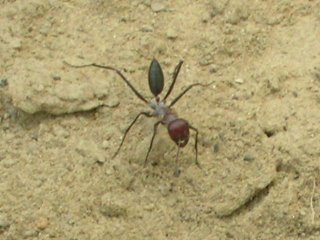 These ants in Jahanpanah Forest were different. Reddish brown in color, the most distinct thing about them was their long legs and a dark abdomen that always pointing skywards. You never saw them go about in groups, to bring home a dead grasshopper, for instance. Always in a tearing hurry, they never stopped by to say hello to comrades, and, when they reached home, they just dived into the darkness.
If curiosity is a disease I seemed to be the only one who got infected in the forest. The sight of a fellow bending over an ant hole attracts curious glances first and then concern (“did you lose something there?”), amusement (“ Hey, look - that anty-guy again!”), before people learn to just leave you alone.
An old villager once came over and said that that the soil excavated by these ants had medicinal properties – it cures children of bedwetting and other ailments. I wonder how. This reminded me of my father’s description of how traditional doctors in Kerala used ants for suturing wounds. They would get black ants to bite torn skin – much like staplers - and once their mandibles clamped down, the bodies would be pinched off.
There is so little information on Indian Ants! The bookshops have lots of stuff on birds and trees, a few books on insects (Europe/America) but nothing on ants. Nothing. If you search the internet for something on Indian Ants, you get vague things like “gold digging ants of India”. Perhaps all the stuff we have is all locked up in the dusty libraries of Zoological Survey of India.
Anyway, hope was rekindled last week when an article in the Hindu featured Ajay Narendra, an ant enthusiast who was about to launch a book to fill that gaping hole in India’s ant consciousness. A couple of quick, cheery emails later, I got this diagnosis from Dr. Ajay –
Hallelujah!
The internet now opened up like Alibaba’s cave. According to a BBC report, scientists have recently figured out that these ants use an internal pedometer to measure exact marching distances. Wow.
___________________________________________________________________
Interesting Ant Sites -
Amazing stuff on Japanese ants:
http://ant.edb.miyakyo-u.ac.jp/INTRODUCTION/Gakken79E/title.html
Recent BBC report on Cataglyphis:
http://news.bbc.co.uk/2/hi/science/nature/5128604.stm
My chase started sometime last year in Jahanpanah City Forest – a wild green belt that stretches about 4km, from Greater Kailash to Tughlakabad in Delhi. One day, as I was cooling off after my morning run, I noticed a little mound teeming with hyperactive ants. These fellows looked like a bunch of turbocharged Ferraris in a world of Maruti-800s.
I don’t know much about ants. My notions are limited to the many bits and bites that have come my way since childhood. I knew, for instance, that if you disturb the little black ones, they give out a smell; the big, shiny black ants in Hyderabad come with a lot of spunk and deliver painful bites but the very same fellows are quite amicable in Kerala and Delhi. The little reds are experts at finding their way into sealed packets of jam and biscuits. I knew that the red fire ants in Kerala look spectacular when they catch the morning sunlight on mossy boundary walls and overhead telephone lines. And that you should never ever mess with their leafy nests while pelting stones at mango trees.
 These ants in Jahanpanah Forest were different. Reddish brown in color, the most distinct thing about them was their long legs and a dark abdomen that always pointing skywards. You never saw them go about in groups, to bring home a dead grasshopper, for instance. Always in a tearing hurry, they never stopped by to say hello to comrades, and, when they reached home, they just dived into the darkness.
If curiosity is a disease I seemed to be the only one who got infected in the forest. The sight of a fellow bending over an ant hole attracts curious glances first and then concern (“did you lose something there?”), amusement (“ Hey, look - that anty-guy again!”), before people learn to just leave you alone.
An old villager once came over and said that that the soil excavated by these ants had medicinal properties – it cures children of bedwetting and other ailments. I wonder how. This reminded me of my father’s description of how traditional doctors in Kerala used ants for suturing wounds. They would get black ants to bite torn skin – much like staplers - and once their mandibles clamped down, the bodies would be pinched off.
There is so little information on Indian Ants! The bookshops have lots of stuff on birds and trees, a few books on insects (Europe/America) but nothing on ants. Nothing. If you search the internet for something on Indian Ants, you get vague things like “gold digging ants of India”. Perhaps all the stuff we have is all locked up in the dusty libraries of Zoological Survey of India.
Anyway, hope was rekindled last week when an article in the Hindu featured Ajay Narendra, an ant enthusiast who was about to launch a book to fill that gaping hole in India’s ant consciousness. A couple of quick, cheery emails later, I got this diagnosis from Dr. Ajay –
"Nothing spectacular is available on indian ants, infact nothing except a 1903 publication by the fauna of british india."
"the ant you have belongs to a genus called Cataglyphis. its primarily a desert ant. The legs are exceptionally long which raises the ants body slightly above the ground to keep itself cool. its active during the hot periods of the day and primarily a scavenger. And as you mentioned they are extremely quick in walking...>30 cm per second. its distribution ranges from north india, middlle east, to North Africa. Incidentally this is one of the ants that I am currently doing my research on (see attached)."
Hallelujah!
The internet now opened up like Alibaba’s cave. According to a BBC report, scientists have recently figured out that these ants use an internal pedometer to measure exact marching distances. Wow.
___________________________________________________________________
Interesting Ant Sites -
Amazing stuff on Japanese ants:
http://ant.edb.miyakyo-u.ac.jp/INTRODUCTION/Gakken79E/title.html
Recent BBC report on Cataglyphis:
http://news.bbc.co.uk/2/hi/science/nature/5128604.stm
Friday, July 14, 2006
Mumbai Blasts: Only 200 dead?
The suburban section of Western Railway in Mumbai, from Churchgate to Virar, extends over 60km and comprises 28 stations. On any given day, this section handles about 1007 suburban trains that carry 3 million passengers and 154 Mail & Express trains.
During peak hours (8:30-11:30AM and 17:30-20:30PM) train are spaced at 3 minute intervals, which is uncomfortably close to the available headway of 3’12”.
The blasts took place during peak hours when trains carry between 6000 to 7000 passengers – more than 500 passengers tightly packed into each of its 12 coaches. In railway parlance this is called “super dense peak load”. A single bomb in a single coach would have been enough to kill more than 200 people.
It is amazing that so many people actually survived seven blasts that had enough power to rip apart steel sidings and roof-plates as though they were made of tin foil!
Or are we missing something here?
During peak hours (8:30-11:30AM and 17:30-20:30PM) train are spaced at 3 minute intervals, which is uncomfortably close to the available headway of 3’12”.
The blasts took place during peak hours when trains carry between 6000 to 7000 passengers – more than 500 passengers tightly packed into each of its 12 coaches. In railway parlance this is called “super dense peak load”. A single bomb in a single coach would have been enough to kill more than 200 people.
It is amazing that so many people actually survived seven blasts that had enough power to rip apart steel sidings and roof-plates as though they were made of tin foil!
Or are we missing something here?
Subscribe to:
Posts (Atom)